
Microchip Reunites Mobile County Owner With Dog Missing Two Years
A Mobile County owner who thought her dog Twix was dead was reunited with him two years later thanks to a microchip scan at the animal shelter.
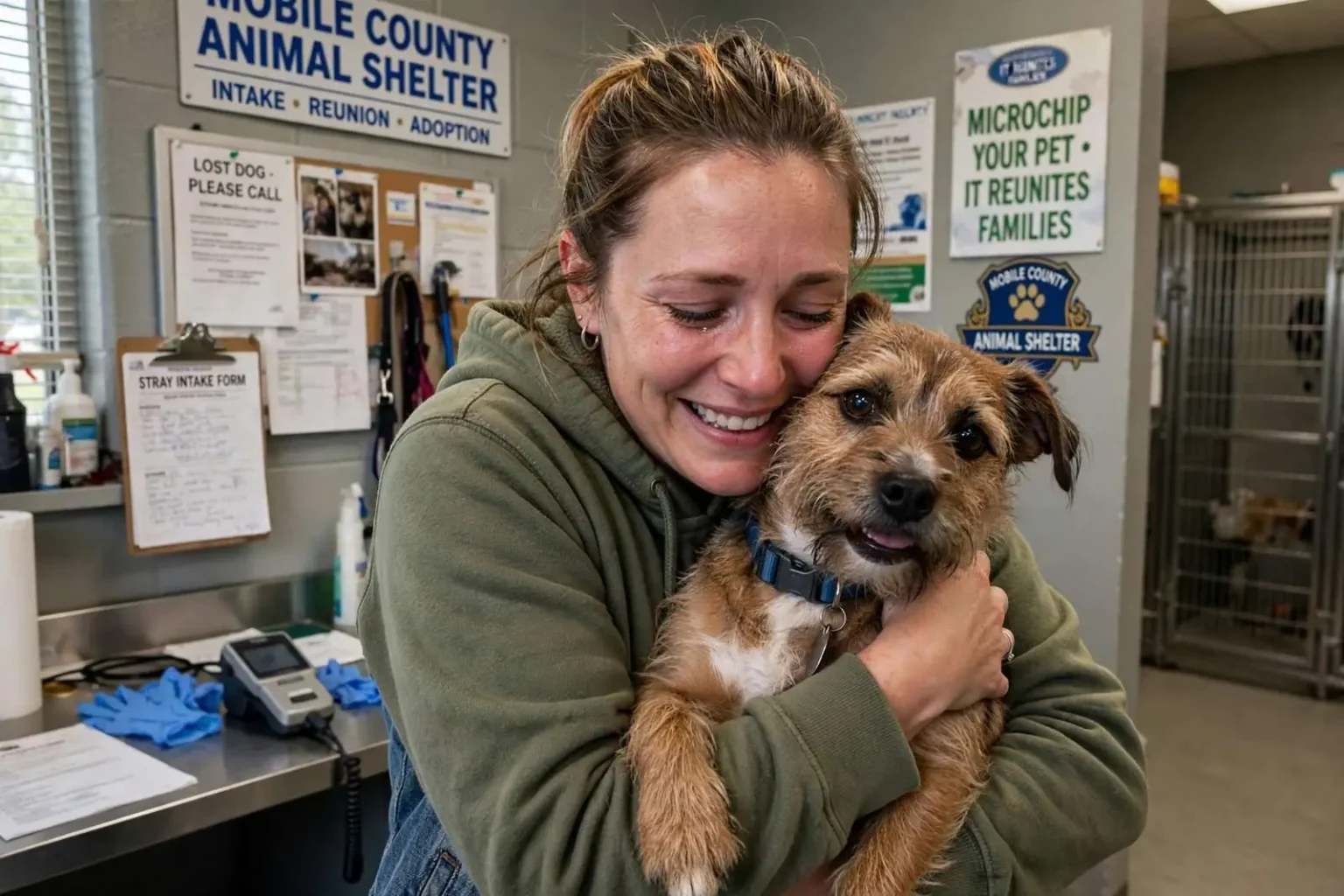
Two years after a Mobile County woman last saw her dog — and after concluding he was gone for good — a microchip scan brought them back together. The Mobile County Animal Shelter documented the reunion on its Facebook page, showing the owner embracing Twix, the pet she had assumed was dead. The shelter scanned the dog’s microchip, confirmed his identity, and made the call that set the homecoming in motion. Shelter officials regularly point to cases like this one when urging owners to microchip their pets: a quick scan at intake can turn an unclaimed stray into a family’s second chance.
The reunion capped a two-year ordeal that plays out, in some version, in every animal shelter in America. Dogs slip collars, bolt from thunder, wander after contractors leave a gate open — and once a pet is loose, the search that follows is one of the most disheartening experiences a family can go through. Posters go up on utility poles, Facebook posts get shared across community groups, and owners walk the same neighborhoods calling a name into the dark. As days become months, hope fades; as months become years, most owners conclude what this woman did — that the pet is gone. Twix’s survival on his own, and his arrival at a shelter where a scanner sat ready, rewrote that ending entirely.
The technology that made the reunion possible is simple and remarkably durable. A pet microchip is a small capsule, about the size of a grain of rice, implanted with a needle under the skin between the shoulder blades. It carries no battery and no location tracking; it stores only a unique identification number that a handheld scanner reads by radio frequency. When the Mobile County Animal Shelter took in the stray and ran the standard intake scan, the chip’s number appeared, registry staff looked it up, and the phone call that followed connected a dog assumed dead with the woman who had spent two years missing him.
How the Mobile County Animal Shelter Works
The Mobile County Animal Shelter operates as the county’s primary intake facility, handling stray pickups, owner surrenders and animal control transfers from across Mobile County outside the city’s municipal system. Shelters like it run on a relentless cycle: animals arrive daily, intake staff photograph and document each one, and every stray is held for a mandatory period so owners have the chance to reclaim them before adoption or other placements become possible. The scan at intake is the hinge of that process — the single step that most often separates a quick reunion from a long stay. Chips are checked at arrival precisely because collars and tags come off, but a chip stays put for life.
The shelter’s social media presence has become an essential part of its work. Facebook posts showing intakes, reunions and animals awaiting adoption reach tens of thousands of local residents, and posts like the video of Twix’s homecoming serve double duty: they celebrate one family’s joy and quietly teach thousands of followers the lesson shelter officials repeat constantly — microchip your pets, keep registration information current, and check the shelter in person when a pet goes missing. Photos and videos of reunited owners embracing dogs that were feared dead are, in the shelter’s world, the most persuasive public service announcements that exist.
Registry information is where many reunions break down. A chip only helps if the number leads to working contact details, and shelters routinely scan animals whose chips were never registered or whose owners moved without updating the record. National registries allow owners to update phone numbers and addresses online at any time, often for free or a small one-time fee. Animal welfare professionals recommend that owners treat the update like a change of address form: whenever you move or change phone numbers, update the chip registration the same week.
Why Pets Go Missing — and How They Survive
The Gulf Coast environment gives lost pets particular challenges and particular stories. South Alabama’s storms and hurricanes scatter animals regularly; fireworks on summer holidays send dogs over fences in clusters every July; and rural Mobile County’s mix of woods, fields and busy roads means a wandering dog faces both danger and open ground. Yet lost dogs also demonstrate a striking capacity to survive — eating what they can find, avoiding people or trusting them depending on temperament, and sometimes traveling miles from where they disappeared. Shelters see animals picked up weeks, months and occasionally years after they went missing, often gaunt and muddy but alive.
What happens next depends overwhelmingly on whether the animal carries identification. A dog with a readable tag or chip typically goes home within days; a dog without one faces much longer odds, because the shelter has no path to the owner and the owner has no way to know where to look. That asymmetry is the entire argument for microchipping, which costs less than a month of pet food and takes a veterinarian seconds to implant. Shelters, rescue groups and veterinary clinics across the Gulf Coast hold low-cost microchip clinics throughout the year precisely to close that gap, and many adoption contracts now require new owners to register the chip before leaving.
For the woman reunited with Twix, the shelter’s call arrived two years after she had mourned him — a call most owners of missing pets never get. Her embrace of the dog, captured on the shelter’s camera, became the kind of post that spreads far beyond Mobile County, shared by people who have lost pets and by people who have found them. Shelter officials used the moment to deliver the message that every such reunion reinforces: the difference between a heartbreaking ending and a joyful one is often nothing more than the rice-sized chip under a dog’s skin and an owner who kept the phone number current.
The Broader Lesson for Pet Owners
Animal welfare organizations sketch the same checklist for every owner. Microchip at the first veterinary visit. Register the chip immediately and verify the record once a year. Keep a collar with current tags for anyone who finds the pet without a scanner. Photograph the pet regularly so current images are available for lost-pet posts. And when a pet does go missing, contact every shelter in the region in person — not just once, but repeatedly over days and weeks — because descriptions over the phone rarely match the reality of an animal that has spent weeks outdoors.
Mobile County’s shelters and rescue organizations handle thousands of animals each year, and the difference between the system’s success stories and its tragedies often comes down to identification. Reunions like Twix’s are the outcome every handler hopes for at intake, and each one circulates through the community as proof of the method. Two years is an unusually long separation; most successful reunions happen much faster. But the mechanism is identical whether the dog has been gone for a weekend or, like Twix, for two years: a scanner reads a number, a registry finds a name, and a phone rings. For one Mobile County woman, that phone call undid two years of grief — and for the shelter staff who watched her embrace her dog, it was the best part of the job.
The story also lands at a moment when shelter systems across the country are under sustained pressure. Intake numbers, staffing shortages and crowded kennels have strained animal services in communities large and small, making the stray-to-owner reunification pipeline more valuable than ever: every pet that goes home is a kennel space freed for the next animal in need. For Mobile County, the image of Twix back in his owner’s arms — after two years, a microchip and one phone call — is exactly the outcome the entire system exists to produce.
Inside a Shelter Intake Day
Understanding what happens when a stray like Twix arrives helps explain why the process works. An animal control officer or a citizen brings the dog to the shelter’s intake desk, where staff check the animal for tags and run the microchip wand along its neck, shoulders and back — chips can migrate slightly from the implantation site, so a careful, full scan matters. Staff photograph the dog, note its condition, sex, breed estimate and temperament, and place it in a holding kennel designated for strays. The mandatory holding period begins, during which the shelter makes public efforts to locate the owner: photos on the website and social media, entry into lost-dog logs, and physical availability for owners who come searching.
Dogs that arrive friendly and healthy often have owners actively looking; dogs that arrive frightened, matted or thin may have been on their own long enough that even their families would not recognize them. That is the quiet complication in cases like Twix’s — the dog that was finally picked up after two years outdoors likely looked different from the well-kept pet who disappeared. It is one more reason shelters beg owners to file missing reports and keep checking: the scruffy stray at the county shelter might be the glossy pet from a two-year-old photograph. The chip, of course, never forgets. Whatever Twix looked like, the scanner read the same number that was implanted years earlier.
The economics of sheltering also explain the emphasis on reunification. Every day a healthy stray spends unclaimed in a kennel costs the county money in food, staff time and medical care, and shelter capacity is finite. Reunions are the cheapest possible outcome — a scan, a phone call, an owner’s driver’s license — and they happen most often where microchipping rates are highest. Communities that invest in cheap or free chip clinics consistently report shorter shelter stays and lower euthanasia of strays, because the animals flow back out the front door to the families waiting for them instead of into long stays or adoptions.
The Two-Year Gap: What Owners Should Know
Owners who lost a pet months or years ago often stop searching, and shelters understand why — but Twix’s case illustrates why surrendering the search entirely can be premature. Dogs found long after they disappeared are usually thinner, dirty and wary, and some have been fed and sheltered by strangers in the meantime, moving between good Samaritans before someone finally brings them to a facility. Any of those paths can lead a lost dog to a scanner years later. Welfare groups therefore encourage owners of long-missing pets to keep a current chip registration, keep a listing active on lost-pet registries and microchip lookup services, and periodically check shelter listings across the region — the dog that returns will not look like the dog that left.
For the newly reunited, shelters recommend a gentle transition. A dog that has spent two years surviving on its own may be startled by ordinary household life: the noise, the schedules, even the abundance of food. Veterinarians typically advise a full examination soon after a long-absence reunion — checking for parasites, dental damage, heartworm and injuries — along with patience as the dog readjusts to a leash, a crate and a soft bed. Families who have lived through it describe the first weeks as a gradual unfolding, the dog relearning that food comes twice a day and that the people are permanent.
Twix went home because two small things were true at once: someone had implanted a chip years earlier, and someone at the county shelter ran the scanner when he arrived. Neither step was dramatic, and neither required luck after the fact — the luck had been banked in advance. Shelter officials in Mobile County and across the Gulf Coast tell the story to every audience they get, and the message never changes: chip the pet, register the chip, update the phone number, and check the shelter in person. Somewhere out there is the next Twix, and the next phone call a family never expected to receive.


