MOBILE, Ala. — As Mobile County students prepared to head back to class on a Tuesday in late August 2020, one Midtown congregation reworked its biggest school outreach of the year to fit the pandemic era. 3 Circle Church’s annual back-to-school bash, once a large indoor gathering, became a drive-through event. Pastor Micah Gaston said the church planned to hand out a little more than 400 book bags to students and families.
The scale of the giveaway made it one of the more substantial school-supply efforts in Midtown Mobile that summer, and the format change said as much about the moment as the backpacks themselves. In an ordinary year, the back-to-school bash fills the church with families, volunteers, and the noise of a community celebration — face painting, food, and tables stacked with notebooks and crayons. In the pandemic summer of 2020, all of that had to be reengineered around a single constraint: keep people apart.
“We moved all of the event to a drive-through so that we can try to keep everyone as safe as possible,” Gaston said in a text message the Saturday morning of the giveaway. The quote, brief as it was, captured the calculus facing churches and nonprofits across the Gulf Coast that month: the need for school supplies had not gone anywhere, but the traditional ways of meeting that need had become health risks in their own right.
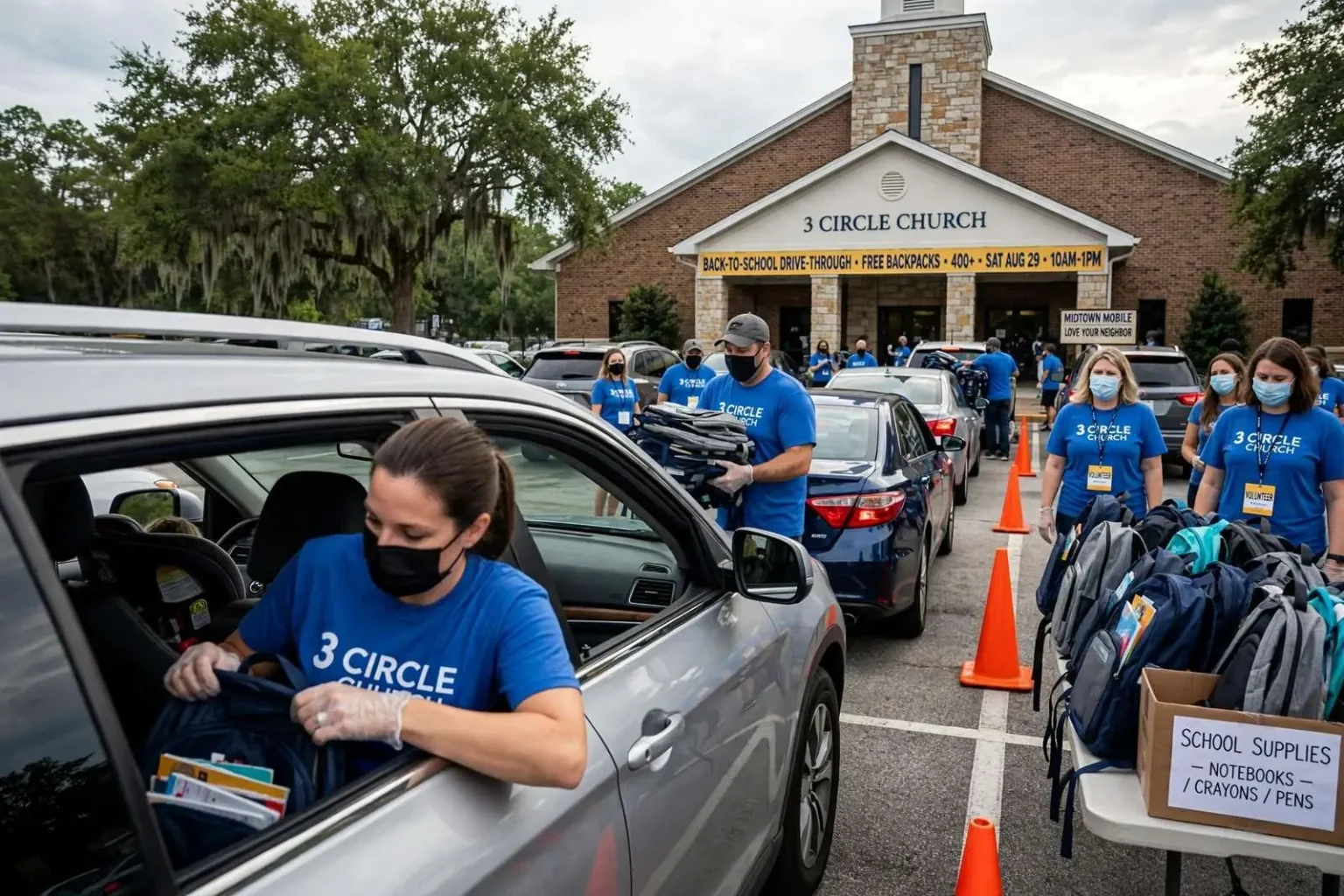
The event ran from 10 a.m. to 1 p.m., with families staying in their vehicles while volunteers loaded backpacks inside, according to the church’s Facebook event listing. Cars lined up in the church’s lot, and volunteers moved from vehicle to vehicle handing bags through windows and rear hatches. No one had to park, enter a building, or stand in an indoor line — the entire exchange happened curb-side, in open air, in a matter of minutes per family.
A familiar outreach, rebuilt for distance
Back-to-school giveaways have become a fixture of late summer in Mobile County, where the cost of outfitting a child for a new school year weighs heavily on many family budgets. Supplies lists run long by the time shoes, backpacks, and classroom materials are accounted for, and households with several school-age children can face real strain. Churches, civic clubs, and charities have stepped into that gap for decades, and congregations in Midtown, Prichard, Saraland, and across the county run some of the largest efforts each August.
3 Circle Church, rooted in the Midtown area, built its annual bash into one of its signature outreach events over the years, drawing families from the surrounding neighborhoods for a day built around the start of school. The 2020 version stripped the celebration down to its essential function — getting supplies into the hands of students — while holding onto the element that matters most to the church’s identity: direct, personal contact between volunteers and the families they serve, even if that contact happened through a car window six feet away.
The logistics of a drive-through giveaway are less simple than they look. Volunteers staged backpacks in the church’s interior spaces, then worked the line of cars as it moved through the lot, loading bags without asking anyone to leave their vehicle. Masks, distance, and quick handoffs replaced the handshakes and playground conversations of a normal year. For the families in line, the experience took on the feel of the curbside pickup routines that had defined everything from groceries to restaurant meals during the pandemic months.
The format mirrored a broader shift across the community that month. Other congregations, including Pathway Church, had already converted their own school-supply outreach efforts into contact-free pickup events as the new school year approached under COVID-19 restrictions. What had been a scattered set of individual decisions hardened into a common playbook: distribute outdoors, keep everyone in cars, minimize contact, and do it earlier and faster than a normal event would run.
The strangest back-to-school season in memory
The giveaway took place against the backdrop of one of the most disorienting school openings in Alabama history. The 2020-2021 academic year began with most Mobile County public school students learning remotely from home, as districts across the state scrambled to balance classroom instruction against a virus that remained active in the community through the summer. Some districts started entirely virtual and planned phased returns; others offered families a choice between in-person and remote enrollment. Either way, the familiar rituals of August — supply lists, meet-the-teacher nights, first-day photos at the front door — all looked different.
For families, the pandemic reshaped what a backpack even meant. With students learning from kitchen tables and living rooms, school supplies became home supplies, and the burden of providing them fell on households in new ways. A free backpack stuffed with materials meant something different in a year when the school building itself was off limits for many children, and churches distributing them became one of the few remaining points of contact between struggling families and the institutions that serve them.
The economic downturn that accompanied the pandemic sharpened the need. Job losses in hospitality, food service, and tourism hit the Gulf Coast particularly hard, and many parents who had never before asked for help found themselves weighing it for the first time. Outreach ministries across Mobile reported demand outpacing recent memory, and drive-through distributions — originally conceived as a safety measure — turned out to lower another barrier as well: families could receive help quickly and without the visible scrutiny of walking into a public event.
Volunteers, for their part, adapted to the new format with the same mixture of caution and commitment that marked church life throughout the pandemic. Masks, distancing, and sanitized workspaces became standard operating procedure, and congregations that had suspended in-person worship for months found in outdoor service projects a way to practice their mission while honoring public health guidance. Loading backpacks into a trunk turned out to be one of the safer forms of community work available, and hundreds of volunteers across the city spent the summer of 2020 doing exactly that.
Midtown Mobile and its churches
The geography of the giveaway matters to how it was received. Midtown Mobile sits between the historic oak-lined streets near Spring Hill and the working neighborhoods that stretch toward Government Boulevard, a stretch of the city where congregations have long anchored community life. Churches in this part of Mobile tend to know their neighborhoods intimately — which families are new to town, which lost jobs, which children will start school without what they need — and outreach events like the back-to-school bash grow out of that local knowledge rather than out of a regional program design.
3 Circle Church’s decision to hold the line on its giveaway, rather than cancel it outright, reflected that relationship. A canceled event is invisible; a drive-through event puts volunteers in the parking lot and backpacks in cars, and it signals to the neighborhood that the congregation adapted rather than retreated. In a summer when so much of civic life had been stripped back to essentials, the sight of a church lot busy with cars on a Saturday morning counted for something beyond the supplies themselves.
The event also fit into the broader ecosystem of pandemic-era mutual aid that flourished across Mobile County in 2020. Food distributions at schools and community centers, blood drives, diaper banks, and mask-sewing groups all operated alongside the church supply giveaways, forming an informal safety net that sprang up where formal systems strained. Congregations were among the most agile players in that network, with buildings, volunteers, and community trust already in place when the crisis hit.
What 400 backpacks represent
Four hundred book bags is a number that multiplies once you picture the households behind it. Each bag represents a student starting a school year — in many cases a virtual one — with the basic tools of the trade, and each household that drove through the lot left with one errand already handled. For Midtown families cobbling together school preparations under pandemic conditions, the drive-through meant one less stop on a checklist that had grown longer and stranger than any school year before it.
That was the quiet achievement of the day: 400 backpacks headed out the church doors without anyone having to leave their car. The pandemic did not pause the start of school, and it did not pause the community’s habit of taking care of its own — it just changed the shape of how that care was delivered. On a late-August Saturday in Mobile, the shape was a line of cars, a team of masked volunteers, and a pastor who summed it up in a text message: everyone as safe as possible, and the job done anyway.