Midtown Mobile Residents Push Back on Car Wash and Float Barn Rezoning Ahead of Planning Commission Vote
Residents in two midtown Mobile neighborhoods are opposing rezoning requests for a car wash near Sage Avenue and Dauphin Street and a Mardi Gras float barn near Old Dauphin Way, both set for a Planning Commission hearing.
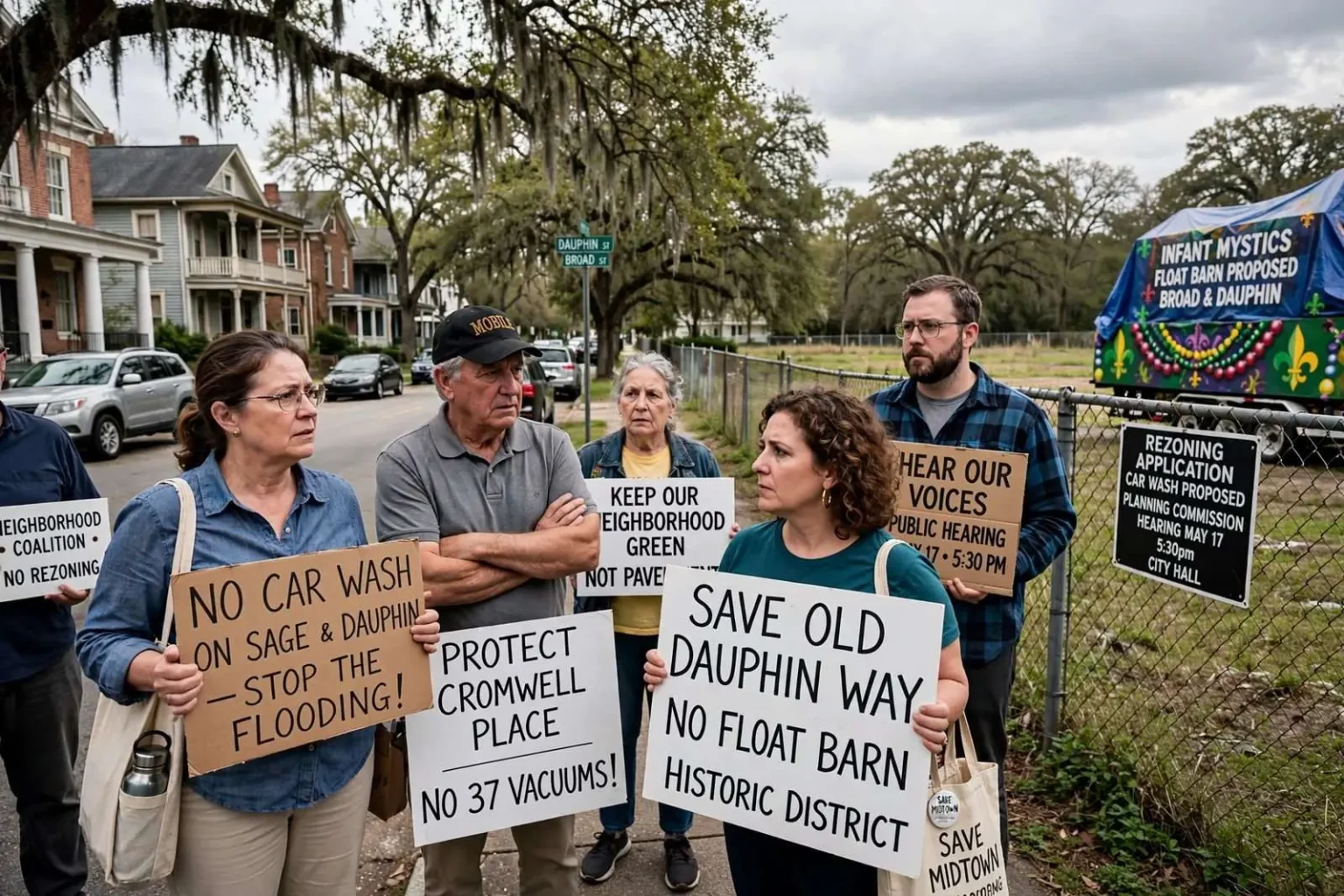
Two rezoning proposals on this week’s Mobile Planning Commission agenda have drawn sharp opposition from residents in the city’s midtown neighborhoods, setting up a contentious public hearing scheduled for Thursday. The items, which will be heard together on the same docket, touch two very different corners of midtown life: a commercial car wash proposed on one of the last big undeveloped tracts in the area, and a float barn sought by a venerable Mardi Gras organization in a historic district. In both cases, the people who live closest to the sites say they were not consulted before the applications went in, and both camps have organized in the weeks leading up to the hearing.
The first item involves an application from Robert Myers seeking to amend a planned unit development to allow construction of a car wash at the southeast corner of Sage Avenue and Dauphin Street. The site sits just west of the Springhill Avenue corridor and in the shadow of the Providence Hospital campus, one of the busiest traffic nodes in midtown Mobile. Planned unit developments are commonly used across Mobile to set a master plan for a larger piece of land, and amendments to them require the same public hearing process as a conventional rezoning. That means residents get a formal opportunity to speak, and the commission’s vote becomes part of the public record that follows the project if it advances to the City Council.
Flooding Sits at the Top of the List
Helena Roldan, who lives in the neighboring Cromwell Place community, said residents there oppose the project for several reasons. Cromwell Place is a compact residential subdivision just off Dauphin Street, and its streets feed directly into the corridors the proposed car wash would draw from. Chief among their concerns is flooding. Roldan said Hillburn Street already experiences flooding issues, and residents worry that paving the currently undeveloped property would make the problem worse.
That worry reflects a broader reality in Mobile, where the city’s flat terrain, heavy Gulf rainfall and aging drainage infrastructure have made standing water a recurring complaint in older neighborhoods. Large undeveloped parcels absorb rainfall naturally; when they are covered with pavement and buildings, runoff that once soaked into the ground instead rushes into streets and storm drains. In neighborhoods like Cromwell Place, where the drainage system was built for a different era of development, residents argue there is little margin left to absorb the added load from a new commercial site.
The proposal also calls for an easement that would give the developer a second curb cut onto Sage Avenue, which Roldan said would create cut-through traffic and make it harder for residents to leave the neighborhood during the afternoon rush. Sage Avenue is already a heavily used connector between the Dauphin Street corridor and Springhill Avenue, and local drivers routinely cut through residential streets to bypass congestion at the major intersections.
“Turning left onto Dauphin from Maury between [3 p.m. and 6 p.m.] is just about impossible,” Roldan said, adding that no traffic study had been conducted as part of the proposal. For residents, the absence of a traffic study is itself a grievance. They argue that a use like a car wash, which generates steady, high-volume, short-stay traffic throughout the day rather than a single peak, should be measured against existing conditions before a curb cut is granted onto a residential collector street.
Noise and the Question Nobody Answered
Noise is another concern for nearby homeowners, according to Roldan, given that the car wash plan includes 37 vacuum stalls. Vacuum stations at modern express car washes run continuously during operating hours, and their blowers carry well beyond the property line in quiet residential areas. Cromwell Place backs up to the tract, meaning backyards that today face an open, green field would instead look onto a row of running equipment.
“It’s going to destroy our quality of life,” she said. “We won’t be able to sit on our back porches anymore.” Roldan also said residents were never told what the car wash’s proposed hours of operation would be. Express car washes across the Gulf Coast commonly operate from early morning into the evening, seven days a week, and residents say the uncertainty makes it impossible to evaluate how disruptive the operation would actually be.
Beyond the immediate concerns about traffic and noise, Roldan said the roughly 38-acre property represents one of the last largely undeveloped pieces of land in midtown Mobile and would be better preserved as open space. Tracts of that size inside the city limits are extraordinarily rare in 2018, and residents argue the land could serve the surrounding neighborhoods in ways a car wash never would — as park space, as retention area that helps manage storm water, or simply as the green backdrop that has defined the area for generations. She said residents worry that approving the car wash could open the door to additional commercial development nearby and depress property values in the surrounding area.
City planning staff recommended denial of the rezoning application at an April 18 meeting. Staff recommendations carry significant weight with the Planning Commission, which typically looks to the professional staff for an assessment of whether a request is consistent with the city’s comprehensive plan and land use map. A recommendation of denial signals that planners see a conflict between the proposed use and the designation the city has assigned to the property.
The item was subsequently held over at a May 3 meeting before landing on the agenda for a public hearing Thursday, May 17. Continuances of that kind are routine — applicants often ask for more time to answer objections, and commissioners sometimes defer items to let neighborhood groups organize their comments. But each delay has also given opponents more time to build their case, and by the time the hearing arrives the opposition is well documented.
A denial from the commission would not necessarily kill the project outright, but it would prevent the three lots involved from being combined for development purposes. Without the combination, the applicant cannot assemble a unified site large enough for the car wash concept as drawn. An applicant who loses at the Planning Commission can still carry an appeal to the Mobile City Council, which has final authority over rezoning decisions, so the fight would likely continue even after Thursday’s vote.
Owner: Land Has Been Commercial for Decades
The property currently carries a low-density residential land use designation, according to a staff report on the application. That designation, adopted as part of Mobile’s long-range planning framework, is what planning staff point to when they argue the car wash does not fit the site. Changing the underlying use designation is a heavier lift than an ordinary rezoning, because it rewrites the city’s expectations for the land rather than simply permitting a particular structure.
Property owner Emil Graf, in a letter submitted as part of the April 18 staff report, wrote that his family was “shocked” by the city’s residential designation for the land, noting that portions of the property were rezoned from residential to commercial roughly a decade ago in anticipation of a development that never materialized amid the housing market collapse around 2008.
“This property has been used commercially for decades as a dairy, and we had portions of it rezoned from residential to commercial for our intended development 10 years ago,” Graf wrote. “To now say that this property cannot be used for commercial purposes is wrong, and a possible illegal taking. Until we find a buyer for this property, it should remain in its current zoning classification.” The property, known as the Graf Dairy, operated as a working dairy farm collecting milk from roughly the 1920s until the 1970s.
The Graf family’s argument captures a familiar tension in land use law. Owners whose property was commercially zoned in the past often feel that later downzoning strands them with land they cannot profitably use, while cities argue that designations must reflect the planning needs of the present, not the economies of previous decades. The “illegal taking” language in Graf’s letter references the constitutional doctrine that government regulation can, in extreme cases, amount to a taking of private property requiring compensation — a claim that is difficult to prove but that owners raise regularly when zoning changes sharply limit what they can build.
A Float Barn in a Historic District
A second, unrelated rezoning request on Thursday’s agenda has also generated pushback from a different midtown neighborhood. The Infant Mystics, a Mobile Mardi Gras mystic society, are seeking to rezone property at the southwest corner of Broad and Dauphin streets from residential to commercial in order to construct a float barn for the Historic Restoration Society.
Mystic societies are the backbone of Mobile’s Mardi Gras tradition, which predates New Orleans’s celebration and fills the downtown streets with parades every Carnival season. Float barns — the large warehouses where societies store, build and repair their rolling stock — are essential to that operation, and most established societies maintain one somewhere in the city. But they are industrial in character: high-bay buildings, truck traffic, and months of fabrication activity leading up to the parades, which makes them a hard fit inside residential and historic neighborhoods.
The Historic Restoration Society, which the Infant Mystics support, works to preserve and restore parade floats, giving older units a second life rather than discarding them. Locating such an operation at Broad and Dauphin would put it at a highly visible corner in one of Mobile’s oldest historic areas, a few blocks from neighborhoods listed on the National Register of Historic Places and characterized by late nineteenth and early twentieth century homes.
Henry Caddell, president of the Old Dauphin Way Historic District neighborhood association, has voiced opposition to that proposal in a letter to concerned residents. The Old Dauphin Way district stretches across dozens of blocks west of downtown and is one of the city’s most architecturally significant residential areas, with a neighborhood association that has been active for decades in preservation, tree planting and code enforcement issues.
“The Old Dauphin Way Historic District is a beautiful neighborhood where I have lived since August 1981,” Caddell wrote. “Our ongoing hope for this neighborhood is that development would only proceed in a fashion that would beautify and enhance the unique historic character of our neighborhood. … The last thing we need at this time is a rezoning to allow an unsightly float barn.”
Caddell’s letter frames the dispute in the language that historic districts use all over the country: not simply opposition to change, but a demand that change fit the character that earned the district its designation. Opponents of the float barn argue that a commercial industrial use at that corner would erode the residential fabric that makes Old Dauphin Way distinctive, and that once commercial zoning is granted, it is rarely pulled back.
Supporters of the project, for their part, point to the cultural value of Mobile’s carnival institutions and to the jobs and activity the society’s operations bring. Mystic societies have historically located their barns wherever space and price allowed, and several operate in mixed neighborhoods around the city without complaint. Whether the Historic Restoration Society’s proposal can win over the commission despite organized neighborhood opposition will test how the city balances its signature cultural tradition against the preservation instincts of its historic districts.
What Happens Thursday — and After
Both items are scheduled to go before the Mobile Planning Commission for public hearing Thursday. The commission, a volunteer body appointed to review zoning changes, subdivisions and planned developments, hears public comment from the applicant and from opponents before voting. Its decisions are advisory in the sense that they can be appealed, but they are the critical first gate: a project that fails there rarely recovers without a sustained effort before the City Council.
For the residents of Cromwell Place and Old Dauphin Way, Thursday represents the moment their objections move from letters and conversations into the formal record, and both neighborhoods expect large contingents at the hearing. The outcomes will say much about how Mobile weighs neighborhood input against development pressure in its older, close-in districts, where nearly every change is now contested.