Emmy-Winning Filmmaker Mike DeGruy Brought the Deep Sea Home to the Saenger
Mobile native and Emmy-winning underwater cinematographer Mike DeGruy was set to appear at the Saenger Theatre in March 2007 with footage from Antarctica, the Titanic and hydrothermal vents.
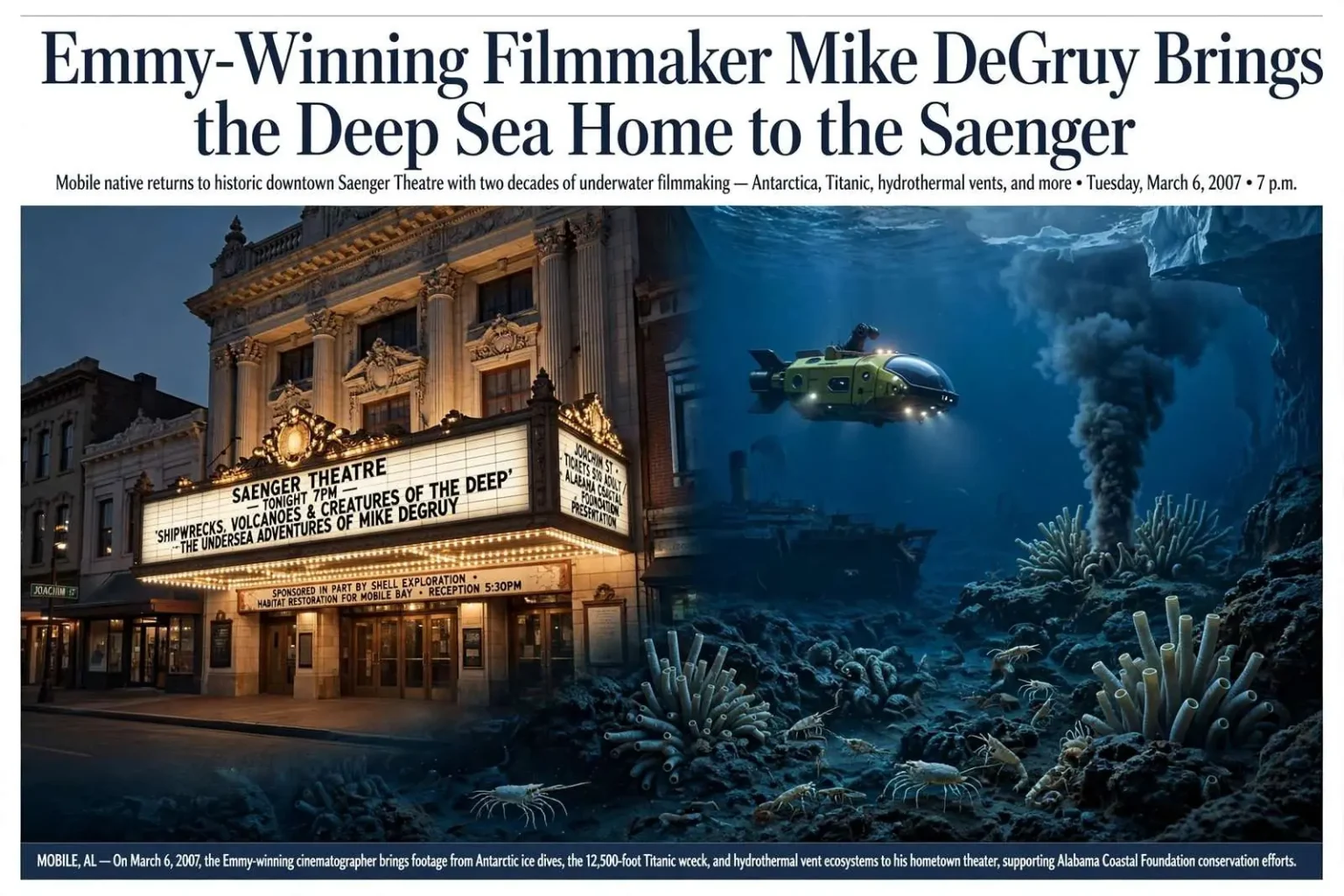
Mike DeGruy, the Mobile native who became one of the world’s most accomplished underwater cinematographers, was coming home. “Shipwrecks, Volcanoes and Creatures of the Deep: The Undersea Adventures of Mike DeGruy” was scheduled for the Saenger Theatre in Mobile on Tuesday, March 6, 2007, at 7 p.m.
The Saenger, the city’s historic downtown theater on Joachim Street, has hosted touring Broadway shows, symphony performances and film series for generations of Mobilians, but rarely had it offered an evening quite like this one: a native son on stage, narrating footage from the bottom of the ocean, beneath the polar ice and inside the wreck of the Titanic.
Two Decades Beneath the Waves
For 20 years, DeGruy had filmed around the globe for the BBC, PBS, National Geographic and the Discovery Channel, as well as for his own company, The Film Crew, Inc. His Emmy-winning work had taken him to the poles, the deep ocean trenches and the coasts of half the continents on earth.
Among underwater camera operators, DeGruy’s name carried the weight that marquee names carry in any craft. He was known not only for the images he captured but for the dives he made to get them — cold, deep, dark and sometimes dangerous water where few camera operators were willing or able to work.
“In the last twenty years I have traveled all the continents and dived in most of the world’s seas making wildlife films about the great, small, mighty and the weak creatures crawling, hopping, slithering, but mostly swimming, in our world,” DeGruy said.
The Mobile appearance promised to compress those two decades into a single evening, pairing the footage with the stories behind it — how the shots were made, what went wrong, and what it feels like to sit in a submersible two and a half miles above the Titanic’s deck.
What the Audience Would See
The presentation was built around footage from some of the most remote and spectacular locations on the planet, organized by expedition and told in DeGruy’s own voice.
Antarctica. For the BBC series “Life In The Freezer,” DeGruy prepared by hauling an eight-foot chain saw to a frozen alpine lake in New Zealand’s Southern Alps and cutting a hole in the ice. A team of four trained for a month, camping and diving beneath it. From there DeGruy and his crew flew to the Ross Sea in Antarctica and began a series of extraordinary dives under the ice shelves at the southern end of the world, in water of startling clarity and constant danger.
Ice diving is among the most unforgiving disciplines in underwater work. The hole cut in the ice is the only exit, safety lines tether every diver, and the water — barely above freezing — punishes any equipment failure with numbers measured in minutes. The payoff is visibility that divers in temperate seas never see, and wildlife adapted to conditions found nowhere else on earth.
Titanic. In the summer of 2005, DeGruy joined James Cameron and his crew on an expedition to the wreck of the Titanic. Aboard the Russian submersible MIR2, he made eight dives to a depth of 12,500 feet.
“I had more meals on the Titanic than the passengers did,” DeGruy said.
The joke was a favorite of his, delivered with the deadpan of a man who had spent hours parked on the wreck’s boat deck while lunch was passed inside a submersible the size of a small car. The Cameron expeditions produced some of the most detailed imagery of the wreck ever recorded, and DeGruy’s eight dives placed him among a very small group of people who had seen the liner with their own eyes rather than through a remotely operated camera.
Patagonia. For the BBC series “The Trials of Life,” DeGruy traveled with fellow Mobilian Paul Atkins to the Valdes Peninsula in Argentina, where over seven weeks the two men filmed full-grown killer whales hurling themselves onto the beach to take baby sea lions, one of the most celebrated sequences in the history of natural history film.
The orca beach-attack behavior at Valdes is performed by a small number of individual whales who time their charges with the tides, deliberately stranding themselves on gravel to seize sea lion pups before wriggling back into the surf. Filming it requires patience measured in weeks, positioning measured in feet, and the nerve to hold steady as a five-ton predator surges out of the water and back within arm’s reach of the camera.
The Deep. For six years DeGruy had spent the equivalent of several weeks inside submersibles, filming undersea volcanoes at hydrothermal vents and recording the strange communities of animals that thrive miles beneath the waves in total darkness, sustained not by sunlight but by chemistry.
The hydrothermal vent communities — tube worms, vent crabs, shrimp and bacteria thriving in mineral-laden water heated by magma — rewrote biology’s assumptions about where life can exist when they were first documented decades earlier, and they remain among the most otherworldly environments ever filmed. Capturing them on camera means repeated dives in submersibles that descend for hours through black water, operating lights and cameras in near-freezing darkness under pressures that would crush an unprotected diver instantly.
A Hometown Connection to the Water
That a boy from Mobile should end up spending his life underwater is less surprising than it might appear. The city sits on a bay, at the mouth of a great river delta, an hour from the Gulf. DeGruy’s fascination with what lives beneath the surface began in waters not far from the theater where he was to speak.
Mobile Bay and the Mobile-Tensaw Delta form one of the richest estuarine systems on the Gulf Coast, a mixing ground of fresh and salt water that teems with fish, crabs, shrimp and the marsh life that supports them. A curious kid growing up on that water — dipping nets off a pier, snorkeling the shallows, watching the tides bring in whatever the bay offered — has an education in aquatic life that no classroom can match, and DeGruy’s own path from Mobile to the deep ocean ran straight through it.
His return to the Saenger gave local audiences a chance to see where that path led: footage from Antarctica and the Titanic in a theater a few blocks from the streets where the journey started, narrated by the man who made it.
Sponsorship and Tickets
DeGruy’s presentation was sponsored by the Alabama Coastal Foundation and funded in part through a grant from Shell Exploration, a supporting partner with the foundation on habitat restoration in the Mobile Bay area. That pairing gave the evening a purpose beyond spectacle: the same bay that produced the filmmaker was itself the object of restoration work.
The Alabama Coastal Foundation has built its mission around protecting and improving Alabama’s coastal resources, combining education, citizen engagement and restoration projects across the Mobile Bay watershed. Corporate partners like Shell Exploration fund that work, and an event pairing world-class ocean footage with the foundation’s local mission served both.
Tickets were available by phone through the Saenger Theatre at 251-208-5600 or at any Ticketmaster location, priced at $10 for adults and $5 for students and children. Tickets to a pre-show reception with DeGruy, including special seating, were available for $25 per person through the Alabama Coastal Foundation office at 251-990-6002. Corporate sponsorships were also offered.
The pricing put the main event within reach of families and students — five dollars for a school-age child to see footage from the bottom of the ocean — while the reception offered supporters a more personal hour with the filmmaker before the lights went down. For the foundation, the evening doubled as its signature event of the season, connecting its donor base to the coastal environment in the most vivid way available.
Science, Storytelling and the Gulf
DeGruy’s career sat at the intersection of science and storytelling. Trained as a marine biologist before he became a filmmaker, he brought to his work a scientist’s understanding of what the camera was looking at and a showman’s sense of how to tell it. That combination made his footage useful to researchers and riveting to viewers, and it made him a sought-after collaborator for producers like Cameron and for series producers at the BBC and elsewhere.
It also made him an effective advocate. Filmmakers who can show an audience what a coral reef, a vent community or an ice shelf actually looks like have a persuasive power that no report matches, and DeGruy’s talks — including the Saenger presentation — mixed wonder with a running argument for taking care of the water that produces it.
The Mobile Bay connection gave that argument local weight. The bay’s oyster reefs, seagrass beds and delta marshes face the same pressures that afflict coastal systems worldwide, and the restoration work the Alabama Coastal Foundation and its partners pursue depends on a public that understands what is at stake underneath the surface of the water they cross on the way to the beach.
A Note for Readers Today
DeGruy continued to film, teach and advocate for ocean conservation in the years after this appearance. He was killed in a helicopter crash in Australia in 2012 while on assignment, a loss felt deeply in the community of filmmakers and marine scientists who regarded him as one of the finest camera operators ever to work underwater, and felt just as keenly in the city that produced him.
Tributes that followed his death came from the top of the profession — producers, explorers and scientists who had worked with him across two decades of expeditions — and they described the same qualities the Saenger audience saw in 2007: boundless curiosity, an appetite for the hardest dives, and a storyteller’s delight in what he found down there.
His archive — Antarctica ice dives, Titanic runs, Patagonia orcas, vent communities — remains in the films and series it was made for, still introducing viewers to a world most will never see. And the Saenger evening in March 2007 stands, in retrospect, as one of the times Mobile got to see its own son show it what he had found down there.
For a city built on a bay, whose economy and identity have always been tied to the water, DeGruy’s career was a reminder of where curiosity about that water can lead: from a pier on Mobile Bay to a submersible parked on the Titanic, with an Emmy or two along the way and a hometown theater full of people who came to hear how it was done.