Milton woman hospitalized after tree falls on mobile home during strong winds
A Milton, Florida woman was hospitalized after strong winds knocked a tree onto her mobile home early Saturday, a neighbor said.
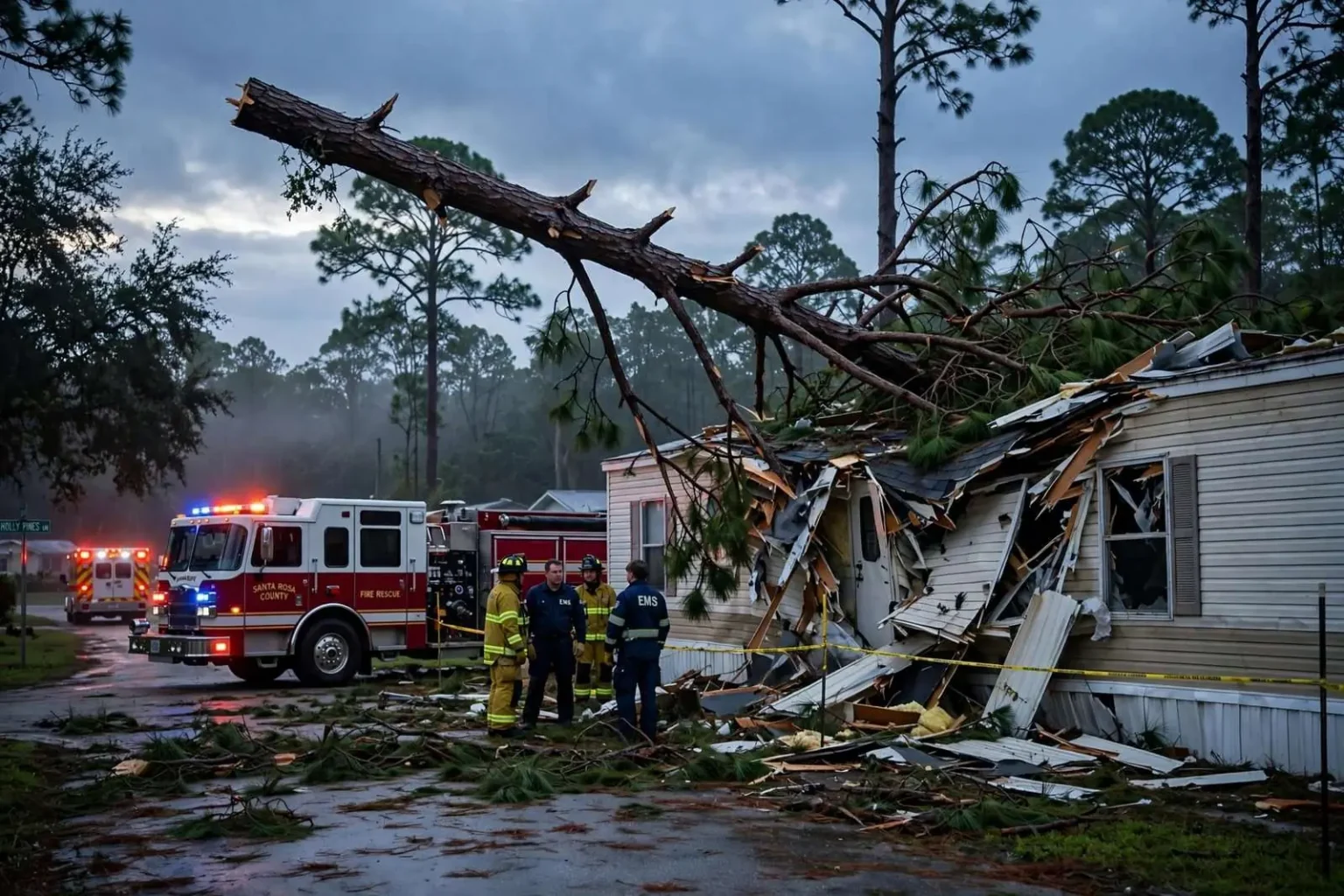
MILTON, Fla. — A woman was taken to a hospital by ambulance early Saturday morning after strong winds toppled a tree onto her mobile home, according to a neighbor who watched the emergency response unfold across the street.
The neighbor, Hermon Williams, lives across the street on Holly Pines Lane, just off Avalon Boulevard south of Highway 90 in Milton. He said he heard a roar of wind between 5:30 and 6 a.m. that lasted only about 10 seconds before it passed. “I thought there was a tornado coming,” Williams said. “It didn’t last long. Just 10 seconds and it was over.”
What the burst of wind left behind was a large tree down on top of the mobile home, crashing through the structure in the area where the woman lived. Williams said he later saw fire and EMS crews arrive at the home and place the woman into an ambulance for transport to a hospital. “I hadn’t seen the inside of the house but they said the inside was messed up pretty bad back where the tree went but maybe she’ll be okay,” he said.
A Sudden Strike in the Pre-Dawn Hours
The timing of the incident — between 5:30 and 6 on a Saturday morning — meant most of the neighborhood was asleep when the tree came down. Brief, intense wind events of that kind are a recurring hazard in Santa Rosa County and across the Florida Panhandle, where squall lines and thunderstorm outflow can produce damaging gusts with little or no warning, particularly in the hours around dawn when storms ahead of a front are most likely to move through.
A wind roar lasting 10 seconds is consistent with what meteorologists call a downburst or straight-line wind gust — air racing down out of a thunderstorm and spreading out when it hits the ground. Such gusts can reach speeds comparable to a weak tornado, and they leave a telltale pattern of damage: trees snapped or uprooted in a single direction, often across a small area, with the destruction confined to the gust’s path. Whether the winds that topped the Milton home were straight-line gusts or a brief tornado is the kind of determination the National Weather Service makes afterward, based on the damage pattern and any radar indications.
Trees and Mobile Homes: A Common and Dangerous Combination
The image of a tree through a mobile home roof is a familiar one in northwest Florida, and it reflects two realities. First, the region is heavily wooded — pines and oaks line the lanes and yards of communities like the one along Holly Pines Lane — and mature trees are everywhere homes are built. Second, mobile and manufactured homes, while built to federal construction standards, offer less resistance than site-built houses when something as heavy as a mature tree lands on the roof. The roof structure takes the impact directly, and the sections of the home behind the strike point often suffer severe interior damage, as the description from the scene suggested.
Emergency crews treat a tree-through-the-roof call as a rescue priority because occupants may be pinned or struck in their beds, particularly at night and during storm season when people are sleeping. Fire crews carry the tools to stabilize a roof section and reach victims, and EMS transports anyone injured for evaluation even when the injuries appear minor, since head and internal trauma can be masked in the immediate aftermath of an impact.
The Setting: Avalon Boulevard and the Communities South of Milton
Holly Pines Lane sits just off Avalon Boulevard south of Highway 90, in the unincorporated stretch of Santa Rosa County between Milton and the growth corridors that run toward Pensacola. Avalon Boulevard is one of the area’s main north-south routes, linking U.S. Highway 90 with Interstate 10 and, farther south, the communities around Navarre and the rapid residential growth along State Road 87. The neighborhoods off the boulevard are a mix of site-built homes and mobile home parks set among mature pines — a landscape that is characteristic of inland Santa Rosa County.
Milton itself is the county seat of Santa Rosa County, sitting along the Blackwater River about 20 miles northeast of Pensacola. The area’s population has grown steadily for decades as the Pensacola metro area spread east and north, but much of the county outside the incorporated cities retains its rural character: wooded lots, long driveways, and the pine forests that give lanes like Holly Pines their names. Those same forests, however, are the reason wind events in the region so often produce tree damage — a mature pine can snap a few feet above the ground in a strong gust, and uprooted oaks and pines are among the most frequent storm damage reports the county sees.
How Emergency Response Works in Santa Rosa County
The response Williams described — fire and EMS crews arriving and transporting the woman to a hospital — follows the standard structure of emergency medical response in Santa Rosa County. Fire departments provide first response to medical calls throughout the county, arriving with personnel trained in emergency care, and ambulance transport is provided by the county’s EMS system, which moves patients to the appropriate hospital depending on the severity of the injuries. In the Milton area, that most often means hospitals in Milton or Pensacola.
When a caller reports someone trapped or injured by a structural collapse, dispatch upgrades the response: additional fire units, possibly rescue crews with heavy equipment, and law enforcement to manage the scene. The process of getting a patient out from beneath or behind a fallen tree can take significant time, as crews must stabilize the structure, cut or move debris, and package the patient carefully before transport — which is why neighbors may see multiple crews and a lengthy operation at what looks, from the street, like a single downed tree.
Wind Damage Season on the Gulf Coast
Incidents like the one on Holly Pines Lane tend to cluster in the months when the Gulf Coast’s weather is most active. Spring and early summer bring severe thunderstorm potential as fronts move through, while the long hurricane season from June through November adds tropical systems to the risk, and even a non-tropical squall line can put down damaging gusts at any hour. The National Weather Service office serving the Panhandle issues severe thunderstorm warnings for such events, but warnings can arrive only minutes before the wind does — sometimes not before a 5:30 a.m. burst of wind in a residential neighborhood.
Local emergency managers use these recurring events to repeat a short list of precautions: keep trees around homes trimmed and remove pines leaning toward structures; secure or bring in objects that strong winds can turn into projectiles; and have a way to receive overnight warnings, since many damaging wind events in the Panhandle occur between midnight and dawn. None of those steps can prevent a tree from falling in a severe gust, but they reduce the odds that a falling tree finds an occupied bedroom — the outcome that turned a routine stormy Saturday morning on Holly Pines Lane into an ambulance run to the hospital.
What the Neighbor Saw
Williams’s account gives a picture of how such an incident appears from across the street: the sudden roar in the dark, the ten seconds of wind, and then the aftermath — emergency lights arriving on a quiet lane, crews working around the damaged home, and an ambulance carrying the woman away. His report that the inside of the home was “messed up pretty bad back where the tree went” matches the typical pattern when a large tree impacts a mobile home: the damage is concentrated where the crown and trunk came through, with the interior rooms behind the strike point taking the debris, broken furnishings, and displaced wall and ceiling sections.
Neighbors are frequently the first witnesses in incidents like this one, and their observations often fill in what official reports leave out — the time the wind hit, how long it lasted, and what the emergency response looked like from the ground. In small communities off the main corridors, where a lane may hold only a dozen homes, residents know one another’s routines, and an ambulance at a neighbor’s door before sunrise draws immediate attention.
After a Tree Strike: Insurance and Recovery
For the woman whose home was struck, the days after the incident would involve the standard recovery path for mobile home damage in Florida. Homeowners and mobile home policies generally cover wind damage from storms, including the removal of a fallen tree from the insured structure and repairs to the home itself, subject to the policy’s deductible. Florida’s insurance market adds its own complications — mobile home policies are written by a smaller set of carriers, and claims involving structural damage typically bring an adjuster to document the roof and interior before repairs begin.
If the home was rendered unlivable, additional living expense coverage under the policy can pay for temporary housing while repairs are made. County building officials may also become involved: structural damage to a manufactured home can require permits and inspections before the home is reoccupied, and utility connections are sometimes disconnected as a safety measure when a roof or wall section is breached. None of that process is visible from the street, but it is the practical aftermath that follows every ambulance away from a scene like the one on Holly Pines Lane.
A Reminder of How Fast It Happens
The defining detail of the morning, in Williams’s telling, was brevity: a roar, ten seconds, and it was over. That is the signature of the wind events that cause much of the tree damage reported across Santa Rosa County and the rest of the Panhandle each year — not a prolonged hurricane passage, but a single violent gust that arrives and departs before anyone can react. The damage, though, is measured in the months of repairs that follow, and in the hospital evaluation of the woman who happened to be home when the tree came down.
As of the morning of the incident, officials had not detailed the extent of the woman’s injuries, and her condition was reported only through the neighbor’s observation that crews placed her into an ambulance and that those at the scene hoped she would be okay. The downed tree, the damaged home, and the response on Holly Pines Lane stood as one more instance of a familiar Gulf Coast lesson: severe weather does not need a hurricane’s name to injure someone, and the margin between an ordinary stormy morning and an emergency can be ten seconds of wind.