Dairy Queen ‘Miracle Treat Day’ Raises Funds for USA Children’s and Women’s Hospital
A one-day Dairy Queen fundraiser held at multiple South Alabama locations sent proceeds from every Blizzard sold toward USA Children's and Women's Hospital.
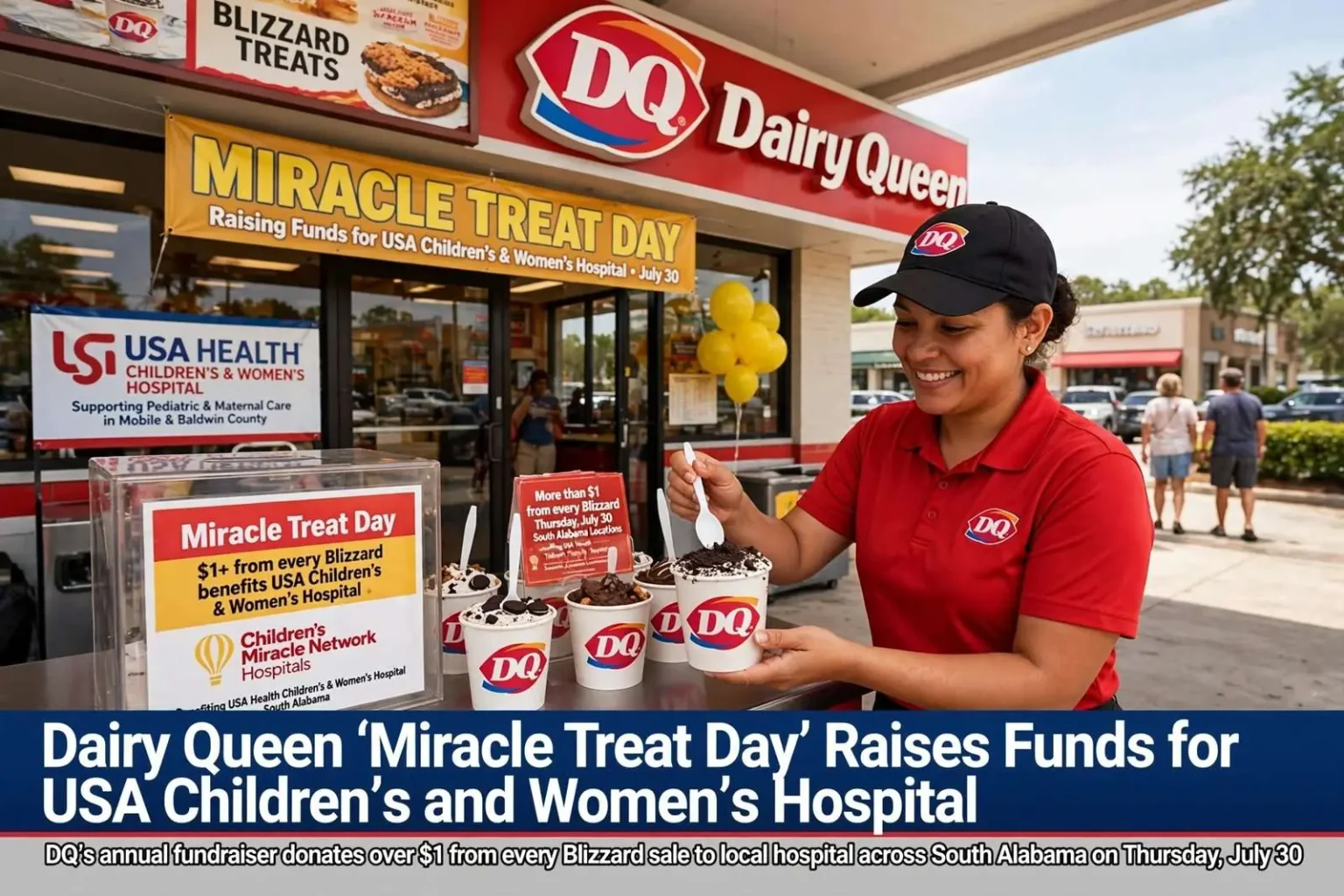
Ice cream lovers across South Alabama had an easy way to support pediatric and maternal care on Thursday, July 30, when local Dairy Queen locations set aside more than a dollar from every Blizzard treat sold to benefit USA Children’s and Women’s Hospital, turning a summer treat run into a fundraiser for the region’s busiest specialized hospital.
The annual event, commonly known among franchise participants as Miracle Treat Day, ties directly into the Children’s Miracle Network, the national nonprofit network that raises money for children’s hospitals across North America. USA Children’s and Women’s Hospital serves as the designated regional hospital for the network in this corner of the state, functioning as the primary specialized care provider for children and women throughout the Mobile and Baldwin County area and beyond.
What made the fundraiser especially accessible was its reach. Rather than concentrating the promotion at a single storefront, participating Dairy Queen locations spanned a wide swath of South Alabama, giving residents in several different communities a chance to take part without traveling far from home. Stores in Mobile proper, along Government Street, Springhill Avenue, University Boulevard and Moffett Road, all took part, as did a location in nearby Saraland.
The promotion extended further still, reaching a store in Jackson to the north and locations along the coast in Orange Beach and Gulf Shores. That footprint meant a family buying a Blizzard in Washington County’s seat, a beachgoer on the Baldwin County shore and a worker grabbing a treat near midtown Mobile were all contributing to the same hospital fund on the same day.
A Fundraiser Built on Simplicity
The structure of the fundraiser was intentionally simple. Customers did not need to make a special donation or sign up for anything in advance. Ordering a Blizzard in any flavor, whether a classic Oreo mix-in or a specialty seasonal creation, automatically triggered the hospital contribution built into the day’s proceeds.
That low-barrier approach has made similar single-day retail fundraisers popular with national nonprofit partners, since it converts routine purchases people were likely to make anyway into charitable giving without requiring extra effort from customers. The model works in both directions: restaurants draw crowds on an otherwise ordinary Thursday in the middle of summer, and the charity partner receives a concentrated, daylong stream of contributions from thousands of small transactions rather than depending on a handful of large donors.
For the franchise owners who participate, Miracle Treat Day requires coordination across registers, staffing for the crowds the promotion draws and a willingness to route a meaningful share of the day’s sales away from the business. South Alabama’s participating stores have made it a fixture of their summer calendars.
The Hospital Behind the Cause
USA Children’s and Women’s Hospital occupies a distinctive place in the Gulf Coast’s medical landscape. Affiliated with the University of South Alabama’s health system, it serves as the region’s referral center for complicated pregnancies, newborn intensive care, pediatric specialties and women’s health services. Families from across Mobile, Baldwin and the surrounding counties depend on its neonatal intensive care unit, its pediatric specialists and its maternity services when local hospitals cannot provide the level of care a patient needs.
Hospitals of that kind operate with thin margins on many services, and philanthropy fills gaps that insurance reimbursements do not. Funds raised through programs like Miracle Treat Day support equipment upgrades, family services and programs that make long stays more manageable for parents of hospitalized children. A single day of Blizzard sales across a dozen stores produces a modest figure in hospital-budget terms, but annual events like this one compound into a dependable funding stream that the hospital can plan around.
The timing matters too. For USA Children’s and Women’s Hospital, the midsummer date arrives just ahead of the school year, when pediatric emergency visits and scheduled procedures climb as families resume routines. The boost from Miracle Treat Day lands as the hospital heads into its busiest stretch, and the awareness it generates often converts into year-round support from customers who learn where their treat money went.
Why the Children’s Miracle Network Model Endures
The Children’s Miracle Network was founded in 1983 to give children’s hospitals a unified national fundraising brand, and its model has proven remarkably durable. The network partners with retail chains, broadcasters and corporate sponsors, channeling small contributions from millions of transactions into its member hospitals, which retain the money raised in their own communities. A dollar collected at a Dairy Queen counter in Mobile stays in Mobile, supporting the hospital that local families actually use.
That local-retention principle is the quiet engine of the network’s success. National partners provide the marketing reach and the familiar campaign calendar; member hospitals provide the accountability of a beneficiary that donors can see and visit. For South Alabama, the designation of USA Children’s and Women’s as the network hospital means the region’s generosity on days like Miracle Treat Day does not subsidize institutions elsewhere — it builds capacity at home.
Specialized pediatric and maternal care is expensive to provide for precisely the reason it is needed: the patients are few in any single community, the equipment is costly, and the specialists are scarce. Regionalizing that care, as this part of Alabama does through USA Children’s and Women’s, concentrates expertise and technology in one place. Fundraisers like Miracle Treat Day are part of what keeps that model viable, supplementing revenue to cover programs that would otherwise go unfunded.
A Day Along Mobile’s Blizzard Corridors
The geography of the participating stores traces the main commercial arteries of the region. Government Street runs east-west through the heart of Mobile, one of the city’s oldest commercial corridors. Springhill Avenue serves the neighborhoods northwest of downtown, while Moffett Road carries traffic toward the Mississippi line as U.S. Highway 45. University Boulevard sits in the shadow of the University of South Alabama campus, not far from the hospital itself.
Saraland’s store serves the fast-growing northern tier of Mobile County, where commuters who work in the city can take part without a special trip. Jackson, the Washington County seat, gave participants in the piney woods north of Mobile a chance to support the same hospital that would receive their children in an emergency. And on the coast, the Orange Beach and Gulf Shores locations turned a summer tourist day into hospital funding, with vacationers from across the Southeast joining locals in the line.
The variety of the locations underscores how far the hospital’s catchment extends. A child from Jackson and a child from Gulf Shores could both end up under the same roof in Mobile, and the fundraiser’s wide footprint mirrors that reality.
What the Money Supports
Hospital fundraisers of this kind typically back the unglamorous essentials as much as headline equipment: child life specialists who help young patients understand treatment, family lounges and lodging support for parents keeping vigil, car seats and education for new mothers leaving the NICU, and comfort items that make long admissions bearable. Contributions also help bridge the cost of care for families who lack insurance or face financial strain during a child’s illness.
The hospital’s role as a teaching institution adds another layer. As part of the University of South Alabama’s medical enterprise, it trains physicians, nurses and allied health professionals who go on to practice across the region, multiplying the return on every dollar invested in its programs.
For the customers who lined up on July 30, the transaction was as ordinary as a summer treat run. For the hospital, each of those ordinary transactions added up to support for the region’s most fragile patients — newborns fighting for a start in the NICU, children facing serious diagnoses, and mothers whose pregnancies require care available nowhere else between New Orleans and Pensacola.
Miracle Treat Day returns each summer, and its formula has changed little: buy a Blizzard, and more than a dollar of the sale goes to work at USA Children’s and Women’s Hospital. In an era when fundraising pitches grow ever more elaborate, the simplicity remains the point.
A Treat With Deep Roots on the Gulf Coast
The Blizzard itself has been a Dairy Queen signature for decades, a thick soft-serve concoction blended with candy, cookies or fruit and served upside down to prove its density. Its staying power is part of what makes Miracle Treat Day work: the product needs no introduction, and a promotion built on an item customers already crave removes every ounce of persuasion from the ask. Families do not have to be sold on participating; they only have to show up on the right day.
Dairy Queen’s presence in South Alabama follows the same pattern as the fundraiser’s footprint. The chain’s franchisees along the Gulf Coast have operated in the region for generations, and many of the participating stores are local institutions in their own right, known for everything from after-game ice cream runs to family dinners in towns where dining options are limited. That community embeddedness gives the charity appeal credibility that a national advertising campaign could not buy.
Supporting the Hospital Beyond One Day
For residents moved by the campaign, the hospital offers ways to give back throughout the year. The Children’s Miracle Network relationship continues beyond Miracle Treat Day through retail partners and community events, and the hospital accepts direct contributions for its programs. Families who spent time in the NICU or the pediatric wards often become the hospital’s most devoted supporters, organizing their own fundraisers and returning to thank the staff who cared for their children.
Local businesses and civic groups also play a role, from radiothons that share patient stories on the air to restaurant nights, charity runs and school fundraising drives that adopt the hospital as a beneficiary. Each of those efforts draws on the same public goodwill that Miracle Treat Day taps, and together they form the philanthropic foundation that keeps the region’s only specialized children’s and women’s hospital growing with the population it serves.
The broader lesson of the event is that institutional fundraising and everyday commerce can reinforce each other. A hospital that treats thousands of children each year is sustained by medical skill, but also by the accumulated small gestures of a community that values having that skill nearby. On the last Thursday of July, South Alabama showed again that it does.