Miss Mobile Bay Bre Vigor Breaks Silence on Years of Online Grooming, Turns Ordeal Into Anti-Trafficking Advocacy
Miss Mobile Bay Bre Vigor is speaking out for the first time about years of manipulation by an online predator that began when she was 12, an ordeal that drew in the FBI and now fuels her advocacy against child exploitation and sex trafficking.
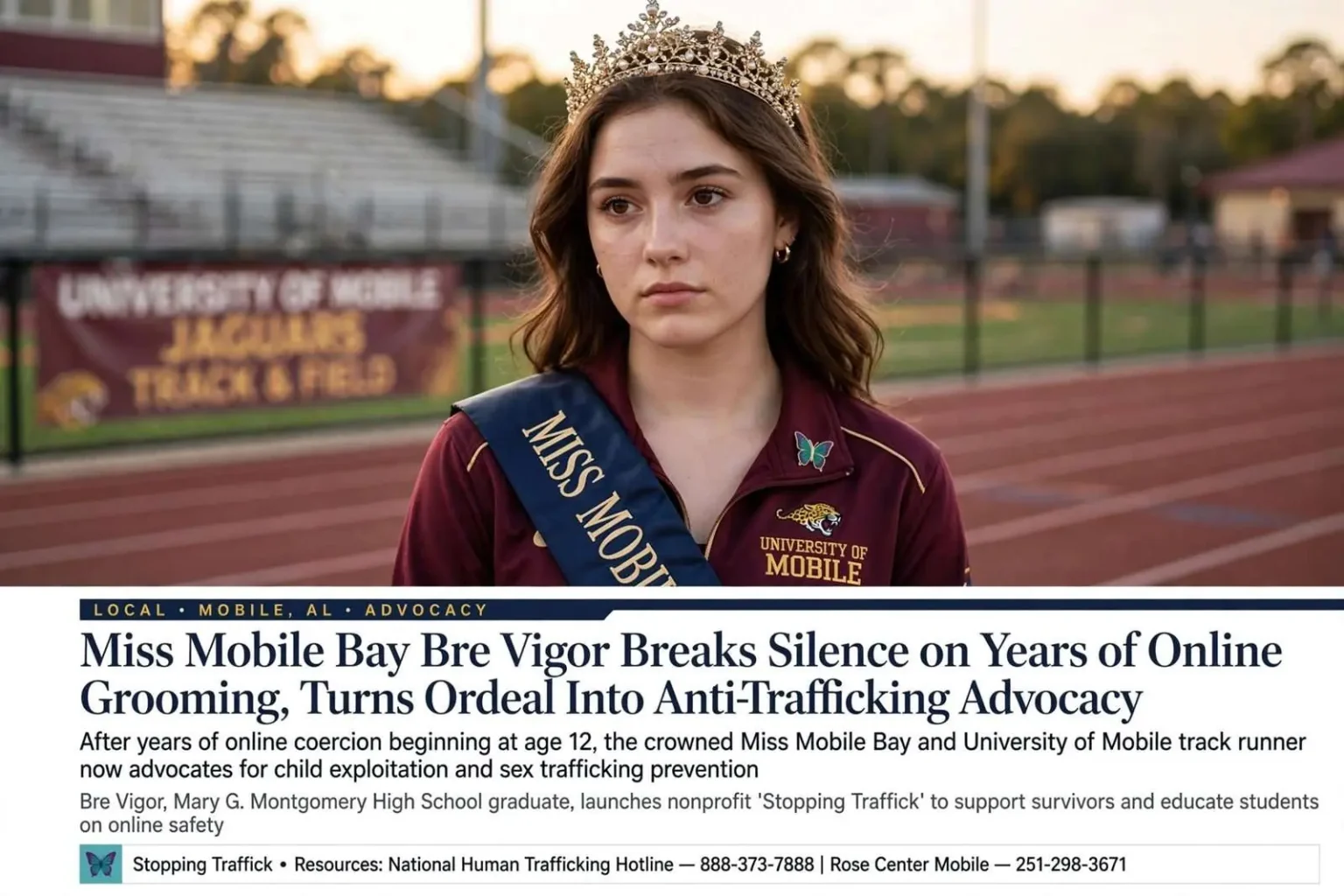
A Mobile County woman crowned Miss Mobile Bay is speaking publicly about years of manipulation and coercion by an online predator that began when she was just 12 years old, describing an ordeal that eventually drew in the FBI and reshaped how she now spends much of her time as an advocate against child exploitation and sex trafficking.
Bre Vigor, a Mary G. Montgomery High School graduate who now runs track for the University of Mobile, first spoke about her experience during the Distinguished Young Women program in Mobile County, telling judges and an audience that included her mother, Cricket Vigor, that her life had at times resembled “a horror film” because she was “a survivor of an online child predator.” It was the first time she had described what happened to her outside of conversations with her family and law enforcement.
Later that same evening, competing in the program’s talent portion, Bre performed a dance to “This Is Me,” the anthem from “The Greatest Showman.” She went on to place as second runner-up in the competition, a result that came just moments after she had, for the first time publicly, named herself a survivor of online exploitation.
Before any of that, Bre had been elected class representative for her sixth-grade class, a role that put her in front of classmates and reinforced the image of a well-adjusted, involved student — someone she has since described as “the girl next door.” That same school year marked her introduction to social media.
How the Grooming Began Online
According to the family, the ordeal began in sixth grade, when Bre, then newly active on Instagram and Snapchat, accepted a friend request from an unfamiliar account. What started as a casual exchange — “How was your day?” — continued for roughly two weeks before the person on the other end began pressuring her for a nude photograph. When Bre searched the person’s username online, she said the search results included a chilling threat: that reporting the account would lead to her family being harmed.
Believing she had no other option, Bre sent the photo. She said the man then used that image as leverage to demand more, eventually taking control of her social media accounts and requiring her to appear on video chat late at night, often until 2 or 3 a.m., before she got up a few hours later for school. Family members later came to believe the disrupted sleep schedule was a deliberate part of a grooming process meant to wear down her ability to resist.
Cricket Vigor said investigators later helped the family understand how deliberate the pattern was. Predators frequently target children between the ages of 11 and 13, she said, because that age group can be more easily manipulated and is less likely to recognize what is happening. She has come to believe her daughter’s abuser had arranged for others to be watching during some of the video sessions he demanded, and that he also used Bre’s close bond with her older sister as leverage, threatening to involve or harm her as well.
The man, who the family said lived on the West Coast, maintained contact for roughly three years. During a national dance competition in Las Vegas in 2014, another parent warned families in a changing area that a man had been pacing outside the door; security removed him, and Bre later received a text saying he had been close to her that day. She and her mother believe he intended to abduct her in person during that trip.
Family Discovers the Abuse
The pattern of secrecy ended after a routine phone check at home. Cricket Vigor said she noticed a contact saved under the name “Daddy” on her daughter’s phone and grew suspicious because her husband, a fire captain, did not use the messaging app in question. Investigators and advocacy groups have noted that traffickers sometimes use similar language to label victims, and the discovery prompted Cricket to begin documenting the messages and eventually reach out for help.
Cricket Vigor said she later learned that people who traffic children are often categorized by advocates in two broad ways: a “Romeo,” who builds trust and affection with a victim before exploiting it, and a “gorilla,” who relies on threats, intimidation and force. She believes her daughter’s abuser used both tactics, alternating attention and apparent affection with threats depending on whether Bre complied with his demands.
An early report to a sheriff’s deputy was classified as harassing communications and did not lead to further action, the family said. A detective at a local Child Advocacy Center later connected the Vigors with the FBI, which began monitoring the situation and warned the family that the man remained dangerous. Even after the family sought outside help, they said the man continued attempting to track Bre’s location through Snapchat and at one point accessed a therapist’s files to delete records related to her case.
Deciding Whether to Report to Investigators
Before going further with law enforcement, the family consulted an attorney, who advised them to make sure investigators formally recognized Bre as a victim rather than a participant in producing the images. Cricket Vigor has said that warning weighed heavily on the family, since handing over the evidence meant acknowledging that Bre herself had sent photos under duress, and there was a real chance she could face charges of her own in the process. The family decided to move forward anyway, concluding the man would not stop pursuing Bre unless someone intervened.
Bre has said the prolonged stress and secrecy contributed to depression, self-harm and suicidal thoughts during her early teenage years. She has also said that school programs at the time focused heavily on drug and alcohol dangers but offered little guidance on how to recognize or respond to online grooming, a gap she now works to address through public speaking.
Cricket Vigor has said her daughter hid the cutting for months, concealing the marks under bangle bracelets and sweaters, and that the full extent of Bre’s despair did not become clear to the family until well after the most acute danger from the trafficker had passed.
Bre has said she knew exactly what to do if she was ever handed a drink at a party or offered drugs, lessons reinforced every year during Red Ribbon Week at school. No one, she said, ever taught her what to do if a stranger online asked for a nude photograph, or how to tell when someone was not who they claimed to be.
A Second Predator and an FBI Sting
The man was never criminally charged, according to the family, but the contact stopped after federal agents visited him; he left the country in 2019. A second attempt at contact soon followed from a different individual, later identified by federal authorities as Garnett James Lloyd, a North Carolina man in his late 40s who posed online as a teenage girl interested in buying formal dresses Bre and friends had listed for sale.
Because the family and the FBI agent already assigned to Bre’s case recognized the pattern quickly, an agent assumed her online identity and continued the conversation with Lloyd, who requested increasingly inappropriate photos and offered as much as $700 for the images, according to a U.S. Department of Justice announcement on the case out of the Southern District of Alabama. Lloyd, a previously convicted sex offender, also instructed Bre to respond to him only with “Yes, Master” or “No, Master.” When the requests were refused, Lloyd threatened to distribute doctored, altered images and to contact Bre’s friends and family. He was arrested at his home days later and was ultimately sentenced to five years in federal prison on a cyberstalking charge.
Turning Advocacy Into a Mission
In the years since, Bre has built a record of academic and athletic achievement, serving as an Azalea Trail Maid and vice president of the National Honor Society at Mary G. Montgomery High School, where she was also voted Most Popular by her senior class. She earned track scholarship offers — by her family’s account totaling in the millions of dollars combined — from programs around the country, and continues to compete for the University of Mobile, where she plans to major in criminal justice with a minor in business. She was crowned Miss Mobile Bay in October 2019 and, with pageants paused during the pandemic, has used the extended time with her title to focus on advocacy work.
That work includes launching a nonprofit, Stopping Traffick, aimed at raising money for organizations that assist trafficking survivors, including the Rose Center in Mobile, and eventually funding scholarships for young women recovering from abuse or trafficking. Bre has said she wants to help survivors gain the education and job skills needed to rebuild their lives after leaving dangerous situations.
Mobile has repeatedly been cited by state and national organizations as among Alabama’s most significant hubs for human trafficking activity — Bre describes it as the state’s second-leading hotspot for the crime, behind only Birmingham — a distinction she now cites often in talks with students and parents about online safety. She has said that if she wins the Miss Alabama title, she plans to spend the following year based in Birmingham, which she and other advocates describe as the hub of trafficking activity in the state, while preparing to compete for Miss America. She has said she hopes to continue raising awareness of trafficking and grooming risks regardless of the outcome.
Anyone who suspects a child is being trafficked or groomed online, or who wants more information about warning signs and resources, can contact the Rose Center in Mobile at 251-298-3671, the Child Advocacy Center at 251-432-1011, or the National Human Trafficking Hotline at 888-373-7888.