Missing Navarre Girl Found Safe; One Person in Custody
A Florida MISSING CHILD Alert for Navarre's Emily Navarro ended safely, and the Santa Rosa County Sheriff's Office reported one person in custody.
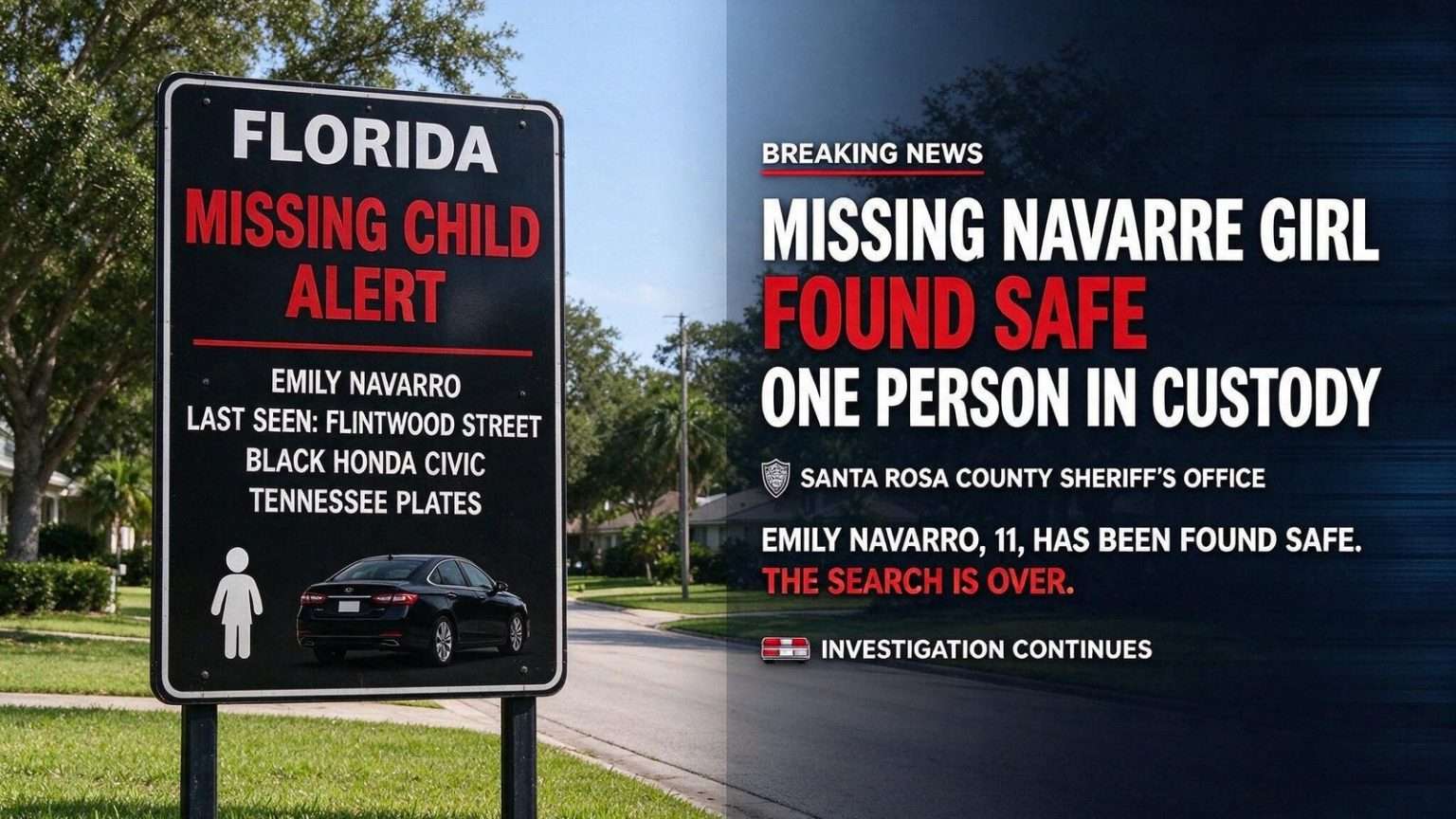
A Florida MISSING CHILD Alert issued for a young Navarre girl ended with good news: the Santa Rosa County Sheriff’s Office confirmed the child was found safe, and one person was taken into custody in connection with the case.
Emily Navarro had been last seen in the area of the 6800 block of Flintwood Street in Navarre, triggering the statewide alert. Authorities said she was believed to be in the company of Elvin Castron Murcia, and that the two may have been traveling in a black Honda Civic with Tennessee license plates.
Along with the recovery, deputies reported that one person was in custody, though the sheriff’s office did not specify whether that person was the man the girl was believed to be with. The confirmation that Emily was safe brought the search to a close within hours of the alert drawing attention across the Panhandle.
The alert system, which broadcasts details to phones and highway signs across Florida, has been credited with quickly mobilizing the public in cases like this one across Northwest Florida.
The Search for Emily Navarro
The case began in Navarre, the Santa Rosa County beach community on the Panhandle between Pensacola Beach and Fort Walton Beach. When Emily Navarro was reported missing after being last seen in the area of the 6800 block of Flintwood Street — a residential neighborhood set back from the beach Highway 98 corridor — the Santa Rosa County Sheriff’s Office moved to get her description in front of as many eyes as possible.
Deputies believed the girl was in the company of Elvin Castron Murcia, and they identified a vehicle they believed the two might be traveling in: a black Honda Civic bearing Tennessee license plates. Those details, along with the child’s description, formed the core of the public alert that followed.
The out-of-state plates and the possibility that the pair had left the immediate area broadened the search beyond Santa Rosa County’s borders. Alerts of this kind are pushed to law enforcement across the region, giving deputies in neighboring counties and states the same identifying information that Panhandle residents were receiving on their phones.
How the Alert Worked
Florida’s MISSING CHILD Alert system is designed for exactly this scenario: a missing child whose circumstances do not meet the stricter criteria of an AMBER Alert but whose welfare is nonetheless at risk. Once activated, the alert broadcasts through the Wireless Emergency Alerts system to cellphones across the affected region, posts to highway dynamic message signs, and spreads through media outlets and law enforcement channels.
The reach is deliberate. A black Honda Civic with Tennessee plates described in an alert is a needle-in-haystack problem: no deputy can watch every road. But thousands of drivers can each glance at the next car in line, and a single match — a driver recognizing a plate, a neighbor spotting the vehicle in a driveway — can resolve a search in minutes.
Sheriff’s offices in Northwest Florida have repeatedly credited the public response generated by these alerts with accelerating recoveries. In Santa Rosa County, the system’s activation for Emily Navarro drew tips and sightings that deputies could run down while the search was still young — a key factor in cases where hours matter.
The Safe Recovery
The Santa Rosa County Sheriff’s Office confirmed that Emily was found safe, closing out the alert and the multi-county search that accompanied it. In these recoveries, deputies’ first priorities are the child’s medical condition and welfare check, followed by interviews to establish the timeline of how the disappearance occurred and where the pair had traveled.
Deputies also reported that one person was in custody following the recovery. The sheriff’s office did not specify whether the person taken into custody was Elvin Castron Murcia, the man the girl was believed to be with, and officials said more information would be released as the investigation allowed.
That restraint is standard practice in the hours after a recovery. Charges in missing-child cases depend on facts investigators must establish first — the child’s relationship to the adult, the circumstances of the taking, whether the child was unharmed and what any statements reveal. Premature identification of charges can complicate the case that prosecutors ultimately bring.
Navarre and the Regional Search Network
Navarre sits in the southern reaches of Santa Rosa County, connected to the rest of the county and the wider Panhandle by U.S. Highway 98 and State Road 87 — routes that tie the beach community to Fort Walton Beach, Navarre Beach, Gulf Breeze and Pensacola. A vehicle leaving the Flintwood Street area has multiple highways to choose from within minutes, which is why regional alerts matter more here than county-by-county coordination alone.
The search drew on that network. The description of a black Honda Civic with Tennessee plates was pushed to deputies and troopers across the Panhandle and beyond, and the public alert put the same information before every driver on those corridors. Santa Rosa County, which stretches from the beaches north to the Alabama line, regularly coordinates with Escambia and Okaloosa counties and with Florida Highway Patrol in such cases.
The recovery confirmed the system worked as designed: a child last seen in a Navarre neighborhood was found safe after a search that mobilized law enforcement and the public across jurisdictional lines.
What Comes Next
With Emily safe, the investigation shifts from recovery to accounting. Investigators will determine the circumstances that led to the alert — how the girl came to be with Murcia, where the pair traveled and what, if any, crimes occurred. The person taken into custody faces whatever charges the facts support, and prosecutors will weigh those decisions as the sheriff’s office completes its work.
Sheriff’s officials thanked the public for the tips and sightings generated by the alert, which they said contributed to the speed of the recovery. For families across the Panhandle, the case was another demonstration of the alert system’s purpose: turning an entire region into searchers within minutes of activation.
Florida’s MISSING CHILD Alert system, operated through the Florida Department of Law Enforcement in coordination with local sheriffs, remains one of the state’s most-used public safety tools, and cases like this one — a child found safe, one person in custody, and a public that played its part — are the outcome the system exists to produce.
Missing Child Alerts in Northwest Florida
Northwest Florida’s geography shapes how missing child cases unfold. The Panhandle’s communities sit along a handful of highways — U.S. 98 hugging the coast, Interstate 10 running east-west inland, U.S. 29 and State Road 87 running north toward Alabama — and a vehicle can cross a county line, or a state line, within minutes. Sheriff’s offices in Escambia, Santa Rosa, Okaloosa and Walton counties have learned to treat every missing child case as a regional one from the first hour.
The Florida MISSING CHILD Alert, distinct from the stricter AMBER Alert, was created to fill the gap for cases where the full AMBER criteria — a confirmed abduction with imminent danger — cannot yet be established, but where the public’s help is urgently needed. Activating the alert does not require waiting for those harder facts; it pushes the description out and lets the public start looking immediately.
The system’s components work together. Cellphone alerts reach every handset in the broadcast area. Highway signs display vehicle and plate information to drivers on Interstates 10 and 110 and the coastal corridors. Local media repeat the details, and sheriff’s offices field tips around the clock. In cases that end like Emily Navarro’s — found safe, quickly — the alert is usually the difference.
Behind the Recovery: How These Cases Are Worked
When a missing child alert is active, the sheriff’s office works several tracks simultaneously. Detectives interview family members and neighbors around the last-seen location — in this case, the 6800 block of Flintwood Street in Navarre — while deputies and troopers concentrate on the routes a described vehicle might take. Meanwhile, tips from the public flow into a command channel, each one checked and run down.
The vehicle is usually the fulcrum. A black Honda Civic with Tennessee license plates is a specific, searchable target, and sightings — real or mistaken — generate the leads that narrow the search. Out-of-state plates add complexity, because the vehicle may have been traveling from elsewhere, but they also make the car more noticeable to observant drivers.
Once the child is located, the welfare check comes first: medical screening, food and rest, and a careful conversation conducted by investigators trained in interviewing children. Only after the child is safe do deputies process the scene, impound any vehicle and begin the interviews that will determine what charges, if any, apply to the adult involved.
For Parents Along the Panhandle
Sheriff’s offices across the region urge families to keep current photos and descriptions of their children, to know the alert system’s role, and to call 911 immediately — not after waiting to search — when a child cannot be located. The early minutes are when an alert can be most effective, because the vehicle and direction of travel are still fresh.
The recovery of Emily Navarro ends her case the way every missing child alert hopes to end: a child safe, a family reunited, and a person in custody to answer for the circumstances. For the deputies who worked the search and the residents who answered it, it was the system performing exactly as designed.
The Santa Rosa County Sheriff’s Office said additional details would be released as the investigation continues, and officials reminded the public that anyone with information about a missing child should contact their local sheriff’s office or call 911 without delay.