Mississippi education board sets policies to resume in-person learning
Mississippi’s State Board of Education approved policies requiring in-person instruction for 2021-2022, with standards for districts offering virtual.
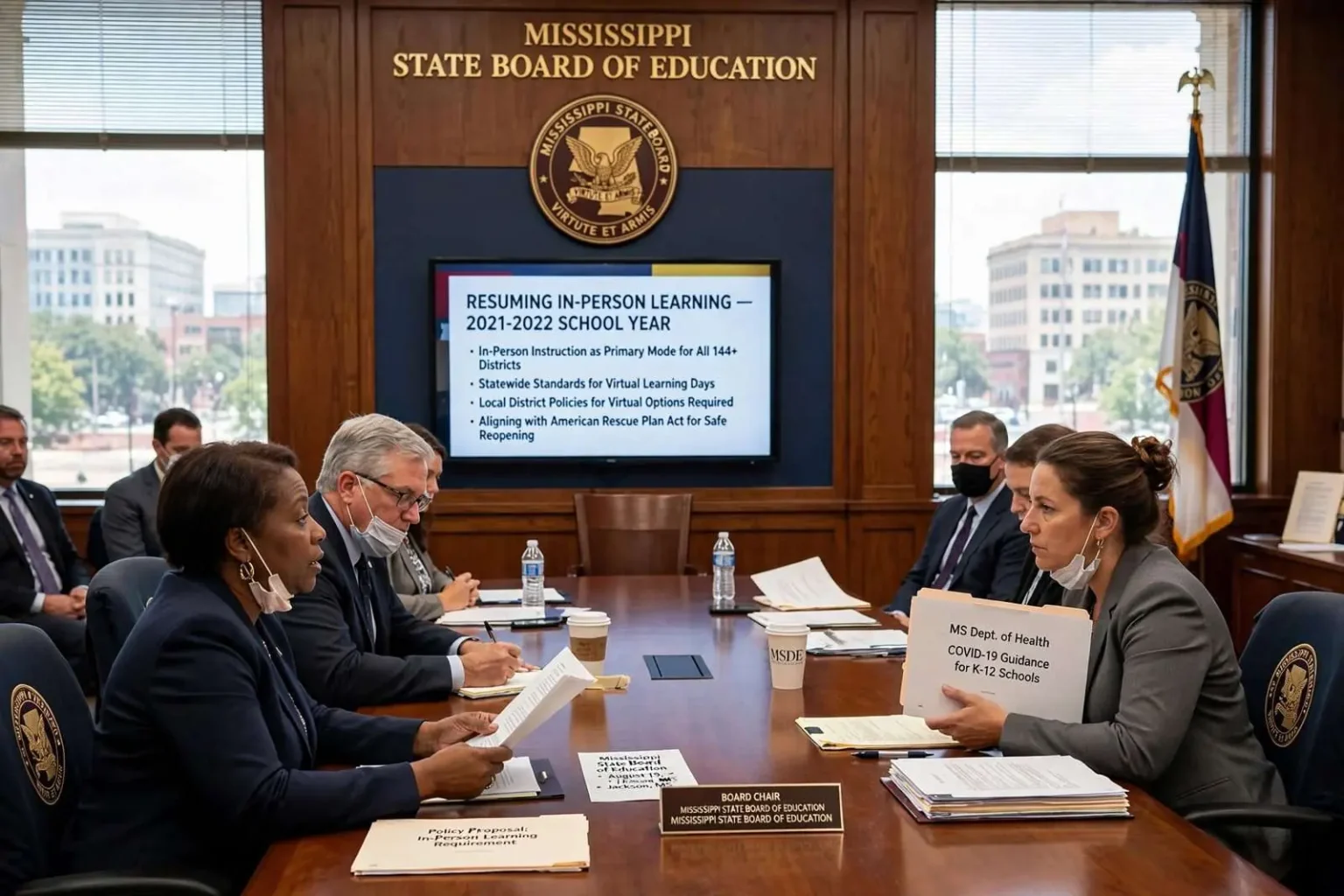
JACKSON, Miss. — The Mississippi State Board of Education on Thursday approved two policies requiring all school districts to resume in-person instruction as the primary mode of teaching for the 2021-2022 school year, formally closing the door on the remote-first arrangements that governed much of the pandemic-disrupted 2020-2021 academic year. The move put the state’s top education policy board squarely behind a return to classrooms across all 144-plus school districts as Mississippi prepared for a fall term that officials hoped would look far closer to normal.
The policies also set requirements for districts that choose to offer a virtual learning option and establish standards for virtual learning days, according to the board. The intent, board leaders indicated, was to preserve the flexibility the pandemic made necessary while ensuring that any instruction delivered through a screen met the same expectations as instruction delivered in a classroom. Districts that had grown accustomed to improvised remote arrangements would now operate under a common statewide framework.
Board leaders said the decisions align with the federal American Rescue Plan Act, the sweeping pandemic-relief law that sent billions of dollars to states and school districts nationwide to support the safe reopening of schools, address learning loss and fund summer and after-school programs. Mississippi’s share of those funds came with expectations that districts would plan for sustained in-person operation, and the board’s policies were structured to match federal requirements rather than run counter to them.
What the policies require
Under the policies, the Mississippi State Department of Health will provide COVID-19 public health guidance to K-12 schools, keeping the public health side of the reopening question in the hands of the state’s medical experts rather than leaving each district to write its own. That arrangement mirrored the approach the state had taken through the previous school year, in which health department guidance — covering matters such as case reporting, quarantine practice and prevention strategies — served as the baseline for school operations even as individual districts made local decisions.
The requirement that in-person instruction be the primary mode of teaching does not mean virtual learning disappears. Instead, districts that offer virtual learning for individual students must adopt locally board-approved policies covering criteria for participation, equipment, connectivity, attendance and student conduct, along with assurances of equal access, non-discrimination and the delivery of a Free Appropriate Public Education for students with disabilities. Those last assurances carry the weight of federal law: the Individuals with Disabilities Education Act obligates districts to provide specially designed instruction and related services to students with disabilities regardless of the instructional format, and theEqual Access requirement extends to civil rights protections that cannot lapse when learning moves home.
For families, the practical effect is a menu shaped by local choice. Some districts, particularly in rural areas where broadband access remains uneven, planned to return fully to classrooms with limited or no virtual option. Others — especially larger suburban districts that built out digital platforms during the pandemic — intended to keep full-time virtual academies staffed by their own teachers, serving families hesitant to send students back into buildings. Under the new policies, either path is permissible, but each comes with documented expectations the local school board must formally adopt.
The standards for virtual learning days address a different problem that emerged during the pandemic: the practice of counting remote instruction as a school day for attendance and funding purposes. By setting statewide standards, the board aimed to ensure that a virtual day means actual, structured instruction — with defined schedules, attendance-taking and academic engagement — rather than a loosely supervised distribution of assignments. The rules give districts a legitimate tool for weather closures, building issues or quarantine situations while preventing the kind of improvised e-learning that produced uneven results in earlier emergency closures.
Why the state pushed a return to classrooms
The board’s action came amid mounting evidence of the academic cost of pandemic schooling. Mississippi students, like their peers nationwide, had spent much of the previous school year in hybrid schedules, quarantines and temporary remote periods, and state assessments administered in spring 2021 showed the expected declines in proficiency, particularly in early grades and mathematics. Education leaders argued that the surest way to begin recovering lost ground was consistent, full-time, in-person instruction — and that districts with robust virtual options risked enrolling students in remote programs that served families’ health concerns but delivered weaker results, especially for younger children and students without reliable home support.
The American Rescue Plan funding context shaped the decision as well. Districts across Mississippi were preparing to spend substantial federal relief allocations on tutoring, summer learning, instructional technology, ventilation upgrades, counseling staff and academic recovery programs. Federal guidance tied those investments to expectations around operating schools in person, and board members framed the new policies as the state-level complement: local plans for spending relief money would rest on an instructional model anchored in classrooms.
Teachers and administrators had spent the intervening months carrying an extraordinary load — covering classes during staffing shortages, adapting lessons for students toggling between in-person and quarantine learning, and managing the health protocols of their own buildings. The board’s requirement that in-person instruction be the primary mode effectively standardized expectations for the fall, giving district leaders a clear mandate to build master schedules around students in seats rather than around contingency remote plans.
What families and districts should watch
For parents weighing a virtual option, the locally approved policies are the document to read. Under the board’s requirements, those policies must spell out the criteria a student must meet to participate — typically including prior academic performance, attendance history and family circumstances — along with expectations for equipment and connectivity, how attendance will be recorded in a virtual setting, and the conduct standards that apply online as surely as they do in a hallway. Districts must also affirm that virtual programs provide equal access and do not discriminate, and that students with disabilities continue receiving the services required by their individualized education programs.
Those safeguards matter most for the students who struggled most during the pandemic’s remote stretches. Federal civil rights enforcement in education has long emphasized that schools cannot allow a change of format to become a de facto reduction in services for students with disabilities, and Mississippi’s inclusion of explicit Free Appropriate Public Education language in the policy framework places that obligation in writing where local boards must acknowledge it.
The virtual learning day standards likewise give families a clearer picture of what to expect when weather or illness closes a building. Rather than a snow-day-by-another-name, a compliant virtual day under the new framework is a scheduled instructional day: teachers available and teaching, attendance recorded, and work aligned to the curriculum. For districts along the Gulf Coast and the Delta, where hurricanes, flooding and ice storms routinely disrupt the calendar, a credible virtual-day standard converts lost days into preserved instructional time — a benefit that extends well beyond the pandemic that prompted it.
The state health department’s role also deserves note for families planning the year ahead. Because the Mississippi State Department of Health provides the COVID-19 public health guidance for K-12 schools, questions about masks, distancing, quarantine lengths and case procedures ultimately trace back to Jackson’s medical guidance rather than to a patchwork of local rules. That centralized approach was credited with giving districts a consistent reference point, even as it left room for districts to adopt stricter measures where local conditions warranted.
The broader picture for Mississippi schools
The board’s action fits within a longer-running effort to stabilize a school system that entered the pandemic carrying significant challenges — teacher shortages concentrated in rural and high-poverty districts, uneven broadband access, and an accountability trajectory that, before 2020, had been one of the notable improvement stories in the South. The pandemic interrupted that momentum, and the 2021-2022 policies represent the state’s attempt to restart it: get students back in classrooms, hold virtual offerings to a real standard, and target federal relief money at the academic damage.
How well the framework works will show up gradually — in attendance figures, in the proportion of students choosing virtual programs, and eventually in state assessment results. Districts that build high-quality virtual academies under the new rules may find the investment pays dividends as a permanent offering for students with health needs, scheduling conflicts or specialized circumstances. Districts that return fully in person will be watching their staffing and their students’ recovery curves.
For now, the message from the State Board of Education is unambiguous: Mississippi’s classrooms are open, and they are the center of the state’s education model again. Virtual learning survives the pandemic in Mississippi, but only as a regulated, board-approved supplement to the real thing — with the health department supplying the medical guidance and federal relief funds underwriting the recovery effort that makes full buildings possible.
Families with questions about their district’s virtual option, virtual learning day procedures or services for students with disabilities can direct them to their local school board, whose approved policies must now be on file and available under the state framework adopted Thursday.