Mithril and Roman Street Team Up at USA’s Laidlaw Center Dec. 8-9
Instrumental bands Mithril and Roman Street perform together Dec. 8-9 at USA's Laidlaw Center, with Tom Morley releasing his solo CD The Raven's Wing.
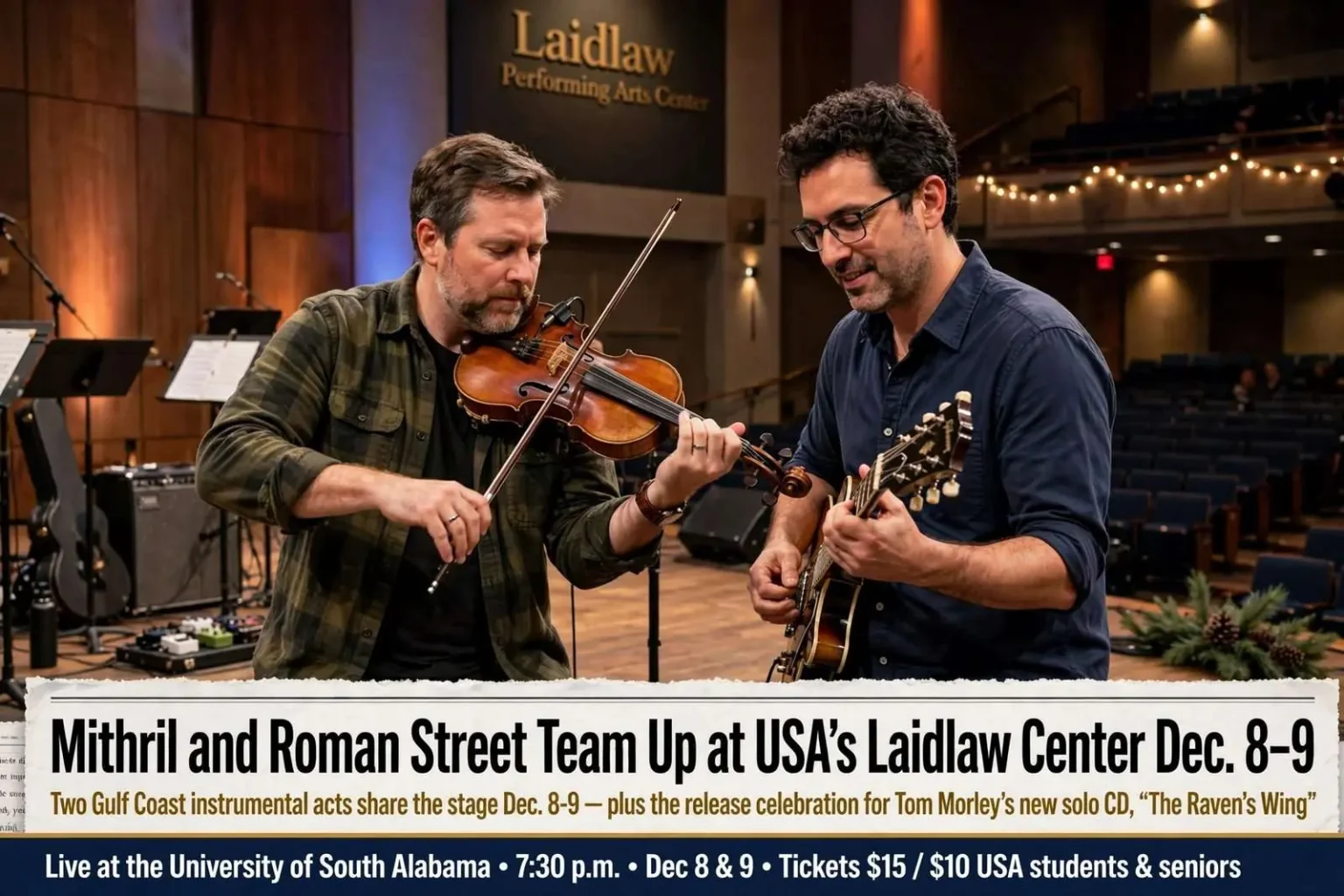
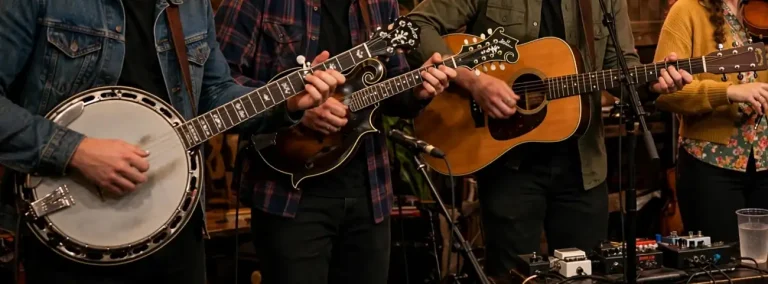
Two of the area’s best-known instrumental acts share a stage this week. Mithril and Roman Street perform solo sets and then together on Wednesday and Thursday, December 8 and 9, at the University of South Alabama’s Laidlaw Performing Arts Center.
The program draws favorites from both bands’ catalogs along with holiday fare, and the pairing of Mithril’s Celtic-tinged strings with Roman Street’s smooth instrumental grooves makes for an unusually wide sonic range in one evening. The concerts also double as a release celebration: Mithril fiddler Tom Morley unveils his new solo CD, The Raven’s Wing.
Showtime is 7:30 p.m. both nights. Tickets are $15 general admission, $10 for USA students, faculty, staff, and senior citizens, available through Brown Paper Tickets or 1-800-838-3006.
A Meeting of Two Gulf Coast Institutions
Mithril has spent years as a fixture of the Gulf Coast Celtic and acoustic scene, built around the interplay of fiddle, guitar and other traditional instruments and a repertoire that moves between driving jigs and reels and quieter, airier material. The band’s sound is grounded in Celtic tradition but is not confined to it, folding in influences from the broader acoustic world, and Tom Morley’s fiddle work sits at the center of that identity. The Laidlaw dates give Morley a formal stage on which to present The Raven’s Wing, his new solo recording, and the release-celebration framing means audiences can expect material from the CD woven into the band’s sets.
Roman Street, meanwhile, occupies the other end of the instrumental spectrum. Anchored by guitar and rooted in smooth Latin-tinged and contemporary instrumental styles, the band has built a following across the Gulf Coast for music that is breezy, technically polished and effortlessly suited to both listening rooms and festival stages. Where Mithril’s energy comes from the rhythmic drive of traditional dance music, Roman Street trades in texture and groove, and the contrast between the two approaches is precisely what makes a shared bill interesting.
The decision to perform solo sets and then combine forces is the rare structure that rewards fans of both bands. Each act gets the room to itself for a stretch, playing the material its audience came to hear. Then the combined portion of the evening lets the musicians stretch across genres — Celtic fiddle lines riding over Latin-inflected guitar rhythms, and the sort of unscripted ensemble moments that only happen when players of this caliber share a stage with no rehearsals left to hide behind.
The Venue: Laidlaw Performing Arts Center
The Laidlaw Performing Arts Center is the University of South Alabama’s purpose-built home for music performance in Mobile, a modern concert facility that hosts student recitals, faculty showcases, touring artists and community presentations throughout the academic year. Its concert hall offers the acoustics and sightlines that instrumental music of this kind deserves, and the university has consistently used the space to connect its academic music programs with the broader Gulf Coast arts audience.
For the university, hosting a double bill of established regional acts during the December stretch fits the pattern. The weeks around the end of the fall semester are traditionally filled with holiday-themed programming, and the promise of favorites from both bands’ catalogs alongside seasonal fare gives the Laidlaw dates an accessible, festive hook without reducing either band to a Christmas act.
The midweek timing — Wednesday and Thursday nights rather than the usual weekend — reflects how the university schedules its performance calendar, and it offers a different kind of night out for Mobile audiences: a seated, listening-room experience in a hall built for exactly this kind of program, well away from the bar-and-club circuit where both bands otherwise spend much of their touring lives.
The Raven’s Wing and a Fiddler’s Solo Moment
For Tom Morley, the dates represent something beyond the usual band appearance. A solo release is a fiddler’s statement of personal voice — the repertoire that reflects his own ear, the arrangements he shaped himself, and the studio work that went into the finished recording. Releasing it in the middle of two concerts with his band and a friendly counterpart act is a natural way to do it: the audience is already sympathetic, the stage is already built, and the material gets its first full airing in front of listeners who know his playing from years of Mithril shows.
Release-celebration concerts also carry a particular energy. Musicians playing new material for the first time before a hometown crowd tend to approach the stage with a mix of nerves and enthusiasm that audiences respond to, and The Raven’s Wing will be performed not as recorded artifact but as living setlist — pieces introduced from the stage, framed by the performer’s own account of where they came from, and delivered in a hall whose acoustics flatter an acoustic fiddle better than most rooms on the Gulf Coast.
That the release happens in December, framed by holiday fare, gives the new work a seasonal launching pad. December audiences on the Gulf Coast turn out reliably for programming that offers a break from the commercial rush of the season, and an evening of instrumental music — part Celtic, part smooth groove, part holiday — fits the mood of the month without demanding anything from the listener except attention and a seat.
Instrumental Music on the Gulf Coast
Both bands belong to a particular Gulf Coast tradition: the regional instrumental act that builds a career without a lead singer, gigging steadily, recording independently and developing a loyal audience through repetition and reputation. It is a harder road than the frontman path in some ways, because instrumental music must win listeners on the strength of arrangement, tone and interplay rather than lyrics. But the acts that succeed at it — and Mithril and Roman Street are the local proof — tend to keep their audiences for decades, since there is no trend-driven lyrical style to age out of fashion.
The region supports that kind of career better than many areas its size. The Gulf Coast’s calendar of festivals, gallery nights, concert series and seasonal celebrations provides steady work, and the universities on both sides of the bay supply venues, audiences and, often, students who go on to join the professional scene. A double bill at a university performance hall draws together those threads: the academic venue, the professional acts, and an audience that spans students, families and longtime followers of both bands.
It is also worth noting what the two acts’ pairing says about the depth of the local scene. A city the size of Mobile sustaining multiple full-time instrumental bands with distinct identities — one Celtic, one smooth-groove — is a sign of a healthy musical ecosystem, and the willingness of the two bands to share a stage, trade repertoire and perform together reflects the collaborative habits that keep such a scene alive.
The Practical Details
Both concerts begin at 7:30 p.m., with doors opening ahead of the show at the Laidlaw center on the USA campus. Tickets are $15 for general admission and $10 for USA students, faculty, staff, and senior citizens, and they are available through Brown Paper Tickets or by phone at 1-800-838-3006. Brown Paper Tickets handles ticketing for countless small and mid-sized venues nationally, and advance purchase is the safe play for a two-night run in a seated hall, where holiday-season demand and a double-bill draw can leave latecomers without the seats they want.
For the price of a movie and a little more, the evening offers two complete sets from two established bands, the combined portion where the two approaches meet, the local unveiling of a new solo recording, and a measure of holiday programming to mark the season. For Gulf Coast music fans, the Laidlaw dates are the rare midweek shows that justify rearranging an evening around — and they arrive with the built-in charm of a hometown release party for one of the scene’s most familiar fiddlers.
Why a Shared Bill Works
Joint concerts between distinct acts are harder to program than they look, and when they succeed it is usually because the musicians share more than an audience. Mithril and Roman Street both trade in instrumental craft, both favor arrangement and musicianship over volume, and both have spent long enough on Gulf Coast stages that their players know each other’s work. That familiarity is what makes the combined portion of these shows more than a novelty: the handoffs between fiddle and guitar, the reshuffled rhythm sections, and the repertoire played with doubled instrumentation all rest on players who already trust each other’s instincts.
For audiences, the structure also stretches the value of a single ticket. A night that moves from Celtic dance tunes to Latin-tinged groove and back again, with holiday material threaded through, delivers range that neither band alone would provide. Listeners who arrived for one band routinely leave with a new favorite, which is the quiet marketing engine behind every well-matched double bill and a big part of why both acts keep saying yes to shared stages.
The December 8 and 9 dates at the Laidlaw Performing Arts Center arrive, then, as a small convergence: two regional institutions, one new solo recording, a hall built for listening, and a season that rewards exactly this kind of evening. With tickets priced at $15 — or $10 for the university community and seniors — and available through Brown Paper Tickets or 1-800-838-3006, the practical barriers are about as low as live music gets. The only decision left for Mobile audiences is which of the two nights to attend, or whether to make an evening of both.