
Mo Brooks Dismisses Report of Trump ‘Buyer’s Remorse’ During Mobile Campaign Stop
Senate candidate Mo Brooks called a report of Trump's buyer's remorse baseless during a Mobile campaign stop, touting his record.
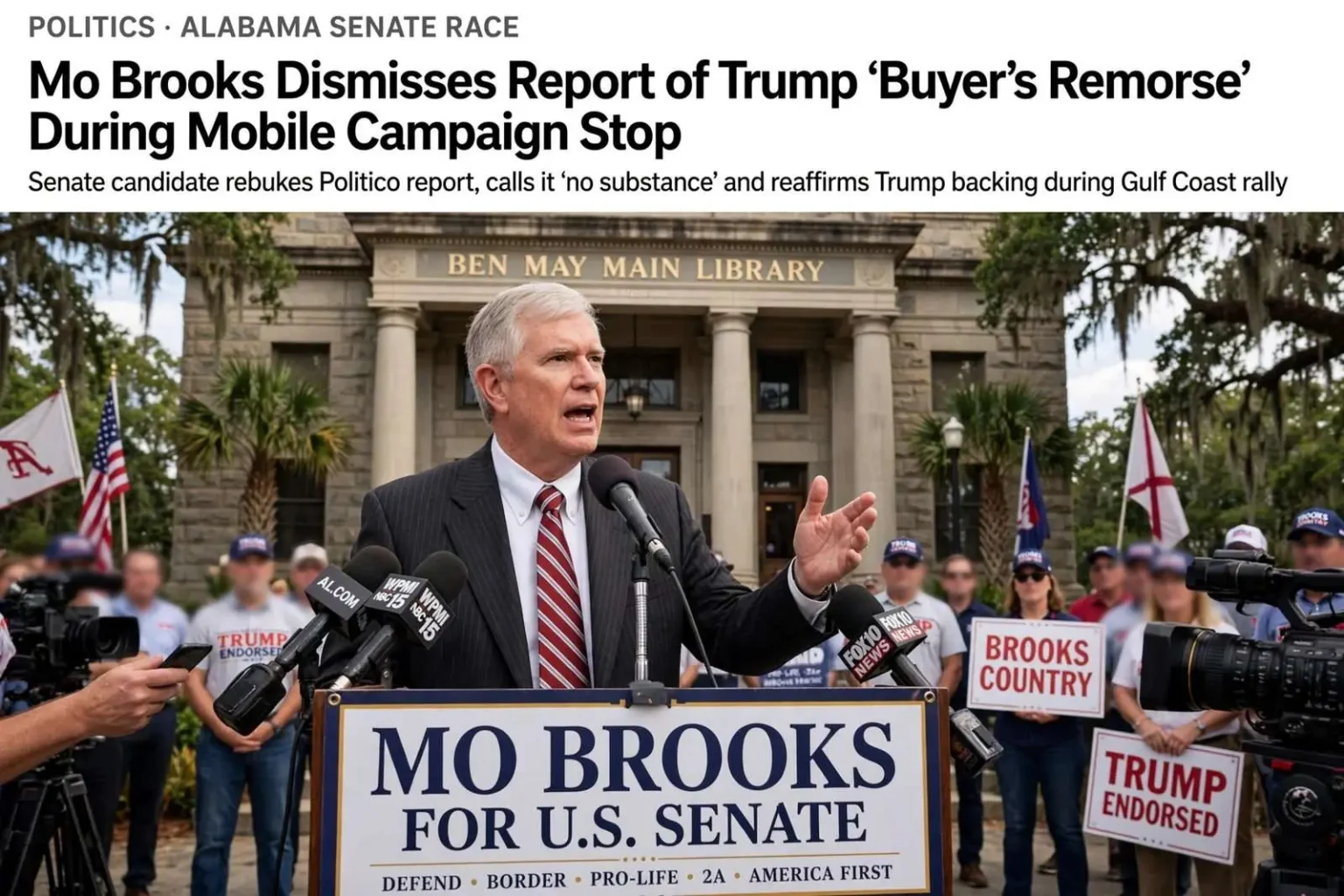
U.S. Senate candidate Mo Brooks brushed off a Politico report suggesting former President Donald Trump regretted endorsing him, telling reporters during a Mobile campaign stop that the story had “no substance.” The appearance gave the Huntsville congressman a chance to push back on the report in front of a friendly Gulf Coast audience and to reframe the narrative around a primary contest that had grown increasingly combative in its final stretch.
The Politico Playbook item, which relied on unnamed sources, claimed Trump was experiencing “buyer’s remorse” over his backing of Brooks and noted that rival Katie Britt had recently met with the former president at Mar-a-Lago. For a campaign whose central argument rested on Trump’s endorsement, even an anonymously sourced story about the endorsement’s health was more than a nuisance, and Brooks treated it as such, addressing it directly rather than letting it circulate unanswered.
Brooks pointed to what he called his endorsement scorecard against Britt, and said he had spoken with Trump just days earlier and that the former president remained enthusiastic about his campaign. He also cited support from Donald Trump Jr. and Sen. Ron Paul as evidence that his coalition extended beyond a single endorsement. His argument was essentially arithmetic: whatever Britt had accomplished with a Mar-a-Lago visit, his own list of Trump-world supporters was longer.
Brooks dismissed the Britt meeting as politically meaningless, saying all Britt needed to get into the resort was an invitation from anyone. The jab was characteristic of a campaign that had spent months positioning Brooks as the race’s authentic Trump candidate and characterizing his rivals’ conservative credentials as newer and less reliable than his own.
Responding to the Reporting
The response to the Politico story revealed how much weight each campaign placed on the perception of Trump’s favor. In a Republican primary where the former president’s endorsement had proven decisive in races across the country, anonymous reporting that the endorsement might be wavering carried the potential to shift donations, endorsements from state officials, and ultimately votes. Brooks’s team clearly calculated that the story could not go unanswered.
Brooks also denied allegations he had sought an endorsement from former U.S. Attorney General Jeff Sessions, calling the rumors false. The Sessions question carried particular sensitivity in Alabama, where the former senator and attorney general remained a complicated figure — beloved by many grassroots conservatives, yet politically diminished in Trump’s eyes after their falling out. Any hint that Brooks had quietly sought Sessions’s backing risked undermining his own Trump-first branding.
While acknowledging he and Sessions had spoken generally, Brooks said he hadn’t even asked Sessions to put up a yard sign. He defended Sessions as “a very good senator,” saying Trump would agree — a careful formulation that kept his distance from the former attorney general’s rift with the former president while declining to disparage a longtime Alabama political figure whose supporters were still listening.
The exchange over Sessions highlighted the delicate map Alabama Republicans were navigating in the race to succeed retiring Sen. Richard Shelby. Shelby’s decision to step aside after decades in Washington opened one of the most powerful Senate seats in the state’s history, drawing a crowded field of candidates and enormous outside attention. Every candidate in the race needed conservative credibility, and every claim to it invited scrutiny from rivals and voters alike.
Drawing Contrast With Rivals
Brooks took aim at both top-tier opponents, Britt and Mike Durant, questioning their conservative credentials and pointing to his own voting record. The contrast he drew rested on longevity and receipts: a decade-plus of House votes that could be scored, rather than biography and business credentials that had to be taken on faith. Durant, a businessman and former Army helicopter pilot, and Britt, Shelby’s former chief of staff and a former president of the Business Council of Alabama, both presented themselves as outsiders to Washington in ways that Brooks’s twelve years in Congress could not.
Brooks’s answer to that framing was his record, which he described as the House’s best on border security, along with strong ratings from pro-life and Second Amendment groups. In an Alabama Republican primary, those three issues — immigration, abortion, and guns — form the backbone of the conservative scorecard, and Brooks argued that his ratings and his role in immigration debates showed a consistency his rivals could not match.
The Mobile stop was his second Gulf Coast appearance of the week, a scheduling choice that acknowledged the region’s importance in statewide Republican primaries. While the Black Belt and north Alabama often anchor the conservative base vote, Mobile and Baldwin counties deliver some of the largest Republican vote totals in the state, and candidates who neglect the coast do so at their peril. Speaking at the Ben May Main Library placed Brooks in the heart of downtown Mobile, blocks from the business and civic institutions whose support statewide campaigns compete for.
Defense Contracts and the Coast
On defense policy, Brooks argued federal contracts should go to whichever firms can deliver better, faster and cheaper — a subject with clear stakes in Mobile, where Austal USA builds Navy ships on the Mobile River. Austal’s shipyard, one of the largest employers in the city, has produced littoral combat ships and expeditionary fast transport vessels for the Navy, and the yard’s fortunes rise and fall with Pentagon procurement decisions made thousands of miles away.
Brooks also noted that Airbus and Lockheed Martin were preparing to compete for the LMXT Strategic Tanker contract, a program with enormous implications for Mobile’s industrial future. The tanker competition pitted an Airbus-based airframe against a Boeing offering, and a win for the Mobile team would have added thousands of jobs at the Brookley Aeroplex, where Airbus already assembles commercial jetliners. For a candidate courting Gulf Coast voters, defense procurement was not an abstract policy debate but a pocketbook issue.
Brooks cited Alabama installations including Redstone Arsenal, Fort Rucker, Maxwell Air Force Base, and the Anniston Army Depot as proof of the state’s defense strength. The list spans the state: Redstone Arsenal in Huntsville anchors missile defense and space programs; Fort Rucker in the southeastern part of the state is the Army’s aviation training hub; Maxwell Air Force Base in Montgomery hosts Air University; and the Anniston Army Depot maintains combat vehicles and missile systems. Together they make defense one of Alabama’s largest economic engines, and any senator from the state inherits the job of protecting them.
He said his 12 years representing north Alabama — and his seat on the House Armed Services Committee — showed the prosperity defense work can bring. Huntsville’s growth into one of the South’s strongest economies, driven by federal installations, contractors, and engineering talent, served as Brooks’s implicit pitch to Mobile: what defense investment did for the Tennessee Valley, smart procurement could do for the Gulf Coast. His argument was that a senator with committee experience and defense credentials would be better positioned than either rival to win contracts for the Port City.
The pitch acknowledged the political reality of the region. Mobile’s economy runs through the port, the shipyard, the aerospace corridor at Brookley, and the tourism and chemical industries along the coast, and federal decisions touch each of them. A candidate who could speak knowledgeably about shipbuilding schedules and tanker competitions had a natural audience in a city where dockworkers, welders, and engineers all track Pentagon budgets.
The Campaign’s Broader Stakes
The Mobile appearance came at a pivotal moment in the Republican primary, with early voting approaching and the field’s top contenders separating themselves from the rest. Brooks entered the race with the Trump endorsement and a deep base of support in north Alabama, but Britt had the backing of much of the state’s business establishment and Durant had invested heavily of his own money in advertising. The contest for the state’s conservative identity played out in stops like this one — library meeting rooms, civic clubs, and campaign events across all 67 counties.
For Brooks, the strategy on display in Mobile was to weather the Washington-generated turbulence and keep the focus on the contrast he had drawn since the campaign’s start: the candidate with the longest conservative record, the strongest Trump ties, and the most specific plans for Alabama’s defense economy. Whether the Politico report had any substance, as he insisted it did not, the episode underscored how much the race revolved around one question — which candidate Alabama Republicans believed would carry Donald Trump’s banner most faithfully into a Senate seat that, with Shelby’s retirement, was up for grabs for the first time in a generation.
The answer Brooks offered at the Ben May Main Library was the same one he had been giving on stages across the state: listen to the scorecard. He had the endorsement and the endorsements behind the endorsement, a voting record scored by the groups Republican primaries reward, and a defense portfolio that stretched from Huntsville’s missile programs to Mobile’s shipways. His rivals, he argued, had biographies; he had receipts. As the primary fight moved from courthouse squares to television screens in the race’s final weeks, that distinction was the case he would keep asking Gulf Coast voters to take on faith — and the one Britt and Durant would keep trying to dismantle.


