Mobile-Area Residents Push Back on Bridge Tolls and Civic Center Redevelopment Plans
Mobile-area residents are voicing growing frustration over a proposed toll on a new Mobile River Bridge and a Cordish Companies plan to raze the Civic Center, even as officials say both proposals remain in early, fluid stages.
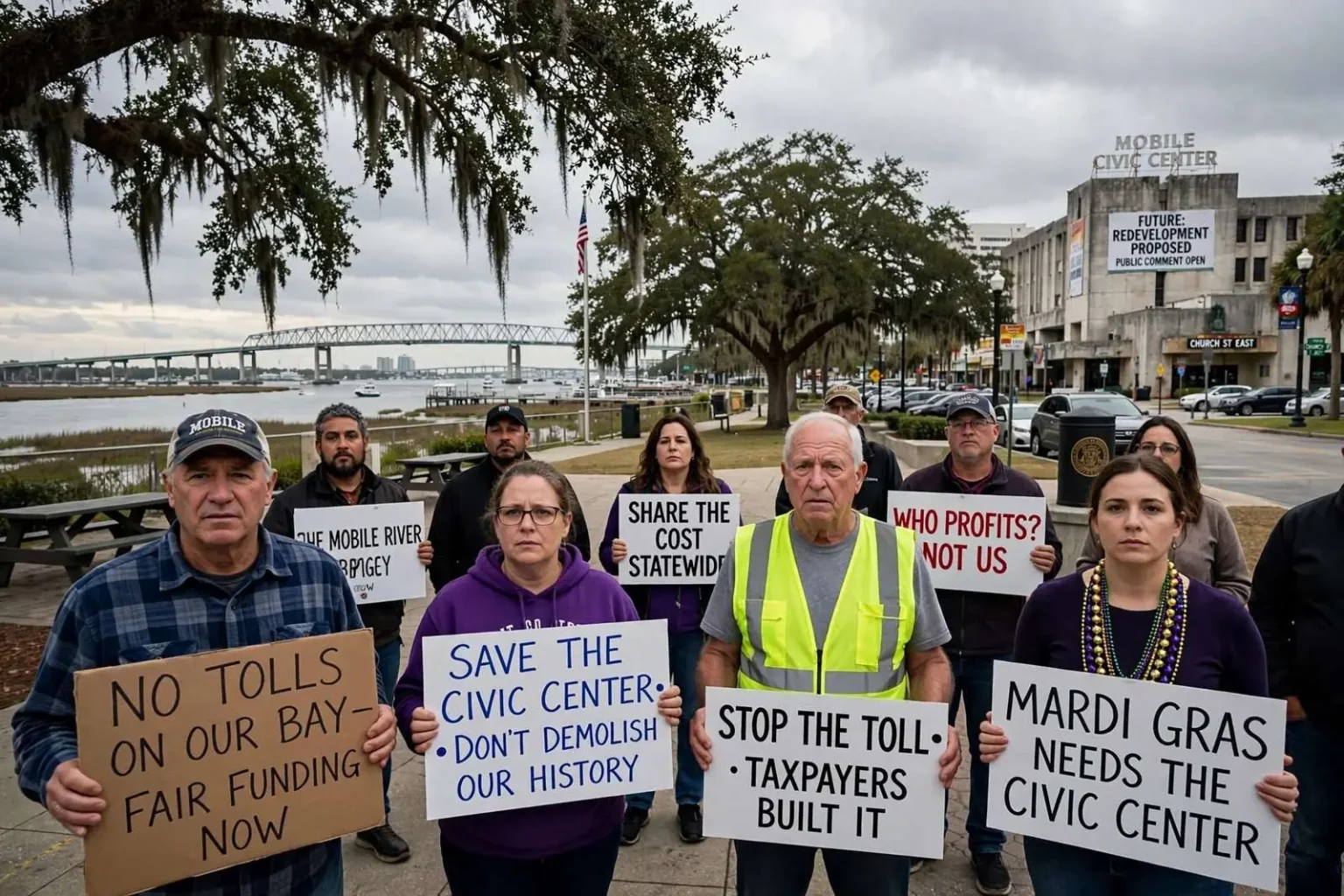
Frustration is building among Mobile-area residents over two unrelated but closely watched local issues: a proposed tolling plan for a new Mobile River Bridge and Bayway, and a redevelopment concept for downtown Mobile’s aging Civic Center. While the two matters have little in common on paper — one a multibillion-dollar interstate project, the other a question of what to do with a downtown block — both have drawn sustained public criticism in recent weeks as officials work through early-stage proposals that residents say raise more questions than answers.
The Tolling Debate
The tolling debate centers on a long-discussed plan to replace the Interstate 10 bridge over the Mobile River and widen the adjoining Bayway, the elevated stretch of I-10 that carries traffic across Mobile Bay. State transportation officials say the project is necessary to relieve chronic traffic congestion and improve safety on one of the region’s busiest corridors — the bottleneck where interstate traffic from Florida, the port district and downtown Mobile funnels through the George C. Wallace Tunnel and onto the Bayway. The proposal has been paired with a plan to charge tolls to help finance construction, a detail that has generated significant backlash among Coastal Alabama commuters who would bear the direct cost of crossing the bay.
Critics of the toll proposal argue that a private company should not be allowed to profit substantially from a public roadway, and many say any toll should be structured as a modest, time-limited fee tied strictly to covering construction costs rather than generating long-term revenue for outside investors. The distinction matters to commuters who cross the bay daily for work: a toll that retires with the construction debt reads to them as user fee, while one that pays investors in perpetuity reads as privatization of a road their taxes already built and maintain.
Others have raised a broader equity argument, noting that residents living well away from the coast benefit from coastal infrastructure and tourism revenue and should share in funding it, much as money from the 2010 Deepwater Horizon oil spill settlement was distributed on the premise that the entire state was affected by the disaster. That argument — that Alabama’s beaches and port drive statewide prosperity, and that the roads serving them are therefore a statewide obligation — has become a fixture of the public comment periods and town halls surrounding the project.
The public pushback has not gone unnoticed in Montgomery, where state lawmakers and transportation officials have found themselves fielding pointed questions from constituents about the toll structure and the project’s overall cost. Local elected officials, several of whom sit on the regional planning body that must ultimately sign off on the project, have faced similar scrutiny as they try to balance the demonstrated need for a new bridge against strong resistance to how it would be paid for. The regional planning organization’s approval is a genuine gate: without its sign-off, federal funding for the project cannot advance, which gives local skepticism real leverage over the project’s schedule.
The Civic Center Question
Separately, plans to redevelop the Mobile Civic Center site have generated their own wave of public concern, even if the reaction has been somewhat less intense than the response to the toll proposal. Maryland-based Cordish Companies has proposed razing the existing arena, which has served as a downtown event venue for decades, and replacing it with an outdoor entertainment district featuring themed restaurants, bars and gathering spaces — the same open-air concept the company has developed in other cities, and the same model behind its Live! branding.
Residents and downtown business owners have raised a series of pointed questions about the concept since it became public. Many want to know why the city would demolish a venue that hosts Mardi Gras-related events and other large gatherings without a clear replacement plan for that programming. Mobile’s Carnival season depends on the Civic Center’s calendar of balls and events, and the venue’s loss without a successor would leave some of the city’s oldest social institutions without a home for the masked balls and benefits that anchor the weeks before Fat Tuesday.
Others have questioned how a large, subsidized entertainment complex would affect existing downtown restaurants and bars that would suddenly be competing with a heavily promoted new development. Downtown Mobile’s dining and nightlife scene has grown over two decades of private investment, and owners who built that scene without public subsidies have asked why a national developer arriving with city support should be positioned to capture the same customers.
Additional concerns have focused on the pace of the process, including why Cordish Companies emerged as the lead contender relatively early and whether other developers were given a fair opportunity to compete for the project. In a city where public projects have a history of drawn-out selection fights, the speed with which one national firm became the presumptive partner struck many observers as a process question that deserved a straight answer.
City officials have responded to the criticism by emphasizing that the Civic Center discussions remain in an early, fluid stage, and that the specific plans presented publicly so far are not necessarily final. Officials have said future iterations of the project could look different from initial renderings and have not ruled out preserving some form of arena or event space on the site — a caveat that has become the one point on which critics and city hall agree matters most.
What Comes Next
Both debates are expected to continue playing out over the coming months as the regional planning organization weighs whether to advance the bridge and toll plan, and as city leaders continue evaluating options for the Civic Center property. For now, residents on both sides of the bay appear united in wanting more clarity before either project moves forward with public money attached.
The two controversies, for all their differences, share a common structure. In each case, officials present a vision backed by a named outside partner — a developer in one instance, a financing structure in the other — and residents respond not by disputing the underlying need but by questioning the terms. Nobody seriously argues that Mobile Bay traffic doesn’t need relief, just as few argue the Civic Center site shouldn’t be redeveloped. The fights are over who pays, who profits, and who decides, and those questions have a way of outrunning the engineering and architectural drawings that accompany them.
The Mobile River Bridge project has been studied in one form or another for years, and its scale dwarfs anything else on the region’s transportation agenda. The current crossing — the Wallace Tunnel and the Bayway — carries interstate traffic through a corridor designed for a smaller city, and congestion there has become a daily fact of life for commuters between Mobile and the Eastern Shore. Port officials add another concern: freight movement through one of the nation’s growing deepwater ports competes with commuter traffic for the same pavement. A new crossing, planners argue, would separate through traffic from local movement and open capacity that the region’s growth will demand regardless of how the tolling question is resolved.
But the tolls have transformed a transportation debate into a political one. Commuters calculate the annual cost of a daily crossing, businesses on the Eastern Shore worry about customers who will think twice before driving into Mobile, and residents of communities far from the bay ask why they should tolerate investor returns on a road in someone else’s backyard. The Deepwater Horizon comparison circulating in public comment has become the sharpest version of that argument: if the entire state shared in the spill’s consequences and its settlement money, the logic goes, the infrastructure that protects and serves the coast should be shared as well.
The Civic Center, meanwhile, carries its own weight of history. Generations of Mobilians attended graduations, concerts, boat shows and Carnival balls inside its halls, and any redevelopment that erases the venue without replacing its function risks severing downtown from the traditions that bring people into it. The Church Street East neighborhood and the city’s Carnival organizations have been among the most attentive audiences for the redevelopment proposals, precisely because their calendars depend on what gets built — or doesn’t — on the block.
What happens next depends on institutions rather than ribbon-cuttings. The regional planning body’s vote will determine whether the bridge and toll plan advances toward federal review, and the city council’s posture toward Cordish Companies will shape whether the entertainment district concept survives its public vetting. Both decisions will be made with the same electorate watching, an electorate that has made itself clear: bring the projects, but bring the details first.
Until then, expect the questions to keep coming at every public meeting where either project appears on the agenda. That is not obstruction, whatever officials privately think of it — it is what a region looks like when its residents understand that the decisions now on the table, about a bridge toll and a downtown block, will shape Mobile’s daily life for decades longer than the meetings that decide them.