University of South Alabama Mobile
Mobile arts calendar packs in piano contest milestone, historian’s lecture and opera scholarships
A 50th-anniversary piano competition, a University of Mobile lecture by historian Wayne Flynt marking Alabama's bicentennial, and newly announced winners of Mobile Opera's Madame Rose Scholarship Competition highlight a busy week for the Mobile arts scene.
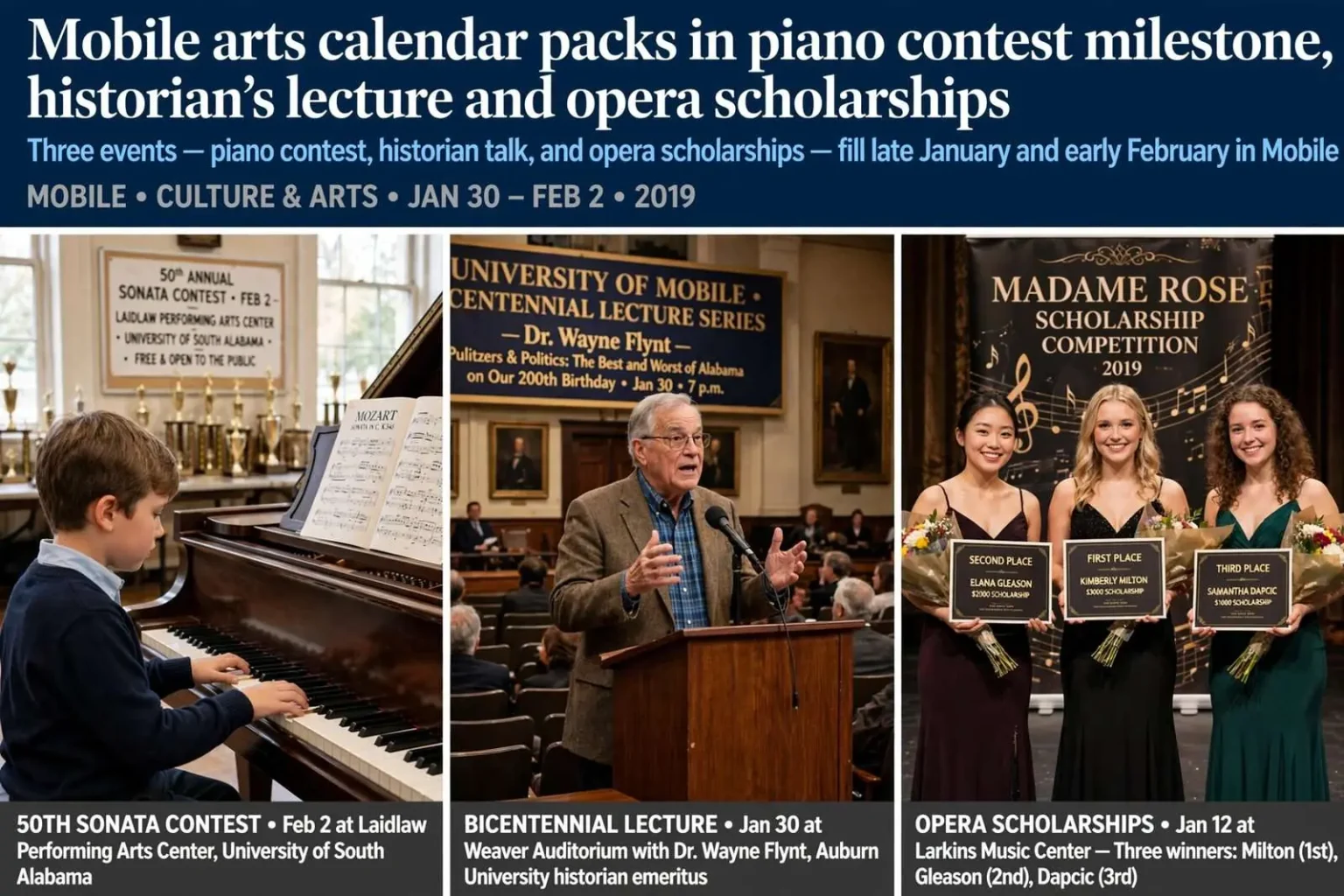
Mobile’s arts calendar is especially full this week, with a milestone piano competition, a visit from one of Alabama’s most decorated historians and the announcement of scholarship winners in a prestigious opera competition all happening within days of one another.
Three institutions, three audiences and three different corners of the arts world — all converging on a stretch of late January and early February that turns the city’s classrooms, auditoriums and rehearsal halls into a single, very busy cultural district. Taken together, they trace the pipeline Mobile’s music community has built for its students: a first trophy at a piano contest, a lifetime of study, and eventually a scholarship check toward a professional career.
A 50th Contest on University Grounds
The Mobile Music Teachers Association will hold its 50th annual sonata contest on Feb. 2 at the Laidlaw Performing Arts Center on the University of South Alabama campus. This year’s contest drew 217 participants across 20 levels of difficulty, ranging from beginning students up through college level and noncompetitive adult musicians.
Competitors will perform individually for judges in rooms throughout the Laidlaw facility before everyone gathers in the concert hall later in the day for the awarding of trophies. The event is free and open to the public. The format — dozens of small practice rooms turned into judging stations for a day — means the building hums from morning to afternoon with the same handful of sonata movements played in every key, by hands of every size, from first-year beginners to adults who kept their lessons going for the love of it.
“We think it’s a big deal,” MMTA Parliamentarian Vincentine Williams said, noting that she and fellow instructors, including University of South Alabama faculty member Dr. Holm and Lin-ya Hsu, have entered the most students in the contest over the years.
Williams, who chaired the contest for 18 years, said turnout has fluctuated significantly over the decades. The high-water mark came in 1987, when nearly 500 students took part; last year’s contest drew 256 participants. “One year I might have 10 trophy winners and the next year not have any. It’s just how they prepare,” she said.
Williams has taught music for 40 years, though she didn’t move to the Mobile Bay area until the late 1970s. In that time, she said she has watched generations of students pass through the program, later returning as parents to bring their own children to the awards ceremony. Some have gone on to build careers in music, including a niece Williams began teaching at age 3, who traveled from Mississippi each year to compete and went on to earn a doctorate before joining the vocal performance faculty at Troy University.
The Laidlaw center itself has become the anchor venue for events like this on campus. As USA’s performing arts home, its mix of practice rooms, faculty studios and a full concert hall lets a single-day contest run without moving participants across town, and the university’s music faculty have long worked alongside the independent teachers who make up MMTA’s ranks. For the students, performing in the same building where college recitals happen is part of the contest’s quiet curriculum: a first trophy won on a real stage, in front of real judges, in a hall built for exactly this work.
The Mobile Music Teachers Association was founded in 1919 and launched the sonata contest to mark its own 25th anniversary, meaning the group itself will soon approach the century mark. It is an affiliation of independent music teachers who instruct students out of home studios, a model Williams said has been squeezed in recent years by the growing prevalence of lessons offered through retail music stores. She said part of the group’s mission is reminding the public that independent instruction is still thriving in the area.
The distinction matters to the teachers themselves. A home-studio instructor typically follows a student for years — through recitals, contests like this one, and the auditions that come after — while store-based programs tend to run on rotating staffs and subscription schedules. The association’s century of continuity is its argument: the contest’s trophies have been awarded under the same institutional roof since the era of player pianos, and the teachers who run it know their students as families, not accounts.
“There are studies that show music instruction does more, as compared to other art forms, to help the brain,” Williams said. “We’re building future responsible citizens, people that are responsible and disciplined and understand the value of hard work, because it does take hard work.”
That case — music as training for everything else — is why the contest puts beginning students on the same program as college-level players. A seven-year-old who watches a teenager receive a trophy in the Laidlaw concert hall is, in the association’s view, being shown the point of the next decade’s worth of practice scales.
Flynt on Alabama at 200
Separately, the University of Mobile will mark the state’s bicentennial with an appearance by acclaimed historian Dr. Wayne Flynt at the school’s Weaver Auditorium on Jan. 30 at 7 p.m. Flynt, professor emeritus of history at Auburn University, will deliver a lecture titled “Pulitzers and Politics: The Best and Worst of Alabama on Our 200th Birthday.” The event is free and will include a book signing.
Flynt began his academic career as a ministerial student at Samford University before double-majoring in history and speech. He went on to earn a doctorate from Florida State University and spent 40 years teaching at Samford and Auburn, where he collected 18 teaching awards along the way.
The lecture’s title also signaled the shape of the evening. “Pulitzers and Politics” put the state’s literary record — the writers who carried Alabama stories to national prizes — alongside the political record that produced both its triumphs and its self-inflicted wounds. That pairing has been the through-line of Flynt’s career: he has spent four decades arguing that the state’s history cannot be told honestly without both, and bicentennial audiences across Alabama turned out in numbers that suggested he was not alone in wanting the full accounting.
He has lectured internationally, including appearances at Oxford and Cambridge universities, and his scholarship has ranged across religion, poverty and literature in addition to traditional history. Flynt has authored 11 books, two of which received Pulitzer Prize nominations, and published a memoir, “Keeping the Faith,” in 2011. He has also been the subject of two Alabama Public Television documentaries and received a Doctor of Humane Letters from Samford in 2000.
A Flynt lecture on the state’s 200th birthday carried its own weight in Alabama’s bicentennial year. His work — from studies of Alabama’s poor and its congregations to close readings of Harper Lee’s fiction — has made him one of the state’s most respected and most quoted public historians, and a “best and worst of Alabama” theme promised the kind of frank reckoning his audiences expect. The bicentennial, observed statewide through 2019, gave schools, universities and museums a ready occasion for exactly this kind of event, and the University of Mobile’s campus in west Mobile drew a free-admission audience that could stay for the book signing afterward.
Opera Scholarships at the Larkins
In the world of opera, three scholarship winners have been named in the 2019 Madame Rose Scholarship Competition, held Jan. 12 at the Larkins Music Center. The competition drew 10 finalists from five states in the Southeast, all vying for cash scholarships to help fund their college and graduate-level studies.
Kimberly Milton of Valdosta State University took first place, followed by Elana Gleason of LSU in second and Samantha Dapcic of the University of North Texas in third. Joanna Burrell of Georgia State University received honorable mention. The remaining finalists were Samantha Anselmo, Natalie Bodkin, Christine Cummins, Carol Marie Gomez, Kyle Melton and Monica Music.
The competition is named for the founder of Mobile Opera, and this year’s finalists were judged by a panel of opera industry professionals that included Kathleen Halm, Tyler Smith and Betsy Uschkrat. The Larkins Music Center, home to Mobile Opera and the Mobile Symphony in the city’s cultural corridor, gives young singers a professional stage — and a professional judging panel — at exactly the point in their training when the gap between a college recital and a working career is widest.
For a city of Mobile’s size, the concentration is unusual: a 50-year piano contest, a bicentennial lecture from a Pulitzer-nominated historian, and a scholarship competition drawing singers from five states, all within a week. The connections run deeper than scheduling. Many of the piano students who lined up for judging rooms at Laidlaw two Saturdays ago were, in the teachers’ longer view, the audience and the applicants for everything else on that calendar — which is, in the end, how a city keeps an arts life going from one generation to the next.