Mobile Arts Council Unveils Inaugural MobTown Mural Festival for September
The Mobile Arts Council has announced the inaugural MobTown Mural Festival, a two-day public art event set for Sept. 12-13, 2026, in downtown Mobile.
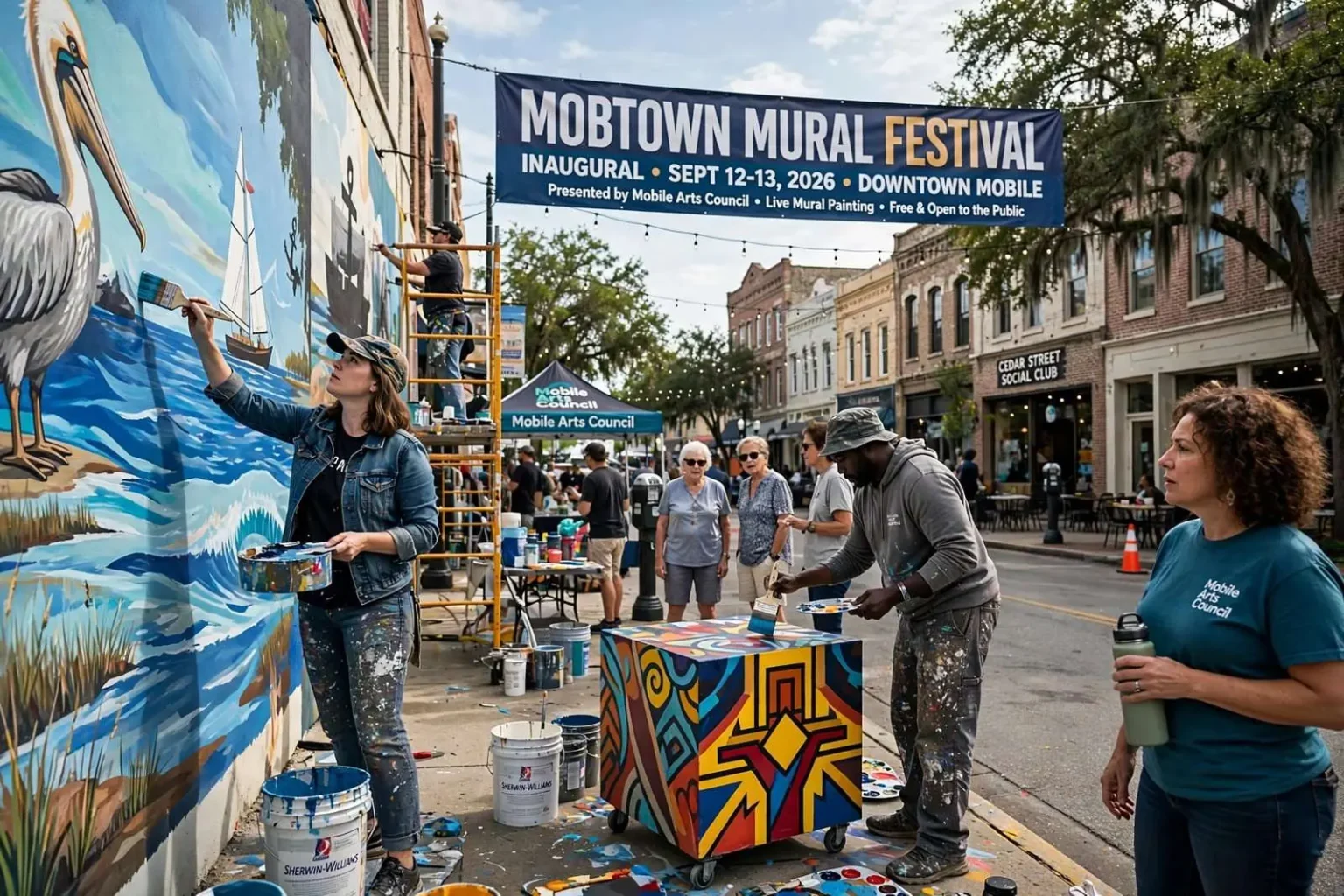
The Mobile Arts Council has announced the inaugural MobTown Mural Festival, a two-day public art celebration set for Sept. 12-13, 2026, that will bring local and visiting artists together to create new murals throughout downtown Mobile. Billed as Mobile’s first large-scale mural festival, the event will invite the public to watch live mural painting on walls as well as on three-dimensional, 4-foot-by-4-foot cubes placed throughout downtown. For a city whose historic district is already defined by centuries of architecture, the festival adds a contemporary visual layer — large-scale art made in public, in real time, where anyone walking by can watch a blank wall become a finished work over a single weekend.
Organizers say the festival will transform walls, public spaces and unexpected corners of the city into works of art, creating what they describe as a lasting visual legacy while showcasing Mobile’s growing creative community. Throughout the weekend, residents and visitors will have the chance to watch artists at work, meet the muralists behind the pieces and experience downtown Mobile through a new artistic lens, according to the Arts Council. The format borrows from mural festivals that have reshaped streetscapes in cities across the country, where the public painting process itself becomes the attraction: audiences return over the course of a weekend to watch a piece advance from sketch to scaffolding to finished wall, and the artists become part of the event rather than working unseen before or after it.
A curated roster of artists
The festival will feature a curated roster of artists chosen for their creativity, technical skill and ability to produce site-specific work that reflects Mobile’s culture, history and spirit. Site-specific selection means each artist will be matched to a location that suits the work, so that the murals respond to their surroundings — a wall near the waterfront may take on the city’s maritime story, while pieces in the historic core can draw on the neighborhoods around them. Curated rosters, as opposed to open calls alone, are how mural festivals maintain quality control and ensure that the works that will stand for years are made by painters with the scale and durability the medium demands.
In addition to permanent wall murals, the event will include large, movable murals strategically placed around the downtown area, giving organizers flexibility in how and where the art appears throughout the weekend. The movable format, along with the 4-foot-by-4-foot cubes, extends the festival beyond the walls that have been secured for permanent painting, letting organizers activate plazas, parks and pop-up locations that could not host a full wall project. It also gives businesses and property owners a lower-commitment way to participate, and it means the festival’s footprint can grow in later years as the movable pieces find permanent homes.
“MobTown Mural Festival is an exciting milestone for Mobile’s arts community,” said Angela Montgomery, executive director of the Mobile Arts Council. “Public art has the power to bring people together, create a sense of place, and inspire civic pride. This festival will not only beautify our city but also create the opportunity for visitors and residents to experience live art in action.” Montgomery’s framing places the event in the council’s larger mission of connecting working artists with the public, and the choice of a downtown-wide canvas reflects how arts organizers across the country have come to treat murals as infrastructure for civic identity rather than one-off decorations.
The name itself signals the ambitions behind the event. MobTown has long been a nickname Mobile residents use with affection, and attaching it to a signature arts festival claims the term for the city’s creative side. Cities that have launched similar festivals have watched them become annual anchors that draw visitors specifically to see the art, put local artists on national radar, and give residents a recurring moment of pride in how their streets look. Mobile’s version, if it follows that path, would add a contemporary arts draw to a downtown calendar already known for its festivals and events.
Part of a larger public art push
The Mobile Arts Council describes the festival as part of its ongoing commitment to expanding public art opportunities and making the arts more accessible to residents across the city. Organizers say the event is designed to do more than decorate downtown walls — it is meant to create a sense of place and give the public a chance to engage directly with working artists rather than only viewing finished pieces after the fact. That access cuts both ways: residents get to see the labor and decision-making behind large-scale work, and artists get an audience and a platform that galleries alone cannot provide, particularly for painters whose medium is inherently public.
Accessibility is the thread running through the council’s description. Public art meets people where they are — on the sidewalk, outside a shop, on the way to work — and reaches audiences who may never enter a gallery or buy a ticket to an opening. By concentrating the festival in downtown Mobile, where foot traffic is heaviest and the pedestrian grid makes walking between sites easy, organizers are building an event that families, tourists and daily commuters can all encounter without planning or admission, during a September weekend built around watching art happen.
For downtown property owners, the festival answers a question that mural movements in other cities have already settled: what to do with large blank walls. Parking structures, service walls, the sides of warehouses and the backs of commercial buildings make up a surprising share of any downtown’s visual surface, and mural programs turn that inventory into canvas. Property owners gain a maintained, rot-resistant painted surface and a foot-traffic draw; the public gains art; and artists gain walls that a gallery scene of Mobile’s size could never supply. The cube sculptures extend the same logic to spaces with no wall at all.
The economics of mural festivals also explain the longer lead time organizers describe. Large-scale outdoor painting requires paint, lifts, scaffolding, wall preparation, sealant and permits, and quality exterior work must be planned around weather and wall conditions. That is why the Arts Council has structured the announcement as the opening of a longer runway: additional details about the festival, including the list of participating artists, specific mural locations and event sponsors, are expected to be announced in the coming months as planning continues. Organizations and businesses interested in sponsorship opportunities, offering wall space, or volunteering during the event are encouraged to contact the Mobile Arts Council directly for more information on how to get involved.
What the weekend could leave behind
The lasting legacy is the part organizers emphasize most. Festivals end on Sunday evening; the murals stay. A successful first year would leave downtown Mobile with a cluster of new large-scale works that photograph well, map easily and age into landmarks that residents use for directions and visitors seek out deliberately. The movable murals and painted cubes extend that legacy into the following months as they circulate or find permanent placements. Cities that have invested in public art at this scale consistently report the same returns: higher pedestrian traffic, longer visitor stays and a stronger sense that the downtown belongs to the people who live there.
For Mobile’s artists, the festival arrives as a professional opportunity as much as a celebration. Mural work is a specialty — it requires scaling up compositions, working at height, mixing durable exterior materials and painting fast enough to finish a wall in days — and festivals are where regional painters build those portfolios and reputations. Pairing local artists with visiting muralists puts those skills in the same workspace for a weekend, and the relationships formed over shared scaffolding are how national mural circuits come to include smaller Southern cities. If the inaugural MobTown Mural Festival delivers what its organizers describe, September 2026 will mark the point where Mobile’s walls became part of the city’s cultural argument — and where the public got to watch it happen, brush stroke by brush stroke, in the middle of its own downtown.
September is a deliberate choice of season for the debut. Mid-September offers Mobile some of its most manageable outdoor working weather of the year, sitting after the peak heat of summer and ahead of the fall festival rush that fills downtown weekends through October and Mardi Gras season into spring. The two-day format also matches the working reality of mural painting: a large wall can be sketched, blocked in and substantially finished across a long weekend, so the public watches genuine progress each day rather than an already-complete reveal, and artists finish their pieces in front of the crowds that followed them.
The festival also arrives as Mobile’s downtown continues its decades-long reinvention as an entertainment and residential district. Investment in Dauphin Street and the surrounding blocks has turned the core into the region’s gathering place, and every addition to downtown’s public realm — streetscape work, park improvements, now murals — compounds the effect that keeps people visiting and living in the historic center. The Arts Council’s festival is timed to add the most shareable, most photographed kind of public improvement there is, in exactly the blocks where the foot traffic can carry it furthest.
How residents can take part
Organizers have structured the run-up so the community shapes the event before the first can of paint is opened. Businesses that want a mural but lack a wall have the movable and cube formats; owners of prominent blank walls can offer them through the council; sponsors can attach their names to individual pieces or to the festival itself; and volunteers will be needed for the logistics that a downtown-wide painting weekend requires. Residents can follow the council’s announcements over the coming months for the artist roster and site map, which will let locals plan a walking route through the weekend’s active painting sites.
The council’s pitch, in the end, is straightforward: Mobile has the walls, the artists and the audience, and a mural festival is the mechanism that connects them. What gets painted in September 2026 will reflect the city’s own character, chosen by a local arts organization and made by painters matched to each site, in front of the residents who will live with the work for years. It is a rare kind of civic project in that the process is the show — and Mobile will get to stand in the street and watch its own downtown gain a new layer of color, one wall at a time.
Update: The Selected Artists
Mobile Arts Council has announced the artists selected for the inaugural festival, which runs Sept. 12-13 from 10 a.m. to 5 p.m. each day in downtown Mobile. More than 65 applications were submitted.
The selected artists are Hannah Legg, Gary Brady, JD Swiger, Apollo, Jenyes, Rachel Schwemin, Brian Tan, David Rojas Pacheco, Greg Crimmins, and Christy LeGros’ Barton Art Class students.
Where the Work Will Happen
Three full-scale mural sites will be transformed during the festival: the Jimmy Buffett mural wall at the National Maritime Museum of the Gulf, the Mobile Mysticks mural wall at Cedar Street Social Club, and the west-facing wall of Innovation Portal.
Five marine-grade four-foot-by-four-foot cubes will also be painted live by artists in Cooper Riverside Park. Once completed, those cubes become additional public art pieces that can be displayed throughout Mobile’s parks and public spaces — a portable form of public art that can be rotated between locations rather than fixed to one wall.
Artists were invited to submit designs for either a full-scale mural or one of the cubes. The call for artists encouraged designs inspired by the Gulf Coast and influenced by Mobile’s culture, landscape, history and lifestyle.
From Competition to Collaboration
The festival marks a shift in Mobile Arts Council’s annual public art programming. After 13 consecutive years of The Throwdown — an event that challenged artists to compete for the Throwdown title belt — the council is moving its focus from competition to collaboration and creation.
“When we place value on our creatives and give them ownership in the city they call home, beautiful things are possible,” said Jessica Jones, community engagement coordinator for Mobile Arts Council. “Public art strengthens our creative currency and helps shape the culture and identity of our community. We are thrilled to exercise our creative community muscles and put Mobile’s incredible artists on full display as they paint the town red, blue, yellow — or whatever colors they choose.”
“Mobile Arts Council believes that when a community embraces its artists, it has the opportunity to create the cityscape it wants to live in,” Jones said. “Public art creates a sense of place, draws visitors, inspires residents, and helps build a community where creatives can thrive.”
Community members are encouraged to visit the mural sites throughout the weekend, watch the artists work and experience Mobile’s creative community in action.
Sponsors
Event sponsors include Downtown Mobile Alliance as presenting sponsor; the City of Mobile; the Ben May Charitable Trust; the Sybil Smith Foundation; the Mobile County Commission; Karen Carr and Michael Smith; UA Local 119 Plumbers and Pipefitters; Hieronymus CPAs; 22nd State Bank; Bright Haven Therapy; Dr. Kristin Rager; Colin-Al Green Attorney at Law; Heroes Sports Bar & Grille; Sherwin-Williams; the National Maritime Museum of the Gulf; Cedar Street Social Club; and Innovation Portal.