
Mobile author Angela Quarles debuts time-travel romance ‘Must Love Breeches’
Mobile author Angela Quarles has self-published her debut novel, Must Love Breeches, a time-travel romance set in 1834 with Ada Lovelace as a secondary.
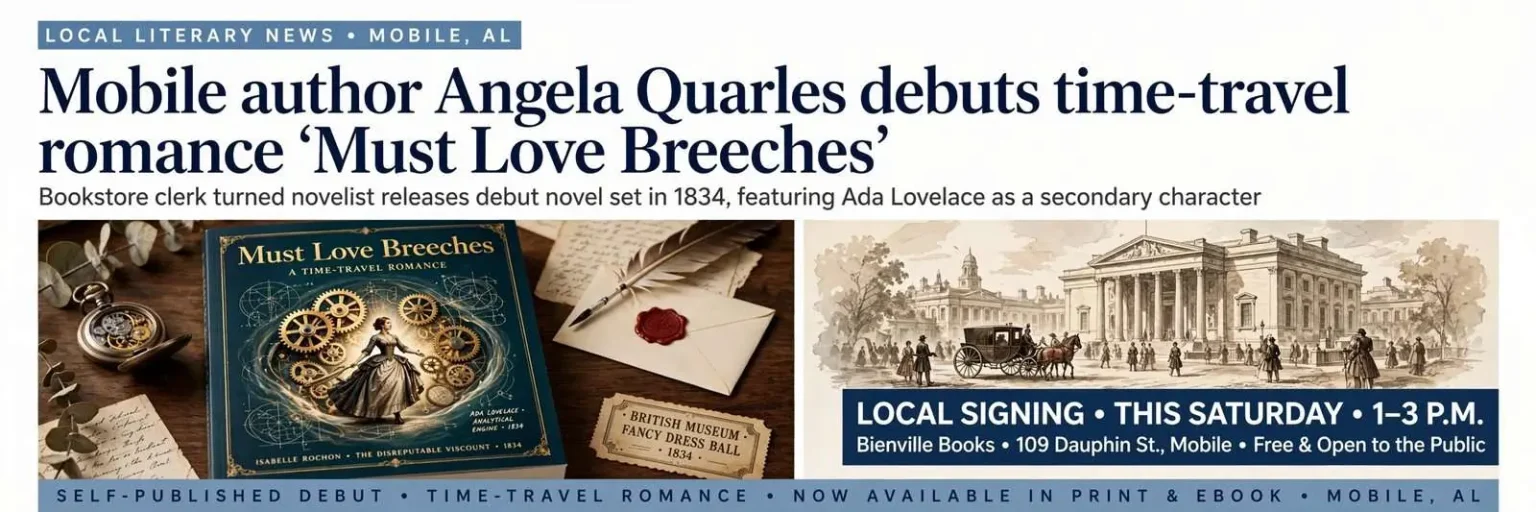
Mobile author Angela Quarles has released her debut novel-length book, “Must Love Breeches,” a time-travel romance set in 1834 with computing pioneer Ada Lovelace as a main secondary character. The book marks a milestone for a writer who spent years honing her craft before committing a full manuscript to paper, and it adds a distinctly Mobile voice to the growing world of independently published genre fiction.
A bookstore clerk turned novelist
Quarles did not start writing fiction until 2005 and did not attempt a novel until 2008. Like many working writers, she built her skills on shorter projects first, learning plot structure, character development and pacing before tackling the kind of long-form manuscript that a novel demands. Those early years of practice are a common thread in the careers of romance authors, a genre where craft matters enormously and readers are famously discerning about story arcs and satisfying endings.
After a small press published a novella in ebook form, she chose to self-publish “Must Love Breeches” — her first full-length book — to keep control over cover art, editors and layout. The decision put her among the wave of authors who have used independent publishing to reach readers directly, a route that has reshaped the romance category in particular. Self-published romance has become one of the most vibrant corners of the book world, with authors able to price competitively, publish on their own schedule and respond quickly to what readers want.
Her reasons for keeping the book in print form speak to her day job. “Since I work in a bookstore, I had to have it in print,” she said. For an author who spends her working hours surrounded by physical books and the customers who browse them, seeing her own title on the shelf was both a professional goal and a personal one — a tangible artifact after years of drafting and revising.
The story: a ball, a museum, and a trip to 1834
The story follows Isabelle Rochon, a newly hired British Museum employee who is plunged from a fancy-dress re-enactment of an 1834 ball into the real thing. The premise plays on the appeal that has kept time-travel romance popular for decades: a modern, independent heroine dropped into a rigidly structured historical world, navigating everything from period manners to corsetry while trying to find her way home.
Once in the past, Rochon finds unlikely allies in Lovelace and a disreputable viscount, who befriend the odd “colonial.” The choice of Ada Lovelace as a secondary character is a notable one. Lovelace, the daughter of poet Lord Byron, worked with inventor Charles Babbage on his early computing machines and is widely credited with writing what is considered the first computer program — making her a fitting companion for a time-traveling heroine with modern sensibilities. Her presence gives the book a foot in both science and society, grounding the 1834 setting in real intellectual history.
The “colonial” tag also sets up the book’s fish-out-of-water humor. An American heroine among the British upper class of the 1830s faces expectations she has no intention of meeting, and the friction between modern attitudes and period propriety is a reliable engine for both romance and comedy in the genre. The disreputable viscount at the story’s center is a familiar and much-loved romance archetype — the charming rake whose facade hides more depth than anyone expects.
Local signing and what’s next
Quarles will sign copies at Bienville Books, 109 Dauphin St., from 1 to 3 p.m. this Saturday. The downtown Mobile independent bookstore has long been a hub for the city’s readers and writers, hosting local authors for signings and giving area book lovers a place to find titles with a Gulf Coast connection. A hometown launch party for a Mobile author’s debut is exactly the kind of event the store has built its reputation around, and readers who attend can get signed copies in print while meeting the author behind the story.
The book is also available online in print and ebook formats, reflecting the dual approach Quarles chose for her debut. Readers outside the Mobile area can order the paperback or download the ebook, and the digital edition gives the title access to the online romance community, where word of mouth among readers can carry a debut a long way.
Up next is a steampunk romance, “Steam Me Up, Rawley,” set in Mobile in 1890 and due in early 2015, followed by another entry in the “Must Love” series. The choice of Mobile as a setting for a steampunk novel is a promising one for local readers: the city of the 1890s was a bustling port with streetcars, grand homes and a booming timber trade, offering rich material for an era of brass, steam and invention. Steampunk — a genre that imagines a world powered by Victorian-era technology — pairs naturally with romance, and few Southern cities have as much 19th-century atmosphere to draw on as Mobile’s historic districts.
Mobile’s growing literary footprint
Quarles’ debut arrives at a time when the Gulf Coast’s literary community has been quietly expanding. Writing groups, indie bookstores and author events across Mobile and Baldwin County have given local writers a support network that did not exist a generation ago, and self-publishing has lowered the barrier that once required a New York publishing deal to reach readers. An author can now build a career from a home office in Mobile with readers around the world.
For aspiring writers in the area, Quarles’ path is instructive: start small, practice on shorter work, learn the publishing options, and choose the route that fits the book and the author rather than the traditional assumption that legacy publishing is the only path. Her move from novella to self-published debut reflects a deliberate, patient approach to building a writing career — one book at a time, with an eye on the next series entry already in the works.
Readers who attend Saturday’s signing will get the chance to ask about that next book, and about what it takes to send a modern heroine back to 1834. For now, “Must Love Breeches” stands as Mobile’s newest contribution to the romance shelf — a debut that mixes time travel, real history and a hometown author’s long-awaited first novel.
Inside the craft of time-travel romance
Time-travel romance carries its own technical demands that Quarles had to manage alongside the love story. Writers in the subgenre have to keep two timelines straight, decide how a traveler’s modern knowledge does and does not change the past, and ground the historical details — clothing, currency, transportation, social rules — well enough that period-savvy readers stay immersed. A single anachronism can pull a reader out of the story, which is why authors in this corner of romance tend to be obsessive researchers.
Setting the story in 1834 puts the action in an era of real momentum. England of the early 1830s sat on the edge of the Victorian age, with the Industrial Revolution transforming daily life, railways beginning to stitch the country together, and scientific societies buzzing with new ideas — precisely the environment that makes a character like Ada Lovelace plausible as a young woman already immersed in mathematics and mechanical calculation. For a heroine arriving from the present day, it is a world close enough to feel familiar and distant enough to feel dangerous.
The romance category itself rewards authors who can balance research with pace. Readers come for the emotional arc, and no amount of period detail compensates for a love story that stalls. Genre veterans often describe the balancing act as the hardest part of historical romance: enough accuracy to earn trust, not so much that the story becomes a textbook. Quarles’ years of practice on shorter fiction before attempting a novel are exactly the kind of apprenticeship that builds that instinct.
Why indie publishing fit this debut
The control Quarles kept by self-publishing extends across decisions that legacy contracts traditionally place in a publisher’s hands. Cover art matters enormously in romance, where readers shop by genre signals — period costume, color palettes, typography — and an author who knows her subgenre can commission a cover that speaks directly to her audience. Editorial choices, too, shape the final voice of a book, and self-published authors can select editors who understand time-travel romance’s particular demands.
Layout and formatting choices also matter more than most readers realize, especially across print and ebook editions. An author managing both formats controls how the book reads on a page and on a screen, and can reissue corrections quickly rather than waiting on a publisher’s schedule. For a first-time novelist building a series, that flexibility is a genuine strategic advantage: the next “Must Love” entry can arrive on the timeline the author sets, not one dictated by a publisher’s catalog calendar.
Physical availability, though, remains the prize that self-publishing handles least easily — which is where her bookstore connection becomes decisive. Independent bookstores are the natural allies of local authors, and a signing at a store where the author already works creates the kind of community launch that online-only releases cannot replicate. The Saturday event at Bienville Books gives the debut exactly that: a hometown shelf, a hometown audience, and a story that started with a bookstore clerk who decided the book she wanted in print would be her own.


