
Mobile Author Kat Kennedy Explores the Gritty Side of Southern Life in Debut Collection
Mobile-area author Kat Kennedy released Flamingo Funeral and Tales from the Land of Tea Cakes and Whiskey, a gritty Southern fiction collection.
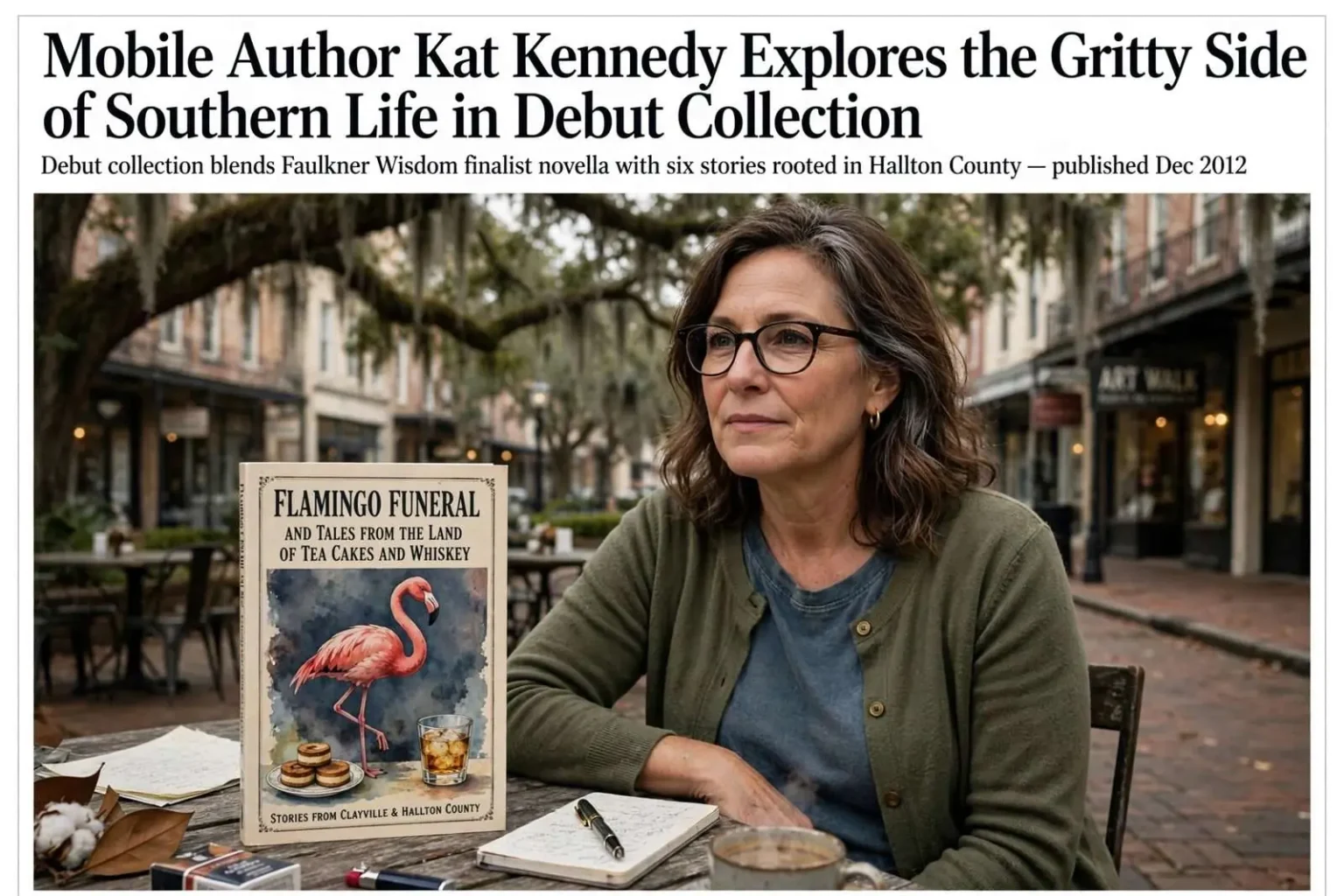
Mobile-area author Kat Kennedy released her debut fiction collection, Flamingo Funeral and Tales from the Land of Tea Cakes and Whiskey, in December 2012. The book combines the novella Flamingo Funeral, which was a short-list finalist for the 2012 Faulkner Wisdom Competition, with six short stories that delve into the rawer side of life in the American South.
The collection marked the arrival of a fully formed literary voice on the Gulf Coast scene — one built not in an MFA program but through decades of poetry, a teaching career and the particular landscape of southeast Alabama. By the time she sat down to sign copies at Mobile’s First Friday Art Walk the following spring, Kennedy had already assembled the surrounding infrastructure of a working writer: a writers’ group, an online magazine and a self-published book with a competition finalist to its name. The Faulkner Wisdom Competition short-list placement gave the debut immediate credibility — the New Orleans-based competition is one of the South’s respected independent literary contests, and a finalist slot put Kennedy’s novella in front of judges and readers who take Southern fiction seriously.
Characters That Feel Real
Kennedy’s fictional world is populated not by genteel Southern stereotypes but by deeply imperfect, whiskey-drinking, cigarette-smoking people who long for something more than the hand life has dealt them. Whether it is a woman trying to maintain control over her perfect house, a grandmother seeking atonement for her family’s mistakes, or a bar owner searching for a good partner, the characters grapple with unfulfilled desires and hard circumstances that feel grounded in reality.
The refusal to polish her characters is what gives the collection its punch. Kennedy’s South is not the moonlight-and-magnolias South of tourist brochures; it is the South of kitchen-table arguments, bar stools and long marriages that have gone slightly wrong, populated by people who fail each other in recognizably human ways. Readers from small Southern towns will recognize the furniture in these rooms, even when the names change.
The stories are set largely in Clayville and Alexville, fictional small towns in the equally fictional Hallton County, all inspired by the mill villages and rural communities of southeast Alabama where Kennedy grew up. The settings give Kennedy the freedom to build a richly detailed world complete with its own history, feuds, and social dynamics. That invented geography lets her write about the real thing without being pinned to it — the textile-mill economy, the family connections that bind small towns together and the pressures that hold secrets in place.
A Southern Writer by Choice and Heritage
Kennedy described herself firmly as a Southern writer, saying that the region’s unique history, language, and culture are inseparable from her work. She pointed to the way Southern dialect shapes her characters, noting that a phrase like “them shoes is worn plumb through” carries a meaning and music that standard English simply cannot replicate. In her stories, the dialect does double duty — it locates every character in a specific place and class, and it protects them from being translated into something more palatable for readers outside the region.
That ear for speech is the collection’s foundation. Dialogue in Southern fiction lives or dies on whether the characters sound like people the reader has actually met, and Kennedy’s insistence on dialect — its rhythms, its grammar, its compressed poetry — signals a writer recording rather than performing. The same dialect that outsiders sometimes flatten into caricature becomes, in her hands, the exact instrument for expressing resignation, affection and humor.
Her background in poetry, which she wrote for years before attempting prose, also influenced the collection. Kennedy said her poetic sensibility shows up in the imagery she uses, from the feel of a Southern rain to the quiet communion of relatives gathered at a kitchen table. The result is prose that lingers on sensory detail — heat, damp, smoke, the texture of a Sunday meal — the way verse does, with each story built from images that carry emotional weight beyond their literal description.
Tackling Difficult Themes
Several of the stories address uncomfortable subjects, including domestic violence. In Mean Woman Blues, the character Jolene’s abuse of Vernon is portrayed without easy resolution, reflecting what Kennedy described as a reality that is still too often ignored, particularly in small Southern communities where reporting abuse remains uncommon. The story’s reversal of expectations — a woman as the abuser — refuses the shorthand that lets readers file abuse neatly under gender categories, and its refusal of resolution refuses the reader the comfort of believing the system works.
Writing about abuse inside the closed world of a small mill town is a deliberate choice. In communities where everyone is connected by family, work and church, reporting violence means contradicting people you will see at dinner, and silence becomes a social skill. Kennedy’s stories live inside that silence rather than lecturing about it, which is precisely why the situations she portrays feel true to readers who know those towns firsthand.
The willingness to leave her characters unhealed also sets Kennedy apart from the redemptive arc that dominates popular Southern fiction. Some of her people find what they are looking for; others simply keep going. The honesty of that distribution is part of what her early readers responded to, and it is what keeps the collection from settling into sentimentality.
From Poet to Prose Writer
Kennedy said she never considered writing prose until her thirties, when editors at the Troy State Dothan Anthology needed a short story submission and encouraged her to try. That first attempt eventually became the story Echoes, included in the collection. The nudge from editors who knew her poetry gave her the push that pure ambition had not — proof that prose was simply another container for the voice she had been developing all along. It is a reminder of how much regional literature depends on small publications that ask local writers to stretch: without that invitation, Kennedy’s stories might never have been written at all.
After retiring from teaching, she committed herself to writing full-time and chose the self-publishing route, drawing on connections she made through social media and the writing community. Self-publishing gave Kennedy control over the timeline and the text of her debut — increasingly a practical choice for established voices whose work does not fit the commercial categories major houses prefer, and particularly common for Southern literary fiction that refuses to sand its dialect down for national retail. The online writing community she had cultivated became her marketing department as well, with fellow writers amplifying the book’s release across the region.
She also co-founded the Five Rivers Writers’ Group with Charles McInnis and served as editor of the Southern Delta Literary Magazine, an online publication aimed at giving local writers a platform for quality work. Both projects addressed a stubborn problem for writers outside major metros: isolation. A writers’ group meets regularly and reads drafts; an online magazine publishes what regional writers finish. Together they form the connective tissue that lets a literary community exist in a place without publishing houses. For Kennedy, the two roles fed each other — editing submissions sharpened her own prose, and the network she built became the audience for her book.
Kennedy’s dual role as writer and builder of platforms is worth noting for what it says about the Gulf Coast’s literary scene. Mobile’s creative community has grown through exactly this pattern — artists who organize the exhibitions they want to see, writers who found the journals they want to appear in — and her collection arrived with that community infrastructure already humming behind it. The First Friday signing put the book in front of exactly the audience a collection like this deserves: readers who walk the art districts, follow the local literary magazines and show up for the region’s own voices.
Where to Find the Book
Flamingo Funeral and Tales from the Land of Tea Cakes and Whiskey was available in paperback and e-book formats on Amazon at the time of publication. Kennedy was scheduled to sign copies at the First Friday Art Walk on March 8, 2013, from 6 p.m. to 9 p.m. in front of the Mobile Arts Council building. The Art Walk, which transforms downtown’s galleries and sidewalks into a monthly festival of regional art, has long been the place where Mobile’s creative community shows itself in public — an appropriate stage for a debut rooted so deeply in the region.
For a first collection, Flamingo Funeral carried impressive credentials: a Faulkner Wisdom finalist novella at its center, six stories around it, and a writer who had spent her whole life collecting the language and landscape of southeast Alabama for the moment she would finally need them. Readers who picked it up found a South they recognized — imperfect, whiskey-soaked, funny and true.