Mobile, Baldwin Counties Under Seasonal Burn Ban as Hurricane Sally Debris Piles Up
Fire officials in Mobile and Baldwin counties are urging residents clearing Hurricane Sally debris not to burn it, citing a seasonal statewide burn ban in effect through October 31 and added dangers from downed power lines and storm damage.
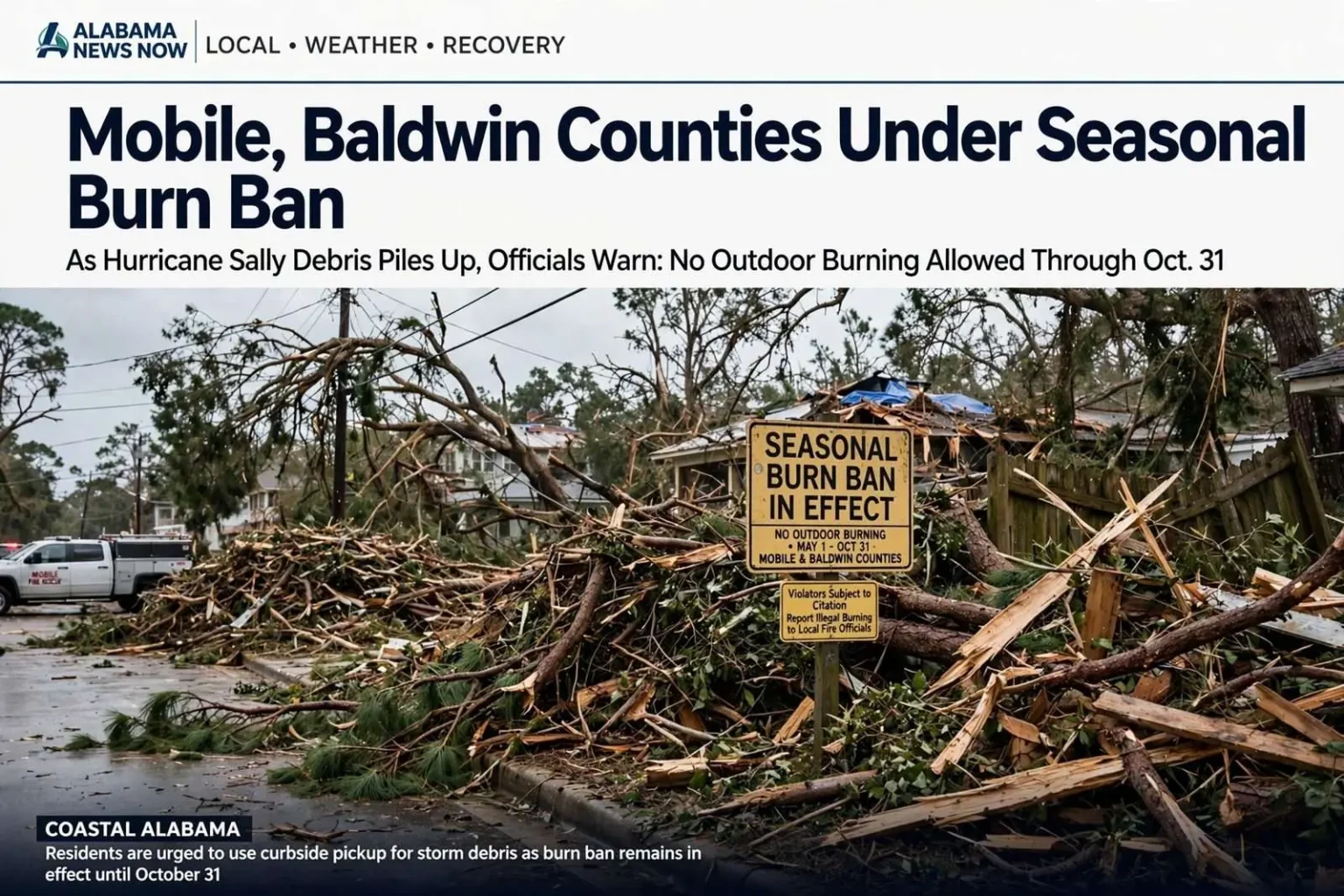
Residents across Mobile and Baldwin counties clearing storm debris from Hurricane Sally are being reminded that outdoor burning remains illegal under a statewide seasonal burn ban that runs through the end of October, even as yards and roadsides fill with downed limbs, fencing and other wreckage. The message from fire officials on both sides of Mobile Bay is blunt: no matter how much debris is stacked at the curb, none of it can go up in smoke.
The Alabama Department of Environmental Management issues the ban annually for twelve counties across the state, including Mobile and Baldwin, covering the period from May 1 through October 31 each year. The restriction is meant to reduce the risk of wildfires during the hottest, driest stretch of the year, but this year it collides with an unusually heavy load of storm debris left behind by Hurricane Sally.
Sally came ashore in late September as a slow-moving storm, and its winds toppled trees across entire neighborhoods from Dauphin Island Parkway to Fairhope and Point Clear. Because the storm lingered for hours rather than passing quickly, the tree damage along the Alabama coast rivalled or exceeded what many areas saw during stronger hurricanes. Weeks later, crews and homeowners are still cutting, stacking and hauling limbs, and the sheer volume of vegetative debris has left many residents wondering what they are allowed to do with it.
The answer, officials say, is anything but burning it. Under the seasonal ban, no outdoor burning of wood, brush, leaves or household trash is permitted in the covered counties until the restriction lifts on October 31. Violations can draw citations and, more importantly in the middle of a debris field, can touch off fires that spread faster than crews can reach them.
A Ban That Collides With a Debris Field
The timing could hardly be worse. The May-through-October ban exists because late summer and early fall are historically the driest and most fire-prone months in south Alabama, when a discarded cigarette or a smoldering brush pile can race through pine woods before anyone notices. This year, the twelve counties under the ban include both of Alabama’s coastal counties, where Sally’s wreckage has added tons of dry, curing wood to yards, rights-of-way and vacant lots.
Fire officials point out that storm debris is an unpredictable fuel. Limbs that seem soaked from recent rain dry quickly in the September sun, and a pile that smolders quietly at first can flare once the outer layer dries. Debris piles also burn hot and long, throwing embers that can land on rooftops, dry grass or stacked debris downwind.
In Mobile County, a Flood of 911 Calls
In Mobile County, fire officials say the bigger issue is not just debris fires slipping out of control, but the volume of 911 calls coming in from residents who spot smoke or flames in their neighborhoods. Every report of a neighbor’s illegal burn ties up dispatchers and sends fire apparatus rolling, even when the situation is not an emergency.
Steven Millhouse with Mobile Fire Rescue said neighbors who notice someone burning debris have other options before dialing emergency dispatch. “You can just ask your neighbors directly, or if it becomes a major issue you can give a call to our Bureau of Fire Prevention or our Community Risk Reduction Division and we will be happy to ask them to put it out,” Millhouse said.
He emphasized that 911 should be reserved for genuine emergencies, so that dispatchers and crews can respond quickly to calls that truly require it. With storm damage still snarling some streets and crews stretched across a wide recovery area, a steady stream of preventable burn-complaint calls slows the system down for everyone.
The Bureau of Fire Prevention and the Community Risk Reduction Division handle exactly this kind of complaint, Millhouse noted, and a phone call to those offices can resolve a burning dispute without lights, sirens or an engine company. The division’s staff can contact the property owner, explain the ban and ask that the fire be extinguished, which is usually how these episodes end.
Baldwin County: Downed Lines and Blocked Roads
In Baldwin County, fire officials are stressing that no outdoor burning should be taking place at all right now, and that the danger goes well beyond the burn ban itself. Barnwell Fire Chief Roy Glenn said storm-damaged infrastructure has made the area far more vulnerable if a fire were to spread.
“We still got power lines down, poles down, tree debris,” Glenn said. “We can’t access a lot of the area if the fire gets out, or if you have a need, it is harder for us to get in. If the fire does get out of control, we will be in the same situation that out West is right now with the wildfires.”
Glenn’s comparison to the large wildfires that regularly plague the western United States may sound dramatic for the humid Gulf Coast, but officials say the circumstances after a major hurricane genuinely change the math. Downed power lines can ignite fires on contact. Blocked roads slow engine companies trying to reach a fire before it spreads to a home or a wooded area. And the debris itself, piled high in yards and along road shoulders, gives any escaped fire a continuous fuel path between houses that would not normally exist.
Barnwell, which sits along the Highway 181 corridor between Fairhope and Daphne, was in the heart of Sally’s worst damage path. Volunteer and combination fire departments across central Baldwin County have spent weeks responding to storm calls, and chiefs say their crews are already worn thin. A wind-driven debris fire in a neighborhood full of fallen trees, they warn, could overwhelm departments that are still handling their normal call volume on top of recovery work.
Why Damp Debris Still Burns
Fire officials note that even debris that seems damp from recent rain can dry out quickly once it starts burning, allowing a fire to keep spreading rather than burn itself out. A pile rained on overnight can be dry enough to burn by mid-afternoon, particularly the fine limbs, pine straw and leaf litter that make up much of Sally’s debris.
That risk is compounded by downed power lines and blocked roads left behind by the hurricane, which can slow emergency crews trying to reach a fire before it spreads to a home or a wooded area. In the worst case, a fire started in a debris pile can climb into a fallen tree still leaning against a house, or travel along a line of storm wreckage straight to a structure.
Smoke and Open Windows: A Health Concern
There is also a public health dimension to the warning. With so many households still without power in the days after the storm, many residents have been opening windows to let in cooler air rather than run air conditioning. Officials warn that if someone nearby is burning debris, smoke can drift into homes through those open windows, creating a potentially serious health hazard for anyone with asthma, COPD or other preexisting respiratory or medical conditions.
Smoke from vegetative debris carries fine particles that aggravate breathing problems even in healthy adults, and it is especially hard on children, older residents and anyone using oxygen equipment. When thousands of homes are running their windows open because the power is out, a single illegal burn can affect an entire block. Officials urged residents to be mindful that their neighbors’ health may depend on what goes into the air.
The Legal Way to Get Rid of Storm Debris
Residents who want to legally dispose of storm debris are encouraged to check with their local municipality or county solid waste department about curbside debris collection schedules and drop-off sites rather than burning it in yards or empty lots. Both Mobile County and Baldwin County, along with the cities inside them, have organized debris-collection operations in the wake of the storm, and residents should separate vegetative debris from construction and household waste where separate pickups are offered.
Curbside collection is generally the simplest option in incorporated areas: debris placed at the right-of-way is picked up by contracted haulers working street by street, a process that can take weeks given the volume but requires no trip and no fee. In unincorporated areas and for residents who want debris gone faster, county and municipal drop-off sites accept vegetative debris, and some sites accept segregated materials for recycling or mulching. Rules vary by jurisdiction, so officials advise calling or checking the local government’s website before hauling.
Mulching and composting are also options for residents with the space. Ground limbs and leaves become useful mulch for garden beds, and many municipalities that operate their own yard-debris programs turn collected material into free or low-cost mulch for residents, closing the loop on what would otherwise be waste.
What To Do If You Spot a Fire
Anyone who spots a fire that appears out of control, or debris burning near power lines, downed trees or structures, should contact their local fire department. In those circumstances a 911 call is exactly the right move — the ban’s exceptions cut the other way when there is an actual emergency, and officials would rather answer a false alarm than arrive late to a fire in a debris field.
Fire officials offered some practical guidance for the weeks ahead: keep a cleared space of several feet between stacked debris and any structure, avoid parking vehicles on top of debris piles where catalytic converters can ignite dry material, and never leave any fire — even a legally permitted one outside the ban period — unattended. Residents should also be cautious with anything that throws sparks, from chainsaws dragging on the ground to grills placed too close to stacked limbs.
Enforcement Through the End of October
The burn ban will remain in effect across both counties through October 31, and officials say it will be strictly enforced given the added fire risk created by the hurricane’s debris field. After November 1, burning rules revert to the ordinary framework that governs each jurisdiction, which in most south Alabama municipalities still restricts or prohibits open burning of household waste and requires permits or distance setbacks for land-clearing burns.
Until then, the message from both counties’ fire services is uniform: the debris will be picked up, the ban is real, and a fire set in Sally’s wreckage risks far more than a citation. For a region still putting roofs, power and routine back together, a preventable fire is one more blow no neighborhood can afford.
Residents with questions about the ban or about proper debris disposal can contact their city hall, the county solid waste department, or — for complaints about illegal burning in Mobile — the Mobile Fire Rescue Bureau of Fire Prevention or Community Risk Reduction Division. Baldwin County residents can reach their local volunteer or municipal fire department, which can address burning complaints and point residents to the nearest legal disposal option.