Mobile, Baldwin Sheriffs Face Funding Losses Ahead of Permitless Carry
With Alabama’s permitless carry law taking effect Jan. 1, Mobile and Baldwin county sheriffs say permit revenue has already dropped sharply.
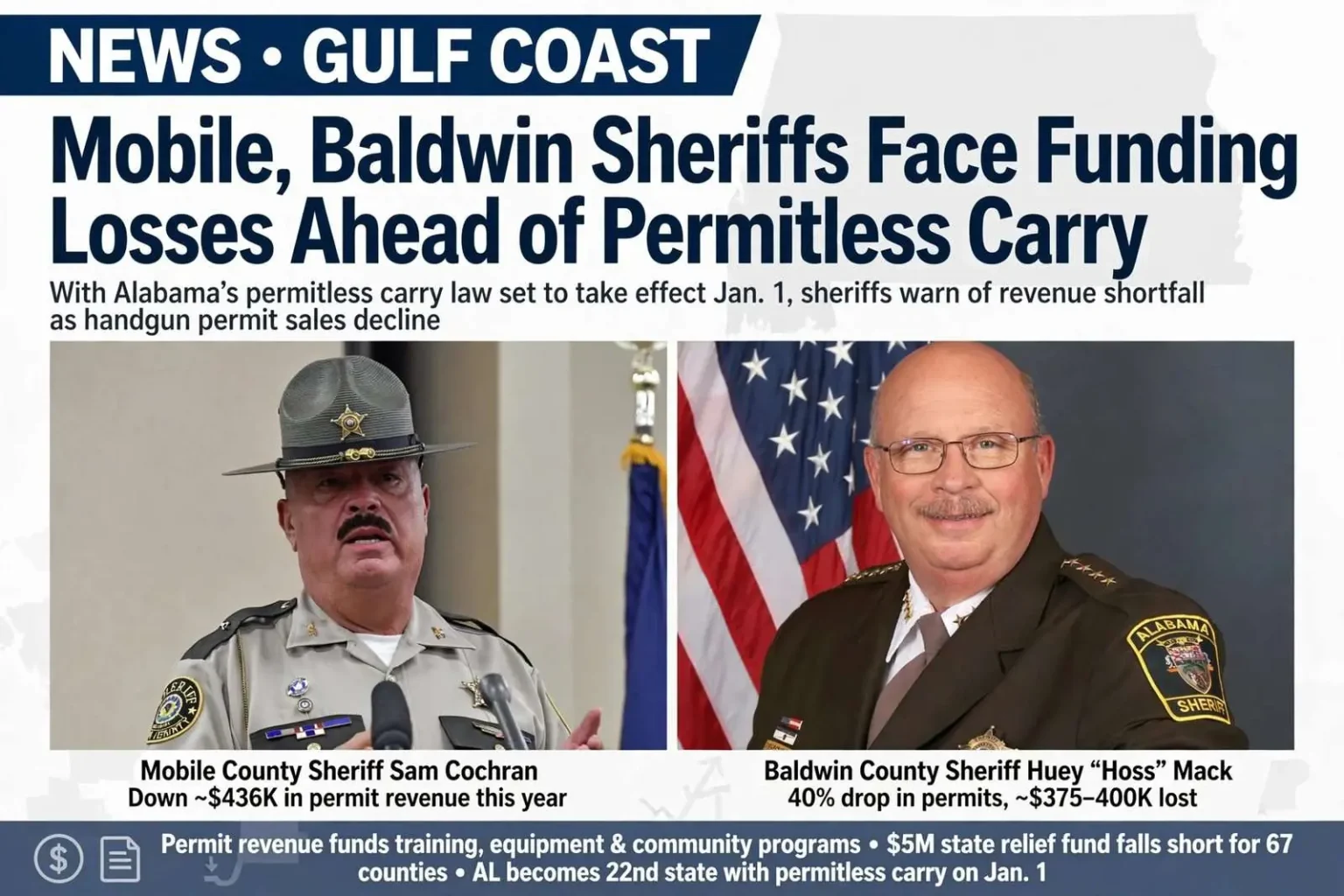
With Alabama’s permitless carry law set to take effect Jan. 1, sheriffs in Mobile and Baldwin counties say they are already feeling the pinch as handgun permit revenue dries up.
The Alabama Legislature voted earlier this year to remove the requirement to obtain a permit to carry a concealed handgun. The change does not apply to rifles.
Mobile County Sheriff Sam Cochran, a vocal critic of the change, said his agency typically collects about $1.2 million a year in permit revenue that funds training, communications equipment and community programs. “Since the bill passed, it’s caused people to stop purchasing,” Cochran said, noting he is down about $436,000 with nine months left in the year.
He said much of the loss reflects gun owners opting for single-year permits rather than multiyear ones while they wait to see how the law plays out. That shift may sound like a small behavioral change, but it multiplies across thousands of permit holders, and it arrives ahead of the larger drop sheriffs expect once the permit requirement disappears entirely and renewals stop coming in.
The dollars behind the permits
In Baldwin County, Sheriff Huey “Hoss” Mack said his office has seen a 40 percent drop in permits, translating to a loss between $375,000 and $400,000. Baldwin County’s gross permit revenue was $900,000 in 2021.
Those figures explain why sheriffs along the Gulf Coast have been among the loudest voices on the issue. Permit fees are not general tax money; they are a dedicated revenue stream that two of Alabama’s largest sheriff’s offices have built their training budgets around. Over the past 15 years, Mack said, 100 percent of his deputies’ and correctional officers’ training was paid for with permit funds.
That arrangement shaped how the offices operated. Alabama requires law enforcement officers to complete continuing training to maintain their certifications, and sheriffs used permit revenue for firearms instruction, defensive tactics, jailer training and the communications gear that keeps dispatch and patrol connected. Replacing that money from county general funds would force commissioners to either raise other revenue or cut elsewhere in the budget, a choice several county commissions have already begun discussing as the Jan. 1 effective date approaches.
How the law changed
Under the old system, Alabama required a permit, issued by each county’s sheriff, to carry a concealed handgun, a requirement that had been on the books since 1939. Sheriffs had discretion over issuance and used the background check process to screen applicants for disqualifying records. The new law removes the permit requirement for carrying a concealed handgun on one’s person, while leaving in place the prohibitions that already barred certain people, including convicted felons, from possessing firearms under state and federal law.
Alabama became the 22nd state to enact permitless carry when Gov. Kay Ivey signed the legislation in March. Supporters framed the change as a constitutional right that should not require a fee or government permission, and the Legislature’s majority agreed after years of similar bills falling short. Sheriffs and police chiefs across the state opposed it, arguing that the permit system gave them a lawful screening tool and that its loss would remove both a public-safety check and a funding source at the same time.
The relief fund, and its limits
Before passing the law, the state Senate created a $5 million, three-year relief fund to help agencies offset losses.
Cochran questioned whether it will be enough, and said the funding formula uses 2022 as a baseline, a year already depressed by falling permit sales. That detail matters to sheriffs doing the math: if the state measures a county’s loss against a lowered starting point, the reimbursement will fall short of what the county actually collected in healthier years. Mobile County alone has historically drawn more than $1 million a year from permits, so a statewide pool of $5 million spread across 67 counties over three years will not come close to replacing what the two Gulf Coast sheriffs describe losing on their own.
The three-year sunset also leaves the question of what happens next. Sheriffs note that training costs and equipment replacement do not expire after three years, and county commissions will have to find a permanent answer once the relief fund is gone, whether through legislative reappropriation, local general fund dollars or a reduced training schedule. None of those options is popular with the agencies that have planned budgets around permit income for decades.
What the law does not change
Sheriffs on both sides of the debate have emphasized the rules that remain. Federal law continues to prohibit firearm possession by convicted felons, unlawful drug users and others in disqualifying categories, and state law still restricts where guns may be carried, including courthouses, schools and certain public events. Business owners may still post property against weapons, and police retain authority to detain and investigate anyone armed in a suspicious manner, standards the courts have long upheld.
Permits themselves are not disappearing entirely. Residents will still be able to obtain them, and many are expected to keep doing so for the practical benefits: Alabama permit holders have long enjoyed reciprocity that lets them carry in other states, a right that does not automatically follow a permitless resident across the state line. Sheriffs say applications for those purposes, along with purchases requiring background checks under the federal system, will remain part of their workload even after the mandate ends.
What it means along the Gulf Coast
Mobile and Baldwin counties sit at the center of the debate because they are among the state’s largest and fastest-growing, with permit volumes to match. Baldwin’s population growth has fed steady demand for permits for years, which is why a 40 percent drop there registers so sharply. In Mobile, Cochran’s office has used permit revenue for programs that reach beyond the jail and patrol cars, and the sheriff has argued publicly that the public will feel those cuts in ways that have nothing to do with who may carry a gun.
The state’s other large counties are watching the same math. Sheriffs’ associations lobbied hard during the legislative session for either a slower phase-in or a dedicated funding replacement, and the relief fund was the compromise that carried the bill over the finish line. Whether that compromise holds, and whether future Legislatures refill it, will shape law enforcement budgets across Alabama long after the first permitless New Year arrives.
Background: how Alabama got here
The debate over permitless carry ran through several legislative sessions before it finally passed. Earlier versions died in committee or stalled in the Senate, where sheriffs’ testimony about funding and screening gave wavering members a reason to hold back. The bill that passed in March came with the relief fund attached, a recognition that even supporters acknowledged the fiscal impact on county government.
The argument split along familiar lines at the Statehouse. Supporters described the permit as a tax on a constitutional right and pointed to the number of other states that had already dropped the requirement without measurable harm. Opponents, including a majority of the state’s sheriffs, countered that Alabama’s system was not like those elsewhere, because permit money here had been quietly bankrolling officer training for decades, and because the sheriff’s discretionary review gave deputies a legal hook when someone dangerous tried to arm himself.
The screening function may prove to be the loss sheriffs regret most. Under the old process, an application put a name before the sheriff’s office, where records checks could flag outstanding warrants, domestic violence findings or other disqualifiers before a handgun went out the door. With no application required, that contact point disappears, and deputies lose an early look at a slice of the population that the permit queue had always delivered to them.
Gulf Coast residents live with some of the practical consequences firsthand. The region’s growth along the I-10 corridor has brought new residents from states both with and without permit requirements, and local gun stores report steady traffic from buyers navigating the changing rules. For now, the advice from sheriff’s offices in Mobile and Baldwin is consistent: the permit requirement remains in force until Jan. 1, permits are still available for those who want reciprocity and documentation, and the prohibitions on carrying for prohibited people have not loosened.
What happens after the effective date will be watched statewide. If permit revenues keep sliding and the relief fund proves thin, the Legislature will face renewed pressure to replace the money or rethink the formula; if training budgets hold, the change may settle into the landscape the way similar laws have in neighboring states. Either way, the two sheriffs who manage the state’s biggest Gulf Coast permit offices have made their position clear, and their agencies’ budgets over the next three years will test both sides’ arguments in real time.