Mobile Bars Clear to Stay Open Past 11 p.m. Again as Dauphin Street Rebounds
The Alabama ABC Board let Mobile bars stay open past 11 p.m. again, with COVID-19 capacity limits as Dauphin Street's nightlife reopens.
Bars in downtown Mobile won back their late nights this week after the Alabama Alcoholic Beverage Control Board voted to allow drinking establishments to remain open past 11 p.m., lifting one of the most visible pandemic-era restrictions on the city’s nightlife. The curfew had been among the strictest measures still in place along the Gulf Coast, and its removal marked a turning point for an entertainment district that had spent months operating at a fraction of its normal rhythm.
Downtown Mobile’s entertainment economy centers on Dauphin Street, the historic corridor where blocks of bars, restaurants and music venues sit in buildings that date to the nineteenth century. On weekend nights in ordinary times, the street draws thousands of patrons from across the Gulf Coast, and the businesses along it depend heavily on the late hours that the curfew had cut off. Losing the post-11 p.m. window meant losing a disproportionate share of revenue, since the last hours of the night are traditionally the busiest.
Capacity Rules Still Apply
The extended hours come with conditions: bars must still operate at half capacity and maintain social distancing between patrons. The change arrived just as Mobile County was seeing its COVID-19 case numbers tick upward, giving owners both an opportunity and a responsibility heading into the first big weekend back. The half-capacity rule meant that even with late hours restored, no establishment could simply return to business as usual; every bar had to count heads at the door and manage its floor plan around spacing requirements.
The state ABC Board, which licenses and regulates alcohol sales across Alabama, had imposed the early closure as part of the pandemic response, and its vote to relax the rule followed weeks of appeals from owners who argued that responsible establishments were being punished for problems occurring elsewhere. Board members weighed the economic damage to the hospitality industry against public health guidance, and the compromise — later hours, but capped occupancy — reflected the middle ground they struck.
Public health officials watched the move with caution. Case counts in Mobile County had been trending upward, and any change that packed more people indoors carried risk. But officials also noted that outdoor and spaced-out seating, mask compliance and ventilation all factored into transmission, and that a regulated reopening with enforceable limits offered more control than an underground scene operating without any rules at all.
How Dauphin Street Bars Are Handling It
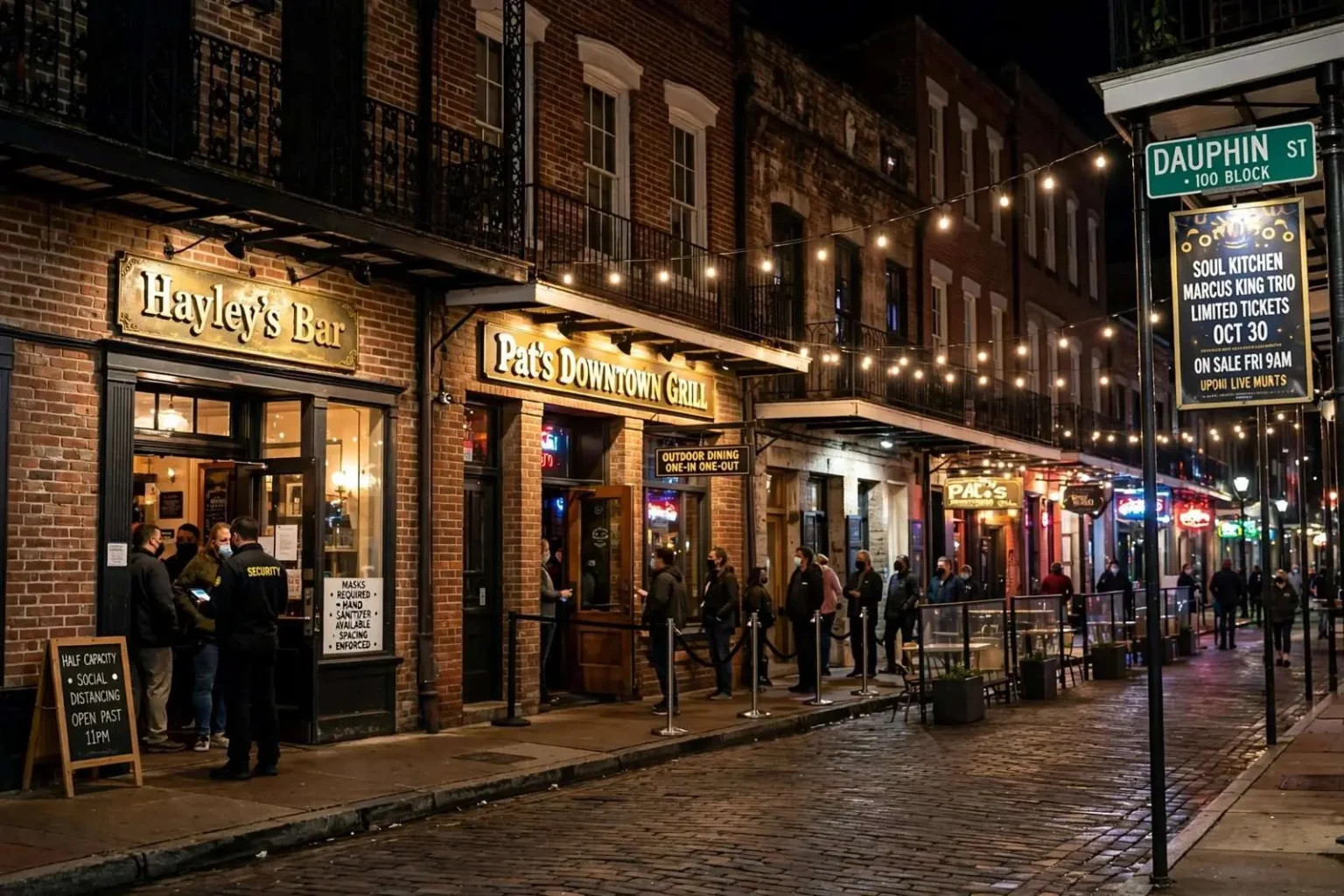
Along Dauphin Street, managers spent Thursday preparing for crowds they hoped would come. Hayley’s Bar capped its count at 40 people, with security stationed at the door tracking every entry. The late-night favorite had no set closing time in mind once it filled. The self-imposed cap was deliberately conservative — well below what half capacity would have allowed — and reflected a business calculus familiar to owners across the district: better to run a smaller, well-managed crowd than to risk the violations and outbreaks that could bring the curfew back.
Pat’s Downtown Grill, with room for 123, planned to run a one-in, one-out system if it hit capacity, spacing guests as far apart as possible. The venue held off on live music and DJs for college nights while the situation settled. The one-in, one-out approach turned the door itself into the enforcement mechanism: once the counter reached the cap, no new patron entered until someone left, a system staffed by door workers keeping a running tally through the night.
College nights had been among the biggest revenue drivers for downtown venues, drawing students from the University of South Alabama and Spring Hill College into the district for themed events and packed dance floors. Pausing the music and the crowds on those nights was a concession to the moment — dancing and shouting in a packed room is precisely the kind of activity epidemiologists warn about — and owners said they would rather hold those events back now than lose the ability to hold them at all later.
Mobile police said officers would run normal patrols downtown but expected bar owners themselves to enforce the occupancy rules, counting on residents and visitors alike to act responsibly. The arrangement placed the burden of compliance squarely on the businesses, with police stepping in only for disturbances and clear violations. Owners understood the stakes: a single chaotic weekend that generated complaints or a visible outbreak could undo the progress that won the late hours back in the first place.
Owners said the plan was simple: get through the first weekend, see how crowds behave, and adjust from there. Some managers considered reservation systems or staggered entry times if demand overwhelmed their caps. Others planned to lean on outdoor seating, which the city had expanded during the pandemic to give restaurants and bars more usable space under the capacity limits.
A Sign of Life for Downtown Entertainment
There was more good news for downtown entertainment — Soul Kitchen announced its first concert since the pandemic began, a limited-ticket show by the Marcus King Trio at the end of October, with tickets going on sale Friday morning. The venue, a longtime anchor of Mobile’s live music scene, had been dark since the spring, and its return to programming signaled that promoters and touring acts were once again willing to route through the Gulf Coast.
Limited-ticket shows became the standard model for venues during the recovery period: selling a fraction of the house, spacing tables and seating, and accepting lower revenue per night in exchange for operating at all. For fans, the shows offered the first chance in months to see national acts without traveling to larger markets. For the venues, they tested whether audiences would turn out under restrictions — a question that would shape booking decisions deep into the following year.
The reopening of late-night hours also carried meaning beyond the balance sheets. Downtown Mobile’s identity is tied to its nightlife, from Mardi Gras season balls to weekend crowds on Dauphin Street, and months of early closures had hollowed out a routine that residents and visitors had built their social calendars around. Restaurants that stayed open for dinner relied on the bar crowd for atmosphere and second-round business, taxi and rideshare drivers counted on the late-night runs, and nearby businesses from barbershops to late-night kitchens felt the absence of the foot traffic.
City officials had spent the pandemic months balancing pressure from business owners against guidance from health authorities, and the ABC Board’s vote effectively reset the terms of that balance. The half-capacity condition remains the guardrail: as long as case trends allowed, owners could operate within the limits, but the limits themselves were the price of staying open. Owners along the street said they understood the deal and intended to hold up their end.
The ABC Board itself is a state agency with broad authority over alcohol licensing, enforcement and rulemaking, and during the pandemic it became one of the most consequential bodies for hospitality businesses, since its orders determined when and how establishments could operate. Business owners learned to track its meetings the way they once tracked football schedules, because a single vote could change their hours, their occupancy and their revenue overnight. The board’s decision to relax the 11 p.m. closure followed similar adjustments in other states, where early curfews were gradually rolled back as evidence accumulated about which settings drove transmission.
The county’s upward case trend served as a reminder that the situation remained fluid. Health officials had spent months urging residents to treat the pandemic as a shared responsibility, and the return of nightlife tested that message in real time. Owners along Dauphin Street said they had invested in spacing, signage, hand sanitizer stations and staff training, and that they planned to document their compliance so that any future outbreak could not be blamed automatically on the bars. Several joined industry groups pushing for clear, consistent rules rather than ad hoc closures, arguing that predictability mattered as much as the rules themselves.
The Marcus King show gave the street a concrete date to point toward. Venue operators across the Gulf Coast had spent the shutdown months sharing strategies for socially distanced concerts, from seated floor plans to timed entry, and Soul Kitchen’s announcement suggested those plans were ready to put into practice. If the show went smoothly, owners said, more bookings would follow, giving the district a ladder back to normal programming one limited-ticket night at a time.
For the first weekend back, expectations were measured. Managers predicted steady but not overwhelming crowds, with some patrons still hesitant to return and others easing back in gradually. The weather, the college calendars and simple word of mouth would determine how quickly the street filled. What everyone agreed on was that the direction had finally changed: the lights on Dauphin Street would be burning past eleven again, and the district’s long, quiet stretch was coming to an end.