Mobile Bay Film Scramble Announces Sixth-Round Winners
Twenty teams signed up for the sixth Mobile Bay Film Scramble, and 13 completed short films that screened at the Crescent on September 28 and 29, 2012....
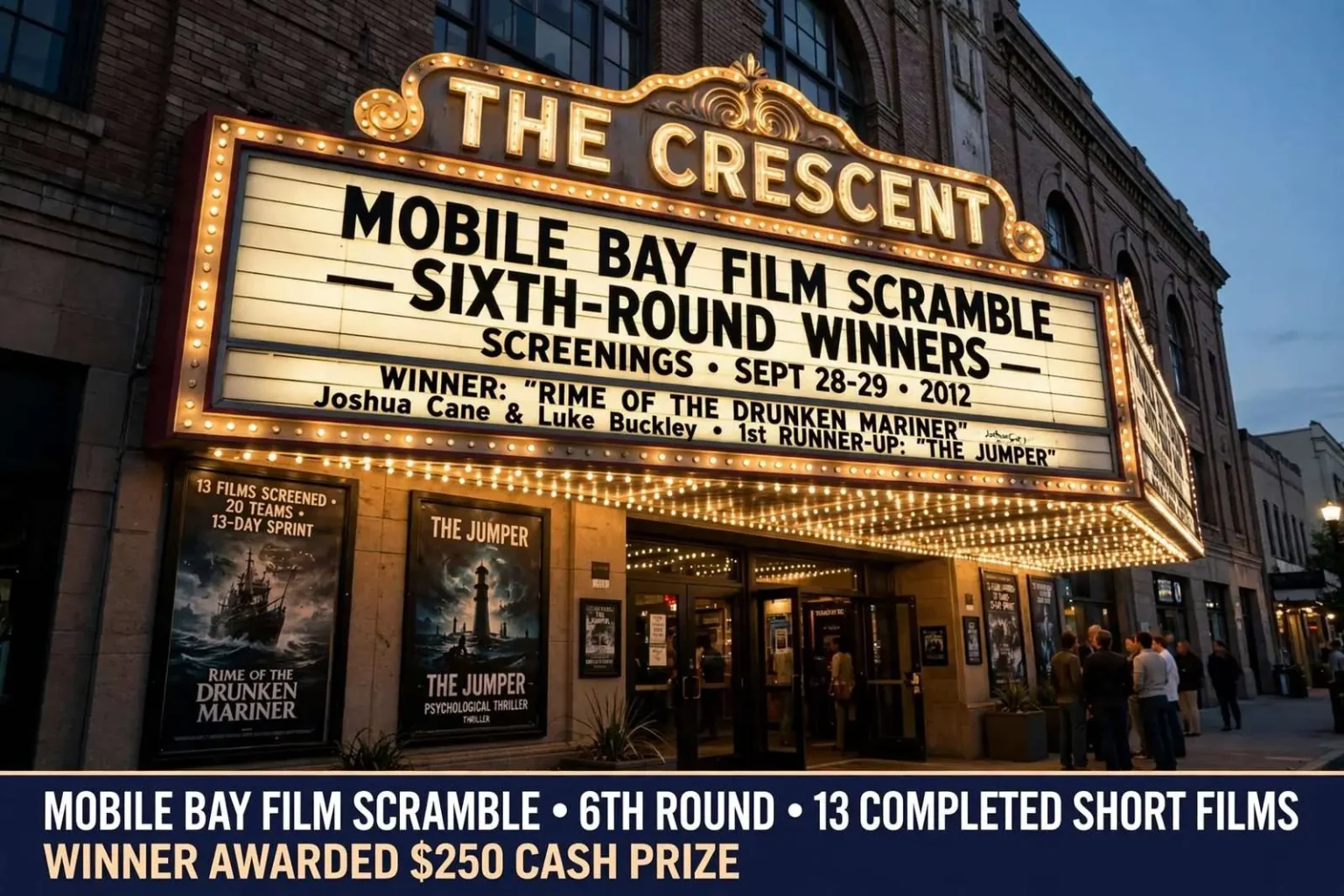
Twenty teams signed up for the sixth Mobile Bay Film Scramble, and 13 completed short films that screened at the Crescent on September 28 and 29, 2012. The attrition between sign-ups and finished films is part of every scramble’s math: the format demands that teams write, shoot, and edit a complete short in a matter of days, and even experienced crews find that real life, weather, and equipment trouble knock some entrants out before the deadline.
Teams had 13 days to produce a film from a brief supplied by the Mobile Writers’ Guild, with prompts leaning toward self-contained drama, psychological thriller, fantasy, science fiction, suspense or horror, often with a macabre twist in the spirit of The Twilight Zone. The Writers’ Guild’s involvement gave the competition a literary foundation, steering teams away from pure spectacle and toward stories with actual narrative shape. The genre menu encouraged filmmakers to work in modes that reward economy, since a twist ending or a slow-building dread can be delivered in a few minutes in a way that an epic premise cannot.
The scramble format itself is simple and demanding. At the kickoff, teams receive the assignment elements they must incorporate, from story premises to required lines, props, or locations, and the clock starts immediately. Everything from scripting to the final edit happens inside the competition window, which forces teams to plan tightly, shoot efficiently, and make hard choices about scope. Finished entries must meet the deadline to be eligible, which is what separated the 13 films that screened from the 20 teams that initially signed on.
The September screenings at the Crescent gave the completed films a proper theatrical debut. Seeing locally made shorts on a real cinema screen with an audience is a rare experience for independent filmmakers, and the two-night program turned the competition’s finish into a small festival for the Mobile film community, complete with the audience reaction that shaped the final balloting.
And the Winner Is
“Rime of the Drunken Mariner,” by Joshua Cane and Luke Buckley, took first place based on a combined judges’, audience and filmmakers’ ballot, and was set to receive a $250 cash prize in early October. The three-way voting structure gave the competition balance: a judges’ panel evaluated craft and storytelling, the audiences at the September screenings voted on what worked in the room, and the competing filmmakers weighed in with the discernment of people who had just wrestled the same assignment. Winning across that combined ballot meant the film satisfied critics, crowds, and peers at once.
Trey Lane’s “The Jumper” was named first runner-up. A runner-up finish in a field of 13 completed films placed Lane’s entry at the top of a competitive pack, and the scramble’s ballot format meant the film had earned support across the same three constituencies. For the filmmakers involved, the recognition carried practical value beyond the ranking: credits in a judged competition, an audience of fellow filmmakers, and a finished short that could go on to other festivals and screenings.
The $250 cash prize that waited for the winner in early October was modest in dollar terms but meaningful in the scramble’s context. Local competitions of this size run on community support rather than large purses, and the award functioned as both a reward for the winning team’s 13-day sprint and a signal of the competition’s seriousness about recognizing completed work.
The Crescent and Mobile’s Film Community
The Crescent, the downtown Mobile cinema that hosted the screenings, had become a natural home for the city’s independent film activity. A single-screen art house devoted to independent, documentary, and specialty programming, it offered local filmmakers an authentic theatrical setting that few other venues in the area could match, and its regular audience included exactly the film-literate viewers a competition like the scramble hopes to attract.
The Mobile Bay Film Scramble, by its sixth round, had grown into a fixture of the local creative calendar. Film scrambles model the reality of production: deadlines are hard, resources are limited, and the finished work either comes together or does not. That compression is why the format has spread to cities across the country, and why participants often describe the experience as the most instructive filmmaking they do. Teams that survive a scramble learn to cut scenes they love, solve problems on the fly, and finish what they start.
The partnership with the Mobile Writers’ Guild set the local scramble apart from similar events that rely on random draw alone. Writers’ Guild members craft the story briefs that seed each round, and the prompts’ emphasis on self-contained genre stories with a twist reflected a screenwriter’s understanding of what a short film can accomplish. For the teams, starting from a well-built brief spared them the blank-page problem and pushed the 13-day window toward production decisions instead of endless brainstorming.
What the Twilight Zone Style Demands
The prompts’ resemblance to The Twilight Zone carried specific creative implications for the entrants. The classic anthology series built its half-hour episodes on a single premise, a small cast, and a final turn that recast everything the audience had seen, and those are precisely the ingredients a short film can handle in a few days of shooting. Psychological thrillers and macabre suspense also avoid the expense of action spectacle, relying instead on performance, sound design, and suggestion, which is why scrambles so often tilt toward the eerie.
For Mobile audiences, the two September nights offered a sampling of what the area’s filmmaking talent could do under pressure. Short film programs of local work rarely draw mainstream attention, but they serve as the proving ground where editors, actors, cinematographers, and directors build credits and relationships. The scramble’s ballot structure made those audiences participants in the outcome, and the discussions in the Crescent’s lobby between screenings were as much a part of the event as the films themselves.
The sixth round’s results demonstrated the health of the format in Mobile: 20 teams willing to commit, 13 disciplined enough to deliver finished films, and a competitive field close enough that the combined ballot decided a clear winner. With “Rime of the Drunken Mariner” by Joshua Cane and Luke Buckley claiming first place and the $250 prize set to follow in early October, and Trey Lane’s “The Jumper” as first runner-up, the 2012 scramble added another round of locally made shorts to the Gulf Coast’s growing film record.
The 13-Day Sprint Behind Each Entry
What a scramble team packs into 13 days would stretch across months on an ordinary production schedule. The first day or two go to scripting and planning, with location scouting and casting squeezed into evenings after regular jobs. Shooting typically consumes a weekend, and the remainder of the window disappears into editing, sound, color, and the final render that has to reach the organizers on time. Teams that make it are usually the ones that ruthlessly limit their locations and cast size, which is one reason the format produces so many stories set in a single room or a single night.
The deadline also changes the creative calculus. A film that runs short and finished beats a masterpiece that misses the cutoff, so experienced scramble teams write to their resources, building scripts around props and places they already control. Actors recruited for a scramble give up several evenings for what may amount to minutes of screen time, and crews work for the same credit and camaraderie. The result is a body of work made almost entirely on goodwill, and the screenings celebrate that volunteer spirit as much as the films themselves.
Building an Audience for Local Film
Competitions like the scramble play a quiet but real role in growing a city’s film culture. Every team that participates leaves with production experience and a finished credit; every screening attendee sees work made by neighbors and learns that filmmaking happens in Mobile, not just in distant production centers. Over multiple rounds, the event builds the connections that later productions depend on, as cinematographers meet directors, actors meet casting-minded filmmakers, and writers see their premises realized on screen.
The sixth round closed with the community’s attention already turning toward the next one. The winning film would collect its $250 prize in early October, the runner-up’s team would carry the momentum of a second-place finish into its next project, and the 11 other films that screened represented two September nights of storytelling squeezed from a 13-day sprint. For the Mobile Bay film community, the 2012 scramble delivered exactly what the format promises: new short films, new collaborations, and proof that the local scene could finish what it started. For the volunteers who staffed the screenings and tallied the ballots, it was also the payoff for months of planning compressed into two busy nights downtown.