
Mobile Bay Flying Club Hosts Aviation Open House at New Airport Site
The Mobile Bay Flying Club held an open house at the new Mobile International Airport site, showcasing aircraft and introducing visitors to local pilots and flight instructors.
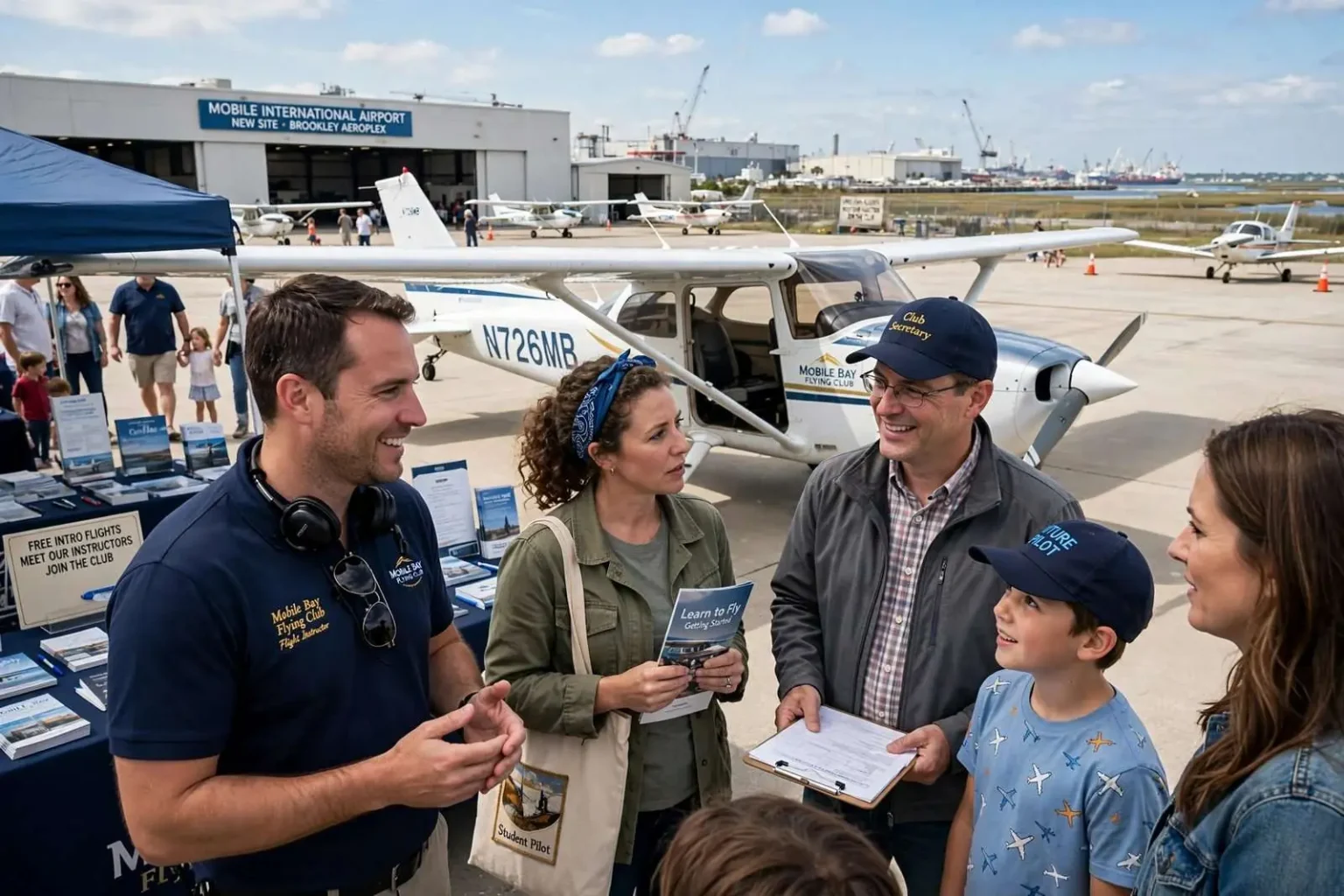
The Mobile Bay Flying Club held an aviation open house at the new Mobile International Airport site on Saturday, drawing licensed pilots, student pilots, aviation enthusiasts and members of the public interested in learning more about flying. The event gave curious visitors a close-up look at an airport project that is reshaping the Gulf Coast’s aviation landscape, and it offered the club a chance to recruit the next generation of local pilots.
The event featured a variety of aircraft on display and gave attendees the chance to meet local pilots and flight instructors. Open houses of this kind serve a dual purpose for flying clubs: they satisfy the public’s curiosity about small aircraft and airport operations, and they put people who have always wondered about learning to fly directly in front of the instructors who can walk them through the process.
Organizers said the open house was designed to welcome anyone curious about aviation, regardless of experience level, and to showcase the range of opportunities available to those interested in pursuing flying as a hobby or career. From student pilots working toward their first solo to licensed aviators maintaining their currency, the club’s membership spans the full range of experience, a structure that is common among community flying clubs across the region.
A new chapter for Mobile aviation
The setting itself carried significance. The new Mobile International Airport site represents the relocation of the city’s commercial air service to the Brookley Aeroplex, the former Air Force field near downtown Mobile that now anchors one of the Gulf Coast’s busiest aviation and industrial complexes. Moving passenger operations to that site puts the airport dramatically closer to the heart of the city than the existing regional facility, a change that civic leaders have pursued for years as part of a broader strategy to tie Mobile’s economy to its waterfront and aerospace assets.
Brookley’s transformation over recent decades has made it a hub for aerospace employers, aircraft maintenance and, with the arrival of major aircraft manufacturing on the site, one of the region’s signature economic stories. An airport built around that activity gives Mobile an aviation identity few cities its size can claim, and events like the flying club’s open house introduce the public to the airfield that will soon handle their travel.
For the flying club, holding the open house at the new site connects a community organization to that larger story. Flying clubs have historically been the grass roots of general aviation, giving members access to aircraft at a fraction of the cost of ownership and creating social communities built around a shared hangar. Mobile Bay’s version of that tradition has served area pilots for years, and its presence at the future passenger airport underscores how much aviation activity the site will host.
Instructors on why flying hooks people
Flight instructor Brendon Hayes said aviation has been a lifelong passion, and his description of the industry’s pull captured the tone of the day. “This has always been a passion of mine since I was a kid, so being able to find like-minded pilots who are also passionate about aviation and as a flight instructor, we’ve been able to share it with other people, show them the industry and that it’s a thriving and growing industry and if you’re not just doing it for a job, you can do it as a great hobby,” Hayes said.
Hayes’ framing reflects the two paths that draw people to flight training on the Gulf Coast. One is professional: the airline industry’s demand for pilots has created career pipelines through regional flight schools and university programs, and Mobile’s aerospace employers add ground-side careers to that picture. The other is recreational: a private pilot certificate remains one of the most achievable big-ticket skills available to someone with the time and commitment, and clubs make the aircraft side affordable.
Club secretary Kevin Kratt said one of the biggest draws of flying is the ability to travel quickly, and his example resonated with the Saturday crowd. “I can hop in a plane, I can go over there, leave in the morning, grab lunch with them, and be back before 1 o’clock in the afternoon. Just the ability to have a time machine, more or less, is big for me being able to see family like that,” Kratt said.
Kratt’s time-machine description is a familiar one among general aviation pilots, and it captures the practical freedom that keeps club memberships active. A light aircraft can cover in an hour a drive that takes four along the highway, opening up day trips across the Southeast, from the Florida panhandle beaches to inland Alabama towns, without a security line or a boarding pass in sight.
What the open house offered visitors
Saturday’s display of aircraft gave attendees the range of general aviation in miniature, from the trainers that student pilots learn in to the kinds of planes licensed members fly for personal travel. Standing next to an aircraft with an instructor beside it demystifies the machine in a way no video can, and visitors could ask the practical questions that stop many aspiring pilots before they start: what training costs, how long it takes, and what the medical and testing requirements look like.
The chance to meet local pilots and flight instructors face to face is often the deciding factor for people who have been circling the idea of learning to fly. Flight training is a relationship as much as a curriculum, with students and instructors spending dozens of hours together in cramped cockpits, and clubs that open their doors tend to convert curiosity into enrollment precisely because the personal connection happens on the spot.
For families in attendance, the event doubled as a STEM-flavored field trip. Airports and aircraft hold a reliable fascination for children, and the pilots on hand could explain everything from how the instruments on the panel work to what the traffic pattern over the field sounds like from the ground. Community events like this one are how aviation organizations build the public goodwill that keeps small airports politically supported.
General aviation’s place on the Gulf Coast
The Gulf Coast is one of the most aviation-rich regions in the country, a fact that locals sometimes take for granted. Alongside the commercial service moving to the new Mobile International Airport, the region hosts military aviation, shipbuilding and aerospace manufacturing, flight training operations, and a network of general aviation fields serving pilots from New Orleans to Pensacola. Coastal flying also comes with its own skills, from navigating over open water to managing the weather patterns that the Gulf generates.
Flying clubs sit at the center of that ecosystem, providing the affordable access point that keeps the pipeline of pilots flowing. Members share the costs of aircraft ownership, schedule planes through the club, and split the social life of the hangar, from fly-in breakfasts to the open houses that bring the public in. For Mobile, a club operating at the gateway of the new international airport is a visible reminder that aviation belongs to everyone, not only to the airlines and the factories.
Saturday’s open house closed with the club’s core message intact: anyone curious about aviation is welcome, regardless of experience level. Whether the interest is a career in the cockpit, a hobby that shrinks the map, or simply an afternoon spent among aircraft at the site where Mobile’s aviation future is taking shape, the Mobile Bay Flying Club’s open house made the case that the runway is open to all comers.
The economics of flying clubs explain why they matter so much to regional aviation. Owning even a modest single-engine aircraft carries costs, from hangar rent and insurance to the maintenance that keeps an airframe airworthy, and those bills land on one person. A club spreads them across the membership, so a pilot pays for the hours flown rather than the airplane sitting idle, and the fleet stays busy enough that maintenance becomes routine rather than ruinous. That structure has kept general aviation accessible in Mobile long after the cost of outright ownership climbed out of reach for most hobbyists.
The path to a pilot certificate follows a familiar sequence. Students begin with the fundamentals of controlling the aircraft, move through solo flight after their instructor endorses them, and then build the cross-country experience and pass the knowledge and practical tests that lead to a private certificate. Each stage has its own milestone moments, and club members describe the first solo and the first solo cross-country as the memories that stick for a lifetime.
Mobile’s geography gives local pilots particularly varied flying. A short flight east crosses Mobile Bay and the Eastern Shore, a route south brings the barrier islands and the Gulf shoreline into view, and a run north follows the Mobile River delta, one of the most distinctive landscapes on the Gulf Coast from the air. Instructors use that variety to build real-world skills, teaching students to manage coastal weather, water crossings and the busy airspace that surrounds the region’s military and civilian fields.
The new airport’s development adds another layer to that training environment. As commercial operations shift to the site, student pilots will gain experience operating around a busier field, learning the communication and awareness skills that come with sharing airspace with airline traffic. Experienced instructors view that environment as a plus, since pilots trained near commercial operations tend to develop habits that transfer smoothly anywhere in the country.
Public open houses also serve a safety purpose that clubs rarely advertise. General aviation thrives when surrounding communities understand what happens at their local airports, and the residents who meet pilots face to face are more likely to support the airspace, the noise patterns and the growth that comes with an active field. Every conversation at Saturday’s event built a little of that understanding around Mobile’s newest air passenger gateway.
The club’s organizers have long emphasized that the door stays open after the open house ends. Prospective members can visit, take an introductory flight, and decide at their own pace whether to begin training, and the club’s instructors volunteer their time to make those first steps approachable. For a region building its future around aerospace, the sight of a community flying club welcoming newcomers at the new Mobile International Airport site is a fitting one: the industry’s next pilots, and its next supporters, start exactly there.