
Mobile Becomes Command Hub for 2010 Gulf Oil Spill Response as Officials Weigh Ways to Push Back the Slick
As the Deepwater Horizon spill neared Alabama, Mobile hosted the Unified Command, and officials weighed using Mobile Bay's rivers to help push back the oil.
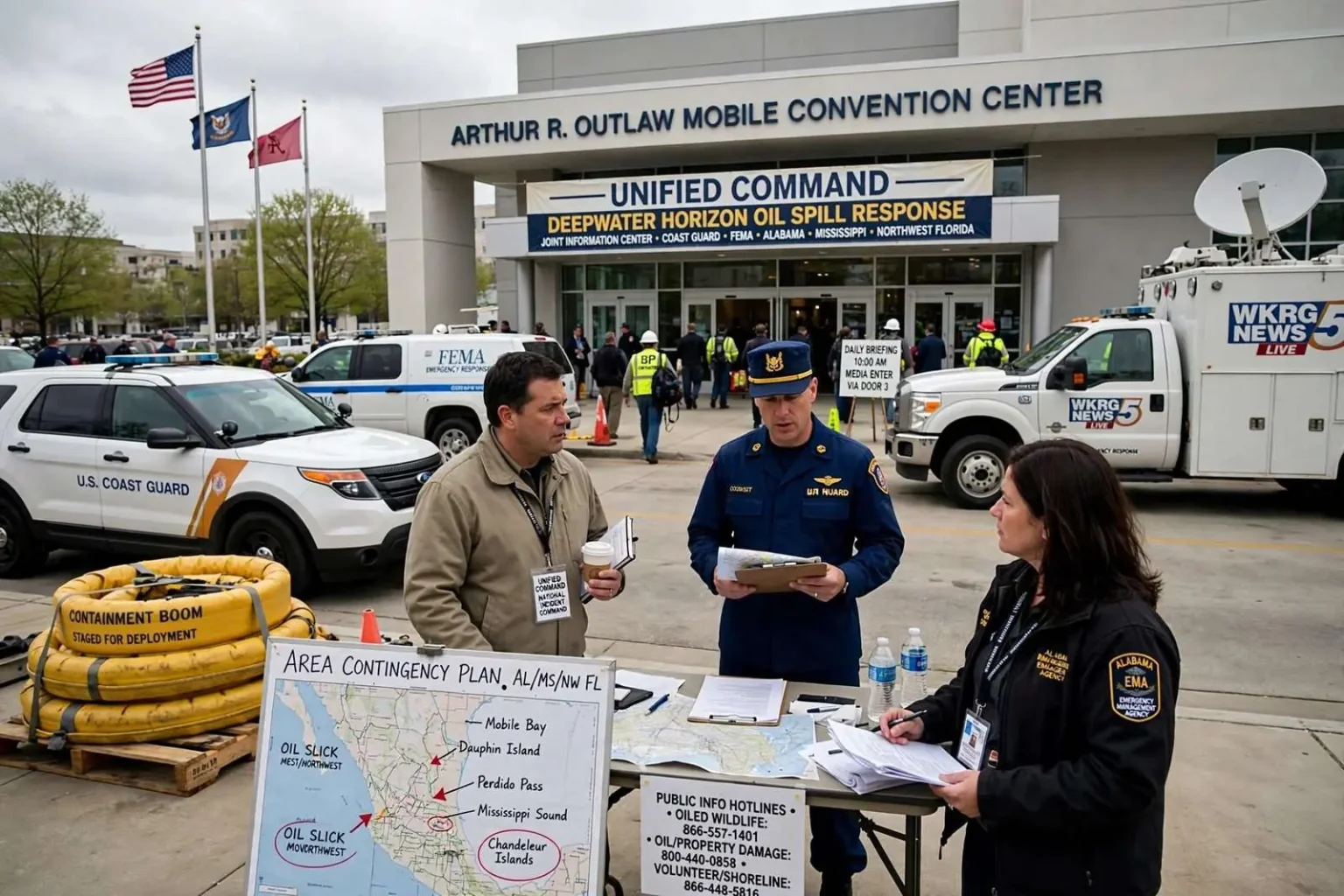
In the first days after the Deepwater Horizon rig explosion set off a massive oil spill in the Gulf of Mexico, Mobile emerged as a nerve center for the response. The Unified Command overseeing the cleanup, along with a Joint Information Center coordinating public updates, was established at the Arthur R. Outlaw Mobile Convention Center downtown. The choice put the response apparatus for three states inside a convention hall a short drive from the Gulf, close enough to the water for commanders to reach the front lines quickly and large enough to absorb the hundreds of federal, state and contractor personnel who would fill it in the weeks ahead.
The command’s Area Contingency Plan covered the coastlines of Alabama, Mississippi and Northwest Florida. That tri-state footprint reflected how the spill threat ignored political boundaries: oil moving west from the damaged wellhead menaced the Chandeleur Islands and Mississippi Sound as readily as it did Perdido Pass and the beaches of Gulf Shores. The pre-existing contingency plan, drafted by federal and state agencies for exactly this kind of disaster, gave responders a framework to work from on day one — staging areas, notification chains, shoreline protection priorities — that would otherwise have taken weeks to improvise.
Hotlines for a Worried Coast
As oil crept toward the coast, federal and state agencies set up a series of hotlines for residents to report spill-related problems and to volunteer. Oiled wildlife could be reported to 866-557-1401, oil-related property damage to 800-440-0858, and oiled shoreline sightings to 866-448-5816. That same number, 866-448-5816, also served as the line for residents wanting to volunteer for cleanup efforts. The lines lit up almost immediately. Coastal residents who found tar balls on their beachfront property, fishermen whose boats sat idle in closed waters, and families wanting to help all funneled into the same reporting structure, feeding information into the command posts and giving agencies a distributed network of eyes along hundreds of miles of shoreline.
The volunteer line reflected a particular Gulf Coast impulse. Within days of the explosion, thousands of residents from Bayou La Batre to Pensacola had asked how they could help, some offering boats, others offering labor. Officials had to balance that eagerness against the realities of hazardous-materials response, which requires trained workers using protective equipment. Volunteers who were accepted received safety training before approaching any oiled shoreline, and the hotline system helped organizers schedule and deploy them in waves as oil made landfall.
Could the Rivers Push Back the Oil?
At a briefing, Admiral Thad Allen, the retired Coast Guard commandant serving as National Incident Commander for the spill response, was asked whether increasing the outflow of the Mississippi River could help create counterpressure against the advancing slick. Allen said that specific option had not been discussed. The question captured the desperation of the moment: with the well uncontrolled on the seafloor, officials were entertaining ideas of almost any scale, and the public wanted to know whether nature’s own currents could be enlisted against the oil.
Allen added that a related idea was under review closer to home. After touring the coast by air with Alabama Governor Bob Riley, officials said they were looking into whether releases from upstream hydroelectric reservoirs could be used to increase the flow of the five rivers that feed Mobile Bay, potentially helping push oil away from the bay’s mouth. The Mobile Bay watershed gathers water from an enormous interior drainage — the Alabama, Tombigbee and Black Warrior rivers among them — and the theory held that boosting freshwater discharge into the bay would strengthen the seaward current at Mobile Pass, forming a kind of hydraulic barrier against incoming oil.
The proposal put federal responders in conversation with the operators of the region’s hydroelectric dams, whose reservoir releases are governed by power contracts, flood control schedules and environmental rules. Even a modest increase in downstream flow required coordination among agencies with different mandates, and engineers had to model how much additional discharge would actually change conditions at the bay’s mouth, more than three hundred river miles from the nearest dam. The review illustrated the improvisational character of the early response, when every plausible defense of the coastline was at least examined before being adopted or set aside.
BP’s Promise on Local Hiring
White House aide John Brennan, then serving as assistant to President Obama for homeland security, said BP had committed to hiring, employing and training local residents for cleanup work along the coast. Brennan described the commitment as a strong one, though it would take weeks of response activity before the scale of local hiring became clear. The pledge mattered enormously in communities such as Bayou La Batre, Coden and Dauphin Island, where the same fishing families harmed by the closed waters stood to earn cleanup wages that could keep households afloat through the disaster.
The Vessels of Opportunity program that grew out of those commitments eventually paid local boat owners to deploy boom, patrol for oil and ferry personnel, putting idle shrimp trawlers and charter boats back to work. Training requirements, payment disputes and questions about how many hours each vessel would get would consume community meetings for months, but in the earliest days the promise of local hiring was one of the few pieces of good news coastal residents heard from officials.
Brennan’s appearance in the region also signaled the White House’s direct engagement with the response. As the assistant to the president for homeland security and counterterrorism, he occupied the seat where federal interagency coordination converged, and his visits to the Gulf communicated that the administration was treating the spill as a national emergency rather than a regional nuisance. For a command operation spread across a convention center in Mobile, staging yards in Alabama and Mississippi, and agencies in Washington, that top-level attention helped cut through jurisdictional friction.
Mobile’s Unusual Role
The convention center command post made Mobile a daily stop for journalists, cabinet members and Coast Guard brass, transforming a city that had braced to be a victim into the headquarters of the fight. The Joint Information Center arranged daily briefings that were carried live by Gulf Coast television stations, and the hotel blocks, rented vehicles and badged contractors that filled downtown Mobile gave the local economy an odd counter-cyclical jolt even as the fishing and tourism sectors that define the coast braced for losses.
The Mobile area’s connection to the oil and gas industry made the command role a natural fit as well. The city hosts offices and shipyards that support offshore energy work, and local marine contractors were among the first suppliers of boom, vessels and manpower to the response. When officials needed staging space, deepwater dockage or industrial services on short notice, the infrastructure was already in place along the Mobile River.
The early days also established the rhythm of communication that would define the response. Briefings at the convention center followed a format veterans of hurricanes would recognize: a federal on-scene coordinator summarizing containment numbers, a state official addressing beach closures and seafood safety, and BP representatives answering for the well kill efforts that proceeded in parallel with the cleanup. Reporters learned to arrive early, and local officials learned to translate technical jargon — skimmers, boom, in-situ burning, dispersant — into language coastal residents could act on. The Joint Information Center’s hotlines and briefings became, for many families, the most reliable source of information about whether their stretch of beach was closed and when cleanup crews would arrive.
Preparing the Alabama Coastline
While commanders debated hydrology and hiring, the physical defenses of the Alabama shoreline took shape. Boom was staged around Perdido Pass, Mobile Pass and the mouths of the bay’s tributaries, with sensitive habitat — the tidal marshes around Bayou La Batre, the dunes of Gulf State Park, the oyster reefs of the bay — prioritized under the contingency plan’s protection schedules. Crews practiced deploying the floating barriers in the protected waters behind Dauphin Island, and shrimp boats prepared to tow longer sections of boom than any of their owners had ever handled. The work proceeded under a ticking clock, since weather and currents would determine when and where the oil actually made landfall.
The weeks that followed would test every element of the plan laid out in those first days. Oil did eventually reach Alabama’s beaches and the marshes of Mobile Bay’s southern rim, triggering the shoreline cleanup operations that continued long after the well was capped. The convention center command post stood down in stages as the response shifted from emergency to long-term restoration, but the structures built there — the hotline system, the interagency coordination, the local hiring programs — became templates referenced in coastal disaster planning for years afterward.
For Mobile itself, the episode left a complicated legacy. The city demonstrated that it could host and support an operation of national scale, and local firms proved essential suppliers to the response. At the same time, the sight of oil on the horizon reminded residents how tightly the region’s fortunes are tied to the Gulf’s health — for seafood, for tourism, and for the energy industry that employs so many along the coast. The five rivers that officials considered enlisting against the slick flow through the same communities whose fishing grounds and beaches hung in the balance, and the episode underscored how interconnected the Mobile Bay watershed really is, from the Black Warrior dams to the passes where the bay meets the Gulf.
The questions officials weighed in those first days — whether rivers could be turned against the oil, whether local workers would share in the cleanup wages, whether the hotlines would hold up under the volume — were answered in the months that followed, but the urgency with which they were first asked defined the character of Mobile’s role in the nation’s worst offshore oil spill.


