Mobile-Born Novelist Thomas Lakeman, From FBI Thrillers to the Playhouse in the Park Stage
A profile of Mobile-born author Thomas Lakeman, creator of the Yeager and Weaver FBI thriller series and playwright for the Playhouse in the Park.
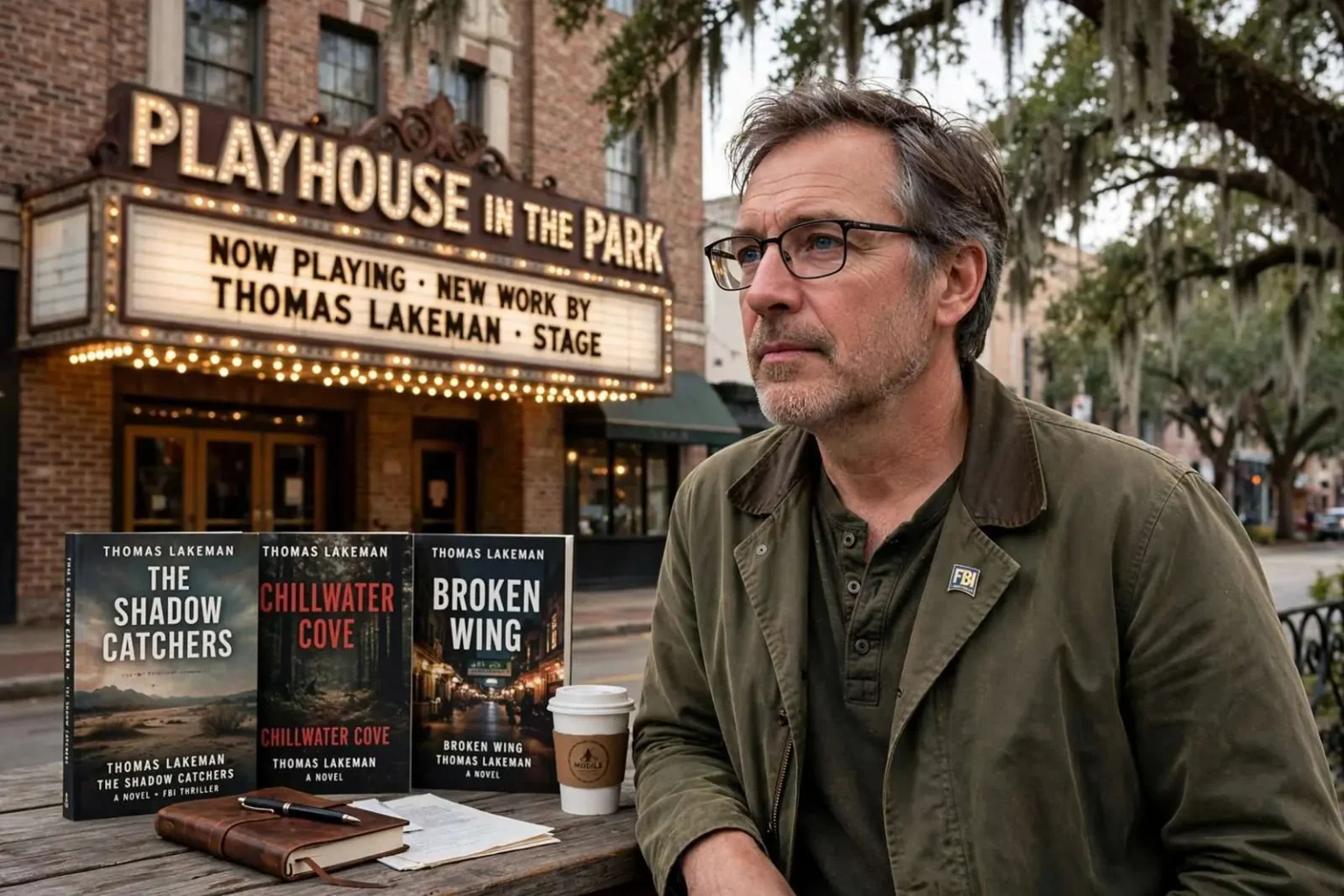
Mobile native Thomas Lakeman has built a writing career that runs from hard-boiled FBI thrillers to the stage of the Playhouse in the Park.
He is the author of three mystery novels published by St. Martin’s Minotaur — The Shadow Catchers (2006), Chillwater Cove (2007) and Broken Wing (2009) — a continuing series following a pair of FBI special agents, Mike Yeager and Peggy Weaver. The novels put Lakeman in the tradition of American crime fiction that stretches from the noir classics of the mid-century to the police procedurals of today, and they gave the St. Martin’s Minotaur imprint — a line devoted to mystery and suspense — a Southern voice with a national stage.
The Shadow Catchers sends Agent Yeager into the Nevada desert on the trail of a serial killer. In Chillwater Cove, Agent Weaver returns to her Tennessee hometown to search for a missing childhood friend. Broken Wing puts Yeager back at the center of the story with an undercover assignment infiltrating the Mafia in post-Katrina New Orleans. Each book gave one of the two agents the lead, building a partnership across three novels the way classic series crime fiction has always worked — letting readers watch the characters deepen from book to book while the settings shifted from empty desert to small-town Tennessee to a drowned city rebuilding itself.
The books have drawn critical praise from several major national publications, a notable achievement for a debut novelist writing in one of the most crowded categories in American publishing. Reviewers responded to the pairing of the two agents, the atmosphere of the settings and the plotting that carried each investigation, and the series established Lakeman as one of the Gulf Coast’s working novelists.
Mobile’s literary son
Lakeman’s roots in Mobile run deep in a city with an outsized literary pedigree. Mobile has produced and nurtured writers whose work gave American letters some of its most distinctive voices — Eugene Walter among them — and the city’s humid, slightly askew atmosphere has long invited comparison with the Southern Gothic tradition just across the state line in Monroeville, Harper Lee’s hometown. For a novelist working in crime fiction, the region offers rich material: the Gulf’s port-city shadows, its old families and new money, its intersections of crime, corruption and grace.
That regional sensibility shows up in Lakeman’s fiction in the way his agents move through landscapes that feel specific rather than generic — the Nevada emptiness of the first novel, the Tennessee hills of the second, the storm-broken New Orleans of the third. Southern writers who leave the South often carry it with them, and Lakeman’s return to Mobile for theater work suggests the pull the city exerts on its own.
The choice of FBI agents as protagonists placed him squarely in the mainstream of the genre. The Bureau procedural offers crime writers a ready-made engine — jurisdiction, forensics, the interplay of partners — and Lakeman used the pairing of Yeager and Weaver to balance action and character across the series. Post-Katrina New Orleans, the setting of Broken Wing, was an inspired choice for an undercover story: a city in ruins, its institutions scrambled, where an outsider with a false identity could move through the rubble unnoticed.
From Hollywood Marketing to the Stage
Lakeman’s path to fiction ran through the film industry. During the 1990s he worked in the marketing department of Universal Pictures and was a founding partner of Digital Planet, a Southern California web design firm later acquired by iXL Inc. As the company’s creative director, he produced some of the web’s first movie promotional campaigns, including sites for Twelve Monkeys and Apollo 13, and co-created the animated web series Madeleine’s Mind.
That résumé placed Lakeman at the frontier of a moment when the internet was inventing itself. In the mid-1990s, the idea of a “movie website” was novel — studios were only beginning to understand that the web could market a film — and the campaigns Lakeman built for Universal titles like Terry Gilliam’s Twelve Monkeys and Ron Howard’s Apollo 13 were among the first efforts to translate big-screen spectacle into interactive promotion. Digital Planet’s later acquisition by iXL, a digital consultancy of the era, marked the moment when the experimental web shops of the 1990s were absorbed into the corporate mainstream.
Madeleine’s Mind, the animated web series he co-created, belonged to the same pioneering period — an early attempt to build original episodic content for a medium that had never hosted it. The skills those years required — pacing, atmosphere, hooking an audience quickly — are the same skills a thriller novelist needs, and Lakeman’s move from campaigns to novels was less a leap than a translation.
His screenwriting includes the independent feature Triptych, produced by Tea Tree Films, and he has written numerous stage plays produced by Mobile’s own Playhouse in the Park. The Playhouse, a Mobile institution that has trained generations of local actors and mounted productions for decades, gave Lakeman a home stage in his hometown — an unusual arrangement for a writer with Hollywood credits, and a measure of his investment in the city’s creative community.
Writing for the stage differs from writing for the page in ways that shape a playwright’s craft: dialogue must carry everything, sets must be imagined within practical limits, and the audience sits in the same room as the work. Lakeman’s plays for the Playhouse in the Park have been part of the theater’s seasons in Mobile, contributing to a local stage culture that Punch-and-Judy puppet shows, youth productions and original scripts have made distinctive over the years.
The Sewanee connection
He has served as Tennessee Williams playwright-in-residence at the University of the South. The residency, housed at the Sewanee, Tennessee, campus and connected to the university’s long association with Williams — whose papers and legacy are entwined with the school’s literary life — placed Lakeman in the role of working playwright and teacher, mentoring student writers while developing his own stage work.
The Tennessee Williams connection matters in Southern letters. Williams, the Mississippi-born playwright whose “A Streetcar Named Desire” and “Cat on a Hot Tin Roof” fixed the South in the American theatrical imagination, spent formative summers in Sewanee with his grandparents, and the university’s Williams-centered literary culture draws writers who work in his tradition. A Mobile-born writer holding the residency ties the Gulf Coast’s storytelling lineage to the broader Southern stage.
Lakeman’s career — novelist, screenwriter, web pioneer, playwright, teacher — resists a single label, but the through-line is storytelling in every medium available to him. From the deserts of Nevada to the stages of Mobile and Sewanee, his work has followed characters caught between what they show the world and what they hide, a theme as native to crime fiction as it is to the theater.
For Mobile readers, the local connection gives the books an added resonance. A hometown writer landing three novels with a major New York mystery imprint, drawing national reviews, and returning to write for the city’s own theater is the kind of literary career the Gulf Coast has reason to claim — and Lakeman’s path from Universal Pictures marketing meetings to the Playhouse in the Park stage traces a route few writers have taken.
The crime fiction field that received Lakeman’s novels was crowded and competitive, dominated by series that stretched into double digits and debut writers fighting for shelf space. St. Martin’s Minotaur, the mystery and suspense imprint of the major New York publisher St. Martin’s Press, launched its Minotaur Books/Best First Private Eye Novel contest era reputation by cultivating new voices, and publishing three books with the imprint marked Lakeman as a sustained presence rather than a one-book experiment.
The genre’s readers are loyal and voracious, and critics who reviewed the series noted the ways the books honored its conventions while giving them a Southern inflection — the FBI partnership, the forensic detail, the ticking investigation, wrapped around settings and moods that owe something to the Gulf Coast sensibility of the author’s upbringing.
Undercover work, the device at the heart of Broken Wing, has long been one of the genre’s most fertile premises: the agent who lives a lie must fight on two fronts, against the criminals he is infiltrating and against the erosion of his own identity. Setting that story amid post-Katrina New Orleans — a real city whose dislocation was fresh in readers’ minds when the novel appeared in 2009 — gave the premise an immediacy that reviewers and readers could feel.
Lakeman’s dual life as novelist and playwright also reflects a balance few writers manage. The novels build atmosphere over hundreds of pages; the plays compress everything into an evening and a stage. Writers who work in both forms often say each discipline sharpens the other — the theater teaches compression and dialogue, the novel teaches depth and patience — and Lakeman’s output in both forms suggests a craftsperson rather than a specialist.