Mobile-Born Singer-Songwriter Walker Hayes Headlines Space 301 Benefit Concert
Mobile-born country singer-songwriter Walker Hayes headlines the CLA's intimate Space 301 concert series, a benefit for Saenger Theatre chandelier.
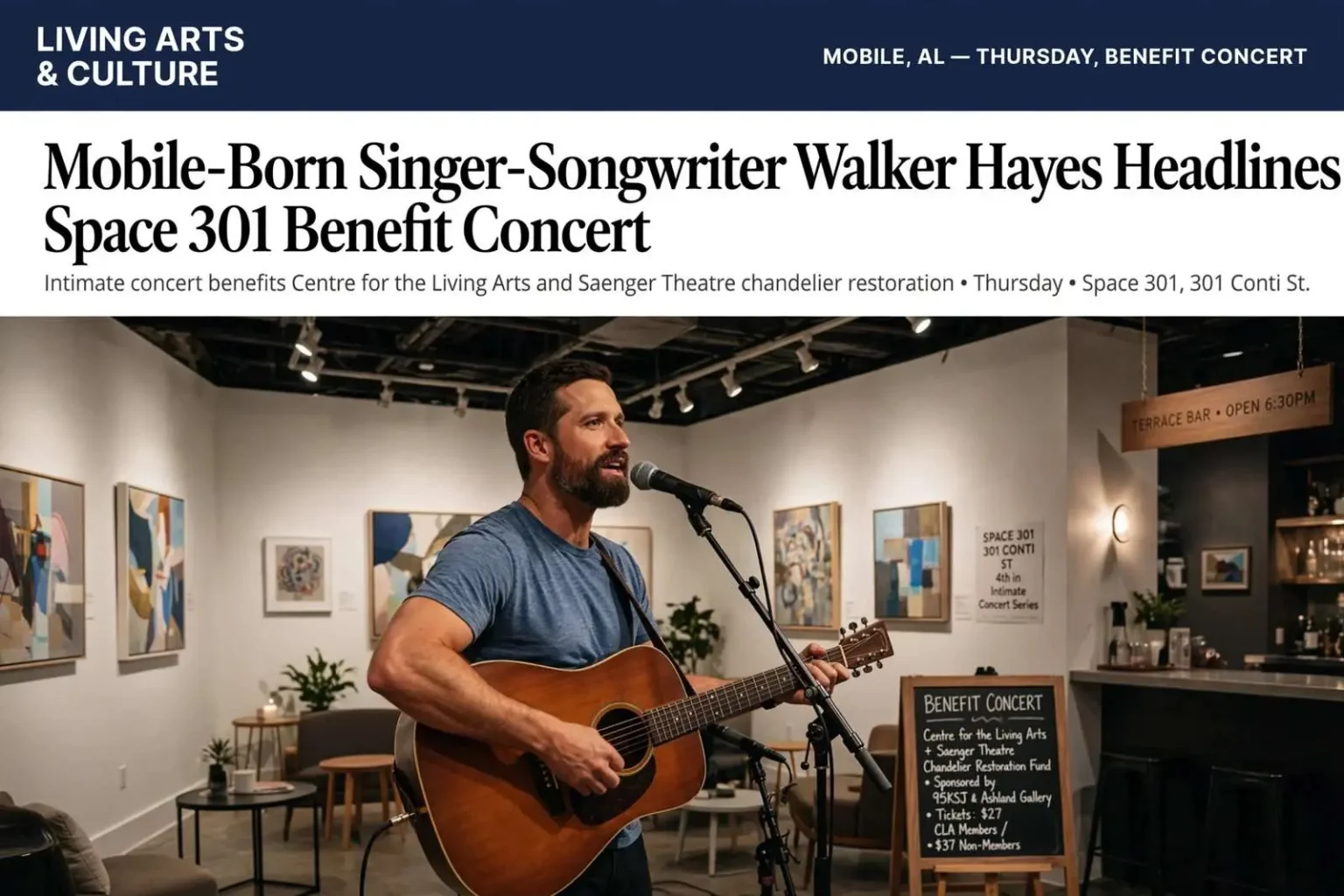
The Centre for the Living Arts continues its intimate concert series Thursday with a benefit show featuring Mobile-born singer-songwriter Walker Hayes at Space 301, the contemporary art gallery at 301 Conti Street in downtown Mobile. The pairing of a rising songwriter and an art gallery one block off Dauphin Street is exactly the kind of evening the series was designed for — close quarters, a serious audience and a performer close enough to talk between songs.
The fourth installment of the series is a benefit for the Centre for the Living Arts and the Saenger Theatre chandelier restoration fund, and is sponsored in part by 95KSJ and Ashland Gallery. Two causes, one night: proceeds support the gallery’s programming and help restore one of downtown Mobile’s most distinctive theatrical details, the Saenger’s chandelier, a fixture of the historic theater’s interior that has watched over performances since the venue’s early days.
Seating is limited to 175 tickets, with the Terrace Bar opening at 6:30 p.m. and the concert at 8 p.m. Tickets are $27 for CLA members and $37 for non-members, with a $2 surcharge on all tickets going to the Saenger restoration fund. Reservations are guaranteed with payment and can be made through the Saenger Theatre box office at 208-5600.
The room itself shapes the experience. Space 301’s galleries, with rotating exhibitions on the walls, give listeners a setting no concert hall can replicate — art on every side, a room built for looking and listening, and an audience small enough that every seat feels close. For a songwriter whose material runs on conversation and detail, it is an ideal stage.
Nashville’s best-known rooms trade on scale; Space 301 trades on proximity, and the series has used that proximity to build the kind of audience loyalty that bigger venues spend marketing budgets chasing. A listener who can see the performer’s face can also feel the song, and the series has made that intimacy its signature. It is a format that flatters writers in particular, because it rewards the narration, pacing and humor that songwriters spend years developing for rooms exactly this size.
From Mobile to Music City
Hayes was raised in Mobile in a blended household of eight siblings and discovered music early, learning piano as a boy and describing himself as torn between athletics and choir. The split identity — sports and songs — is a familiar story for future Nashville writers, but Hayes carried both through a Mobile upbringing that he credits with shaping his ear for the everyday details his songs return to.
He earned a degree in general music with an emphasis on piano at Birmingham-Southern College, then moved back to Mobile to work in real estate with his father before following his songwriting ambitions to Nashville. The detour — a college music degree traded for a family business — is part of the biography that sets Hayes apart in a city full of writers who never did anything else, and Mobile audiences Thursday will hear a songwriter whose route home ran through both.
His debut single, “Pants,” comes from the album “Reason to Rhyme,” which Hayes wrote for his wife. The collection also includes “My Best Friend’s Fiancé,” a playful song he has said was written just for fun — the kind of song that exists because a line made him laugh, a reminder that Nashville careers are still built one funny idea at a time.
Once a cover artist at Nashville’s Bluebird Café, Hayes now makes his living writing original music. The Bluebird is famous for the opposite of what Hayes does now: a room where writers perform other people’s hits in the round, trading stories about songs the audience knows by heart. Learning that trade — holding a room with a story, selling a song line by line — is the apprenticeship behind his own material, and it shows up on stages like Space 301, where the connection between writer and listener is the whole show.
The path from cover sets to original material is the standard Nashville gauntlet, and fewer writers clear it than attempt it. Hayes’s version — a degree, a detour, a cover residency, then a record deal and a debut album built around his own songs — will read as familiar to anyone who knows Music City, and as a reminder of how much persistence the familiar story actually requires.
“From now until the day that I die I can get up and write a song and hopefully it will be better than the last one I wrote,” he said.
The quote captures the workmanlike ambition behind his career: not a single breakout hit as a destination, but a craft to be practiced daily and improved on, song after song. It is the mindset Nashville rewards, and it is the reason a Mobile-born writer with a real estate detour and a college piano degree ends up headlining a benefit concert downtown.
Thursday’s benefit adds Hayes’s name to a series that has quietly built a following among Mobile listeners who prefer their music up close. Each installment pairs a performer with the gallery’s one-of-a-kind setting, and the format — a bar upstairs, a small floor, no barrier between artist and audience — turns the evening into something closer to a house concert than a ticketed show.
The beneficiary organizations both carry weight in Mobile’s cultural life. The Centre for the Living Arts operates Space 301 as the city’s contemporary art venue, mounting exhibitions and arts programming in a building that once housed the Press-Register’s operations downtown — a newspaper address turned into studio and gallery space. The Saenger Theatre, a few blocks away on Joachim Street, has anchored downtown performance since the 1920s, and its restoration fund targets the details — like the chandelier — that keep a historic theater feeling historic rather than merely old.
The $2 surcharge on every ticket is a small line item with a visible result: each attendee walks out having contributed directly to the restoration, whatever the base ticket price. It is the kind of fundraising that suits a community-sized venue — thousands of small gifts rather than a few large ones, each tied to a night of music the donor actually attended.
Sponsorship from 95KSJ and Ashland Gallery connects the event to two audiences at once — the country radio listenership that follows Hayes’s music and the gallery-going crowd that follows the Centre’s exhibitions. That crossover is the point of the series: downtown Mobile’s arts audiences overlap more than their marketing suggests, and a Thursday night that puts a songwriter in an art gallery with a country radio sponsor is the overlap made real.
A hometown return
For Hayes, the show is a return to the city where he learned piano, sang in choir and first imagined music as something more than a hobby. Nashville writers pass through Mobile regularly, but hometown dates carry a different weight — rooms full of people who knew the songwriter before the songs, and who hear the local details in the writing differently than anyone else can.
The 175-seat cap guarantees the intimacy the series promises, but it also means the show will sell out the way the series’ earlier installments have — by word of mouth, quickly, among listeners who know that a ticket to a CLA concert is a season’s worth of live music in one night. Reservations through the Saenger box office guarantee seats with payment, which spurs early action from anyone weighing a Thursday plan.
Hayes’s set will draw on a catalog that ranges from the piano-driven material of his Mobile years to the Nashville songs he now writes for a living, and in a room the size of Space 301, the stories between songs matter as much as the songs. Writers who came up in the Bluebird Café tradition tend to thrive in exactly this setting — unamplified conversations with a room that is listening closely.
The benefit also highlights the circuit that keeps downtown Mobile’s arts venues connected: a gallery on Conti Street, a restored theater on Joachim, sponsors across the dial and the grid, and audiences that move between them. Nights like Thursday — a Mobile-born songwriter, a chandelier fund, an art gallery full of listeners — are the connective tissue of the city’s cultural scene, built show by show rather than by any single institution.
For attendees, the essentials are simple: doors and the Terrace Bar at 6:30, music at 8, $27 or $37 depending on membership, $2 of every ticket to the Saenger’s chandelier, and reservations through 208-5600. For Mobile, the evening offers something rarer — a chance to hear a hometown writer’s story in the room where it started, and to help restore a piece of the theater district while he tells it.