
Mobile Broadcasting Legend Mel Showers Inducted Into Alabama Broadcasters Hall of Fame
Longtime Mobile news anchor Mel Showers was inducted into the Alabama Broadcasters Hall of Fame during a weekend ceremony in Birmingham.
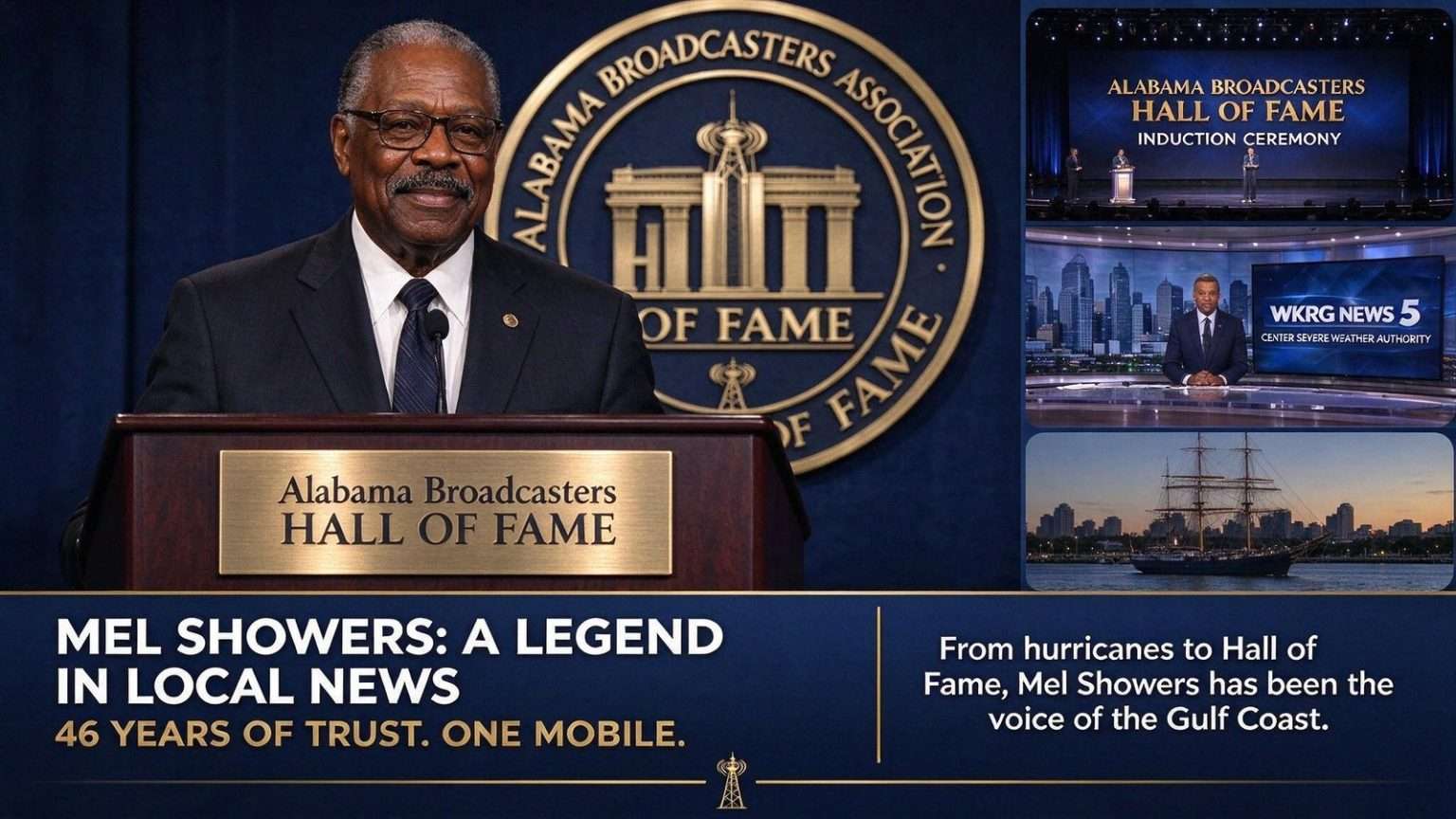
Veteran Mobile news anchor Mel Showers received one of the highest honors in his profession when he was inducted into the Alabama Broadcasters Hall of Fame during a ceremony in Birmingham. The Hall of Fame recognizes broadcasters across the state for their achievements and lasting contributions to the industry, and Showers’ name now sits alongside the men and women who built radio and television news in Alabama from the ground up.
Showers, whose career in Mobile television news spanned more than four decades at the time of the induction, was celebrated for both his longevity and the trust he built with generations of Gulf Coast viewers. In a market where anchors come and go, his presence on the evening news became a fixture of daily life in households from Mobile County to the Florida line.
For the colleagues who gathered in Birmingham, the honor was less about awards and more about recognition of a career spent telling the Gulf Coast’s stories — hurricanes and Mardi Gras, elections and ship launches, triumphs and tragedies alike.
Four Decades of Trust
Longevity in local television is rare; longevity paired with credibility is rarer still. Showers spent the bulk of his career at WKRG, the longtime CBS affiliate serving the central Gulf Coast, where he anchored through an era that transformed local news — the arrival of color broadcasts, radar technology that revolutionized Gulf Coast weather coverage, the internet and the collapse of the traditional evening newscast’s dominance.
Through all of it, viewers kept tuning in. Showers said the relationship between an anchor and an audience is built one broadcast at a time, over years, and that the Hall of Fame honor belonged as much to the people who watched as to the man on the set.
“When you have been around for 46 years that means someone had to watch you and that means that someone cared for you,” Showers said after the ceremony. “In the case of my family, and my Mobile family, I have to admit that today I felt a lot of love.”
The 46 years he referenced capture more than a job. During that span, Mobile grew and changed around him: the port expanded, Airbus arrived to build airliners downtown, and storms from Frederic to Katrina to Sally tested the region’s resilience. Viewers measured many of those moments against the anchor desk they trusted to explain them.
Colleagues Make the Trip
A number of his colleagues made the trip to Birmingham for the honor, including fellow on-air personalities Alan Sealls, Devon Walsh, Rose Ann Haven and John Nodar, along with station news director Mike Rausch, chief photographer Gary Arnold and general manager Mark Bunting.
The turnout said as much about Showers as the plaque did. Newsrooms are demanding places, and careers that stretch across four decades inevitably outlast many of the people a journalist started alongside. That a full delegation of current and former coworkers crossed the state to see him honored reflected the regard he earned inside the building as well as outside it.
Sealls, the veteran meteorologist whose hurricane-season briefings became their own Gulf Coast institution, and Walsh, Haven and Nodar have all spent years delivering the region’s weather and news, and their presence connected the Hall of Fame ceremony back to the station’s daily mission. Rausch, Arnold and Bunting represented the leadership and production side of the operation — the people, as Showers has often noted, who make the broadcast possible long before the anchor reads a word.
A Mentor and a Mobile Historian
Known around the newsroom for his deep knowledge of Mobile history and his willingness to mentor younger journalists, Showers has long been regarded as one of the defining voices of local television news on the central Gulf Coast. Reporters who cycled through the station over the years routinely described him as a resource as valuable as any archive — the person who could explain why a street had its name, how a political feud began, or what a neighborhood looked like before a storm reshaped it.
That institutional memory matters in a city like Mobile, one of the oldest communities on the Gulf Coast, with a civic story that runs from colonial settlement through the shipbuilding and port industries that still drive its economy. Anchors who understand that context can ask better questions and tell fuller stories; Showers’ grasp of the city’s history became part of the station’s on-air identity.
His mentorship extended beyond newsroom walls. Over the decades he spoke to classrooms, church groups and community organizations across the area, and generations of aspiring broadcasters from Mobile and Baldwin counties traced their interest in journalism to watching him on television and deciding that the work looked worth doing.
What the Hall of Fame Means
The Alabama Broadcasters Hall of Fame exists to preserve exactly this kind of career. Inductees are drawn from radio and television across the state and chosen for contributions that outlast individual newscasts — the standards they set, the people they trained and the trust they accumulated. The ceremony in Birmingham brings together broadcasters from every market, from the smallest AM stations to the state’s largest television operations, and the hall’s rolls include some of the most recognizable voices in Alabama history.
For Mobile, Showers’ induction is a reminder that local journalism is built locally. National networks cover the region during hurricanes and elections, but it is the homegrown anchor who sits with a community through the long recovery that follows, the school board dispute that drags on for months and the Friday night scores that never make national air.
Showers’ comments after the ceremony suggested he understood the honor in those terms. The love he felt in Birmingham, he said, came from two families — the one that raised him and the one that watched him for 46 years. Few broadcasters anywhere get to retire that claim, and fewer still get a hall to house it.
As for what comes next, colleagues say the anchor’s habits are hard to break: he still follows the news of the city he covered for most of his adult life, and he still picks up the phone when a young journalist calls asking how a story used to be done. That, more than any plaque, may be his lasting contribution to Alabama broadcasting.
An Era of Change in Local News
Showers’ career also spanned the most turbulent period in the history of local television news. When he began, the evening newscast was the community’s common ground, and stations competed on the strength of their newsrooms. Since then, cable, the internet and social media have fractured the audience, cut newsroom budgets and shortened attention spans across the industry.
Anchors of his generation adapted or exited. Showers adapted, carrying the standards of the older era — verification, fairness, a steady delivery viewers could rely on in a crisis — into a faster and louder media environment. Colleagues say his calm presence during severe weather coverage was a model for how local television serves the public when it matters most: not with spectacle, but with clear, repeated, trustworthy information.
Gulf Coast viewers have long graded their broadcasters on hurricane performance, and for good reason. In this region, an anchor is not simply a presenter but a companion through evacuations, curfews and the uncertain days after landfall. The trust Showers built over decades was earned in exactly those moments, when accuracy and composure carry real consequences.
The Celebration Back Home
The Birmingham ceremony was the official recognition, but the celebration continued back in Mobile, where viewers and former colleagues shared memories of broadcasts past. Longtime listeners to the station’s coverage recalled election nights, Mardi Gras parades and storm coverage stretching back decades, a reminder of how deeply a local anchor weaves into a community’s shared memory.
For the Alabama Broadcasters Association, honoring a career like Showers’ also serves a forward-looking purpose: it shows young journalists entering the profession what a career in local news can mean, and it reminds stations that investment in people — not just technology — is what audiences remember decades later.
Showers joins a distinguished line of Gulf Coast broadcasters in the hall, and his induction adds Mobile’s name to a list dominated by the state’s largest markets. For a newsman who spent 46 years insisting the story was never about him, the tribute was an overdue acknowledgment that in Mobile, the storyteller became part of the story.
Friends of the program note that Showers’ reach extended well beyond the anchor desk. He lent his voice to community events across the city, moderated civic forums and appeared at school functions, treating the visibility that came with his job as something to be spent on Mobile rather than hoarded. It is the sort of intangible contribution a hall of fame exists to honor.
The measure of his standing may be simplest of all: in a market that has seen anchors arrive and depart with regularity, mention of Mobile television news to a longtime resident of the area still, for many, begins and ends with Mel Showers.