
Mobile Catholics Divided as Joe Biden Becomes Second Catholic President
Mobile Catholics were split on Joe Biden's inauguration while Archbishop Thomas Rodi noted the 60-year link to JFK and urged dialogue with the new.
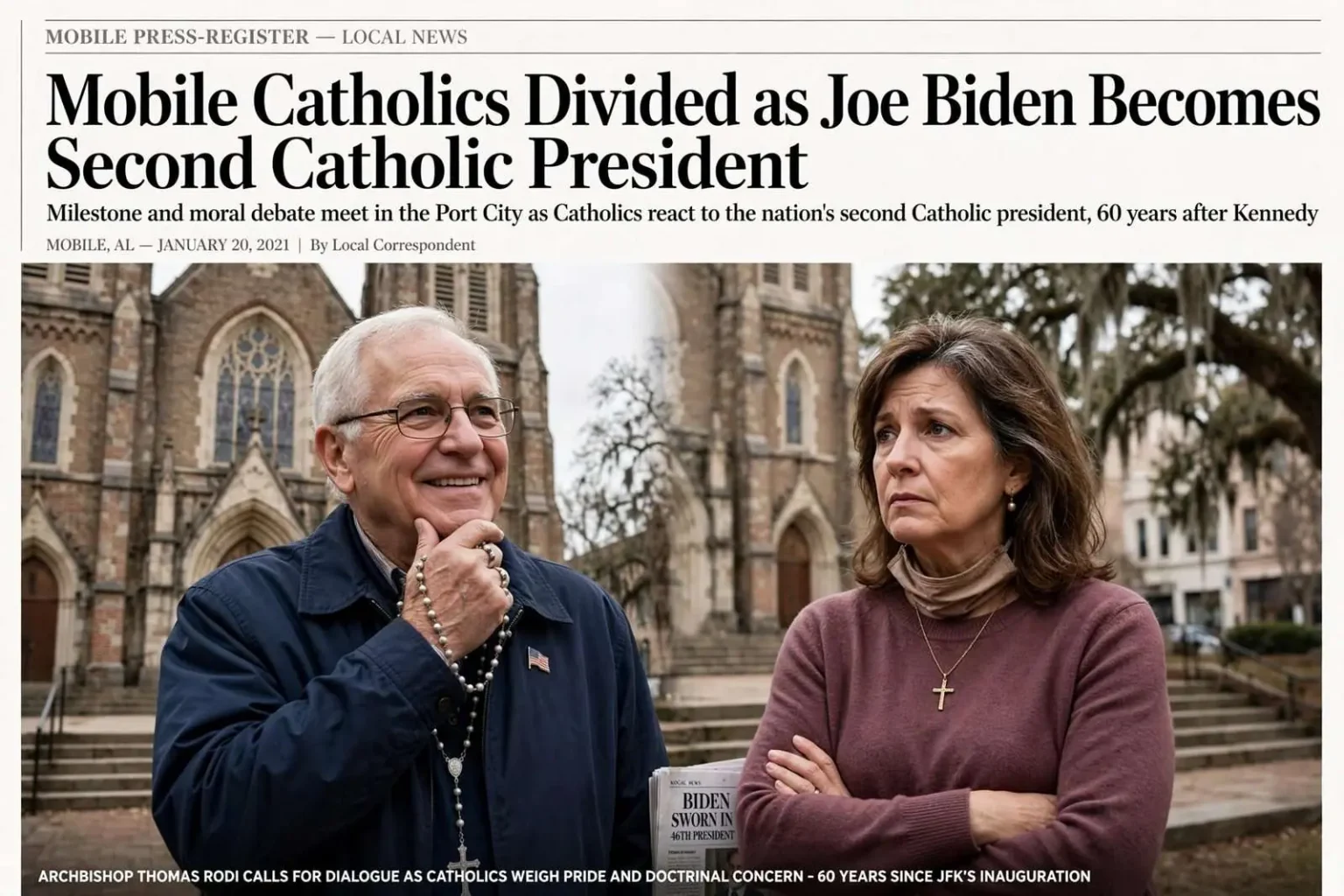
MOBILE — Joe Biden’s inauguration made him the first Catholic president in decades, and the moment drew sharply different reactions from Catholics in Mobile — reactions that mirrored the wider argument running through the American church. In pews, parish halls, and family group chats across the Port City, the arrival of a Catholic in the Oval Office was received simultaneously as a milestone and as a problem, depending on which Catholic you asked.
Some local Catholics celebrated the milestone without reservation. “I think it’s awesome,” said Ronald Sutherland, reflecting a pride many Catholic voters felt in seeing a member of the church take the oath of office. For Catholics of an older generation, the moment carried a particular echo: John F. Kennedy’s election in 1960 had broken a barrier that once seemed insurmountable in a country historically wary of Catholic politicians, and Biden’s swearing-in meant that, at last, a second had followed.
Others questioned whether Biden’s politics reflect their faith. Susan Comeaux argued that because Biden supports abortion rights, contrary to church teaching, he is not truly a Catholic president. That critique — voiced by Catholics across the country in the days around the inauguration — rests on the church’s teaching that abortion is an intrinsic evil, and on the argument that a public official who supports legal abortion cannot claim to govern in conformity with his faith, whatever his personal practice.
A date with history in it
Mobile Archbishop Thomas Rodi called it significant to have a Catholic president, pointing out that Biden’s inauguration fell exactly 60 years after John F. Kennedy — the nation’s first and, until that day, only Catholic president — took the oath of office. The coincidence of the calendar gave the day a symmetry that preachers and commentators noted immediately: January 20, 1961 and January 20, 2021, sixty years apart, each marking the moment a Catholic placed a hand on a Bible and swore to preserve, protect, and defend a Constitution written by Protestants of a different age.
Biden began inauguration morning with a Catholic Mass at the same Washington church where Kennedy’s funeral was held, a detail that fused the two presidencies before the oath was even taken. The private service, held before the president-elect departed for the Capitol, was attended by congressional leaders of both parties — a small ritual of faith at the start of a day that ended with a heavily guarded, largely empty National Mall amid a pandemic and the aftermath of the Capitol riot two weeks earlier.
The archbishop’s hope for dialogue
Rodi acknowledged that some of the new president’s policies will contradict Catholic teachings but expressed hope for dialogue between the White House and the church. It was a deliberately measured stance from a shepherd whose flock, like the nation’s, spans the political spectrum. On issues where believers disagree with the administration, he said, “we’re just going to have to work together,” adding that a divided country needs unity and that the church looked forward to being part of that conversation.
The archbishop’s approach reflected a reality of Catholic life in America: the church’s moral teaching cuts across party lines, opposing abortion and euthanasia while also demanding attention to immigrants, the poor, capital punishment, and care for creation. No administration aligns fully with that teaching, and Rodi’s formulation — acknowledgment of conflict, commitment to engagement — treated the incoming president less as an ally or an enemy than as a counterpart in a long conversation.
Mobile’s Catholic history colors the moment
Nowhere in Alabama is the Catholic question older than in Mobile, home to the state’s first Catholic congregation and the seat of an archdiocese that traces its origins to the 1820s — generations before Alabama had a significant Catholic population elsewhere. The Port City’s parishes, schools, and institutions grew out of a French and Spanish colonial Catholic heritage that makes Mobile distinct within the Deep South, and its Catholics have long been accustomed to being both a minority and an establishment at the same time. That history gave the local reaction to Biden’s inauguration its texture: pride in a barrier crossed, from a community that remembers when Catholics were the ones the barriers were built against.
Older Mobilians can recall the era when Kennedy’s candidacy required a campaign trip to Houston to reassure Protestant ministers that a Catholic president would take orders from the Constitution, not the pope. The fears of that era — that Rome would govern Washington — look distant now, but the memory shapes how Catholic families here read milestones like this one. Biden’s inauguration did not settle the old question so much as render it obsolete: sixty years after Kennedy, a Catholic president required no defense at all, only evaluation on his merits and his policies.
The argument inside the church
The disagreement between Catholics like Sutherland and Comeaux is not a Mobile peculiarity; it is the central argument of American Catholicism in this generation. One camp emphasizes identity and representation — a Catholic in the White House is a sign of the church’s arrival in American life. The other emphasizes fidelity and discipline — a Catholic in the White House whose positions contradict church teaching is a scandal, not a triumph. Both camps quote the same catechism, and the argument has flared around every prominent Catholic politician of both parties for decades.
For parishes, the argument lands in the pews, where neighbors who share Communion do not share politics. Pastors in Mobile and across the country spent the season around the inauguration navigating that reality: preaching church teaching without endorsing candidates, welcoming all comers while teaching clearly, and holding together communities in which the election was a genuine wound between friends. The archbishop’s public tone — hopeful about dialogue, candid about disagreement — modeled the stance most local pastors attempt.
What unity requires
Rodi’s closing note — that a divided country needs unity and that the church looked forward to being part of that conversation — framed the church’s role as one of participant rather than partisan. In a nation coming off a contested election, a pandemic, and an assault on the Capitol, the archbishop’s argument was that institutions like the church, which cross class, race, and party lines, have something particular to offer a fractured public square: a habit of community that persists past the voting.
Whether the Biden presidency deepened or healed the Catholic divide remained, on inauguration day, an open question. What was already certain was the milestone itself: for the second time in American history, and the first time in sixty years, a Catholic took the oath of office — and in Mobile, the city that is home to Alabama’s oldest Catholic community, the news was received the way Catholics here have received most things for two centuries, with a mixture of pride, scrutiny, and the certainty that faith and politics will keep testing each other.
The Kennedy parallel, sixty years later
The sixty-year gap between the two Catholic oaths of office invites a comparison the two men themselves would have understood. Kennedy, the Massachusetts senator, was elected amid open questions about whether his religion disqualified him; he answered them by insisting on the absolute independence of his office from his church, and he governed in a way that kept the subject marginal. Biden, a lifelong Catholic known for attending Mass regularly and carrying his son’s rosary, presents a different model: not a Catholic proving his religion costs him nothing, but a Catholic whose faith is publicly personal even as his policy positions draw fire from his own bishops.
For Catholics evaluating the moment, the comparison cuts both ways. Some see progress in the fact that a Catholic no longer has to explain away his faith to hold the office. Others see decline in the fact that a Catholic president’s most visible conflicts are now with his own church rather than with those outside it. Both observations were heard in Mobile in the days around the inauguration, often from Catholics in the same parish.
How the local church marks such moments
The Archdiocese of Mobile, as the metropolitan see for all of Alabama, speaks for a statewide Catholic population that is small by Southern standards but old by American ones. Its communications tend toward the measured, and Rodi’s inauguration-week comments fit the pattern: no celebration of party, no condemnation of person, an acknowledgment of the historic significance of a Catholic president, and an honest statement that the new administration’s positions would conflict with church teaching on some issues.
That kind of statement serves pastors and parish leaders across the state, who inherit the question the moment raises and must answer it locally. A milestone that one parishioner reads as vindication and another reads as betrayal requires a shepherd who can hold both readings in view — which is, in effect, what the archbishop attempted: naming the pride and the conflict together, and pointing both toward the work ahead.
For the Catholics of Mobile, the day itself passed the way such days do — with the Mass at the same church where Kennedy was mourned, the oath at the Capitol, and then the longer work of deciding, parish by parish and conscience by conscience, what it means when one of your own reaches the office that, for most of American history, Catholics were told was beyond them.


