Mobile Celebrates Path Forward for I-10 Mobile River Bridge, Groundbreaking Expected by Year’s End
Mayor Spiro Cheriogotis celebrated a major milestone in the long-promised I-10 Mobile River Bridge and Bayway project, as federal, state, and local partners cleared a path toward groundbreaking before the end of 2026.
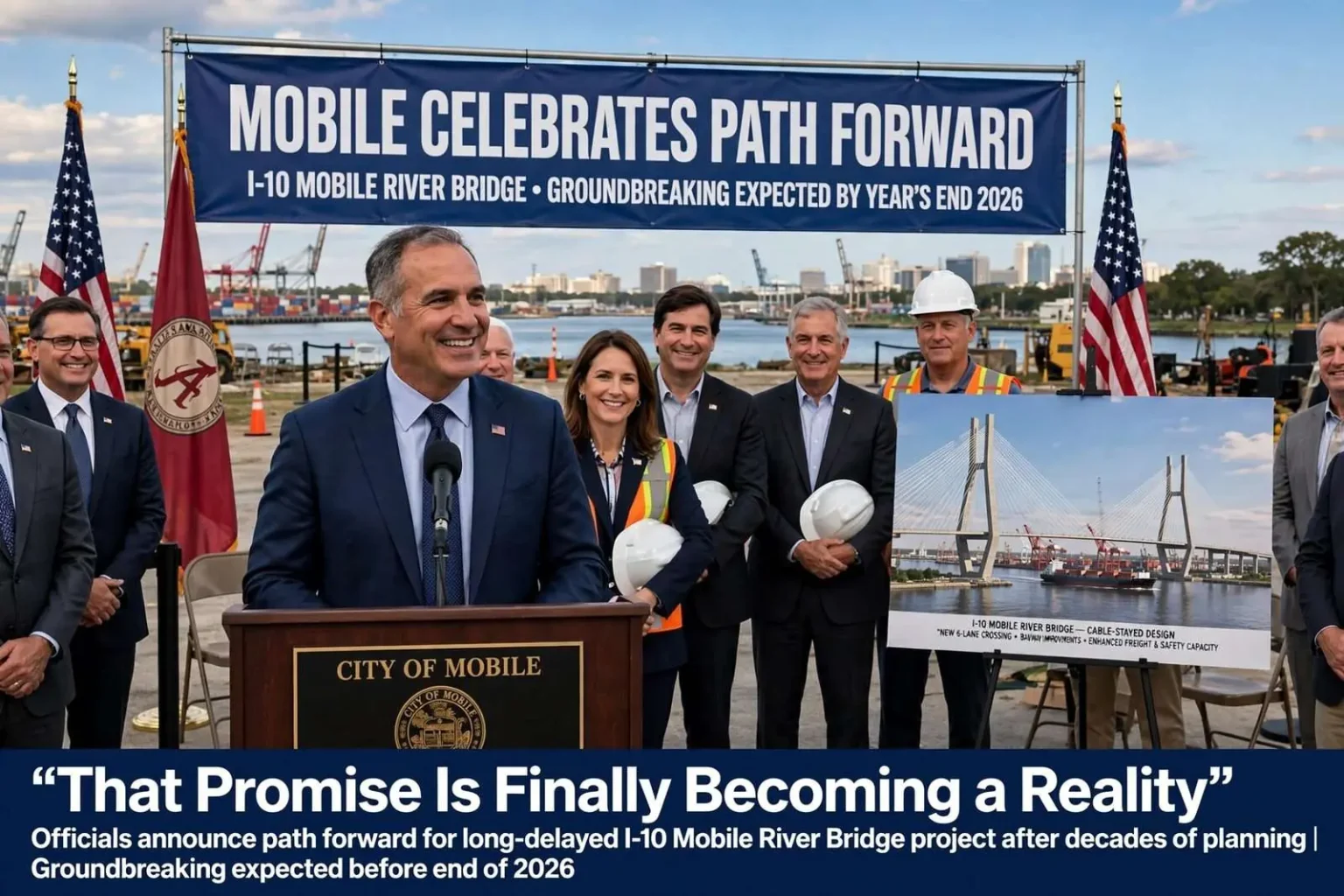
Mayor Spiro Cheriogotis celebrated a major milestone in the decades-long push to build a new I-10 Mobile River Bridge, as federal, state, and local partners announced a path forward that positions the long-delayed project for groundbreaking before the end of 2026. The announcement marks one of the most significant developments yet in a project residents have heard promised for years without seeing shovels in the ground.
“That Promise Is Finally Becoming a Reality”
“For many years, the people of Mobile have been promised a new I-10 river bridge,” Cheriogotis said. “Today, I’m proud to say that promise is finally becoming a reality. This is the most significant infrastructure project in the history of our region, and it has been decades in the making. A milestone like this does not happen overnight.”
That framing reflects just how long the project has languished in planning stages. Various versions of a new Mobile River crossing have been studied, debated, and shelved over more than a decade, with earlier proposals derailed in part by public opposition to proposed tolling structures. The renewed path forward described by Cheriogotis and his federal and state partners suggests that at least some of those earlier obstacles have been resolved sufficiently to allow construction to move ahead.
What the Project Includes
The project encompasses construction of a new cable-stayed Mobile River Bridge, along with improvements to key interchanges and traffic flow throughout the broader I-10 corridor. It also includes enhancements to the existing Bayway, the elevated highway spanning Mobile Bay, intended to expand capacity to six lanes across the bay. Cable-stayed bridges, which use cables anchored to towers to support the deck, are typically chosen for long-span crossings where a traditional suspension bridge would be more costly or where navigational clearance requirements for shipping traffic beneath the span are a factor — both considerations relevant to a crossing over the actively used Mobile River shipping channel.
City officials emphasized that the project will not eliminate existing free routes across the river. The Wallace Tunnel, Bankhead Tunnel, the Causeway, and the Africatown Bridge are all expected to remain open and free to motorists once the new bridge is complete, addressing a concern that has featured prominently in past public debate over whether a new bridge would come bundled with tolls on routes that are currently free.
A Project of National, Not Just Local, Significance
Cheriogotis framed the bridge’s importance well beyond Mobile’s city limits, describing the I-10 corridor through the area as a critical chokepoint in interstate commerce. “I-10 through Mobile is the primary chokepoint for traffic between Houston and Jacksonville,” Cheriogotis said. “It is a critical military corridor and a linchpin of our national supply chain. What we build here doesn’t just move Mobile forward — it strengthens the entire nation. This bridge is not just a Mobile priority, it is an American priority.”
That characterization reflects the corridor’s role as one of the few interstate crossings connecting the Gulf Coast’s major population centers along the I-10 route, which runs from Los Angeles to Jacksonville and serves as a primary artery for both commercial freight and military logistics moving along the southern United States. Bottlenecks at aging river and bay crossings like Mobile’s existing tunnels and Bayway have long been cited by transportation planners as a drag on regional and even national freight efficiency.
Crediting a Broad Coalition
Cheriogotis credited a lengthy list of federal, state, and local partners with helping move the project across what he described as the finish line of the planning process, including the White House, the U.S. Department of Transportation, Governor Kay Ivey, Sen. Katie Britt, Sen. Tommy Tuberville, Rep. Shomari Figures, and Rep. Barry Moore, along with the Mobile and Eastern Shore Metropolitan Planning Organizations. He also acknowledged the many former elected officials who played a role in advancing the project over the years it spent in various planning stages.
Notably, Cheriogotis specifically recognized his predecessor, former Mayor Sandy Stimpson, “for being such a devoted champion of this project throughout his administration” — an acknowledgment that the bridge’s path to groundbreaking spans not just years, but multiple mayoral administrations, underscoring how long a project of this scale can take to move from concept to construction even with sustained political will behind it.
What Comes Next
With officials now pointing toward groundbreaking before the end of 2026, attention will shift toward finalizing remaining engineering, environmental, and funding details needed to move the project from milestone announcement to active construction. Given the project’s scale — spanning a major shipping channel, a heavily trafficked interstate corridor, and an elevated bay crossing — the full construction timeline is expected to extend over multiple years once work begins.
“Mobile, you’ve waited long enough,” Cheriogotis said in closing his remarks. “We’re building this bridge.” For a project that has tested the patience of Gulf Coast commuters and regional logistics operators alike for more than a decade, that simple declaration carries the weight of a long and, at times, uncertain road to this point.
A Familiar Struggle for Aging River Crossings
Mobile’s decade-long path toward a new I-10 river crossing mirrors a challenge faced by numerous American cities whose aging bridges and tunnels have fallen well behind current traffic demand. Major bridge replacement projects of this scale routinely take a decade or more to move from initial engineering studies through environmental review, funding assembly, and final design before construction can begin, a timeline that often outlasts the political careers of the officials who first championed a given project.
The financing puzzle behind projects like this one typically requires layering together federal discretionary grant programs, state transportation department funding, and in many cases local or regional contributions, since few bridge megaprojects can be funded entirely through a single funding source. Public opposition to tolling — a recurring flashpoint in Mobile’s own bridge planning history — has similarly complicated bridge and tunnel replacement efforts in other American cities, where residents accustomed to free crossings have resisted proposals that would introduce new tolls even when a toll-funded structure represents the fastest path to construction.
\n
What a Cable-Stayed Design Means for the Region
\n
Choosing a cable-stayed design for the new Mobile River Bridge reflects engineering considerations specific to the site: the design allows for a long, unobstructed span capable of accommodating both the navigational clearance needs of vessels using the Port of Mobile’s shipping channel and the aesthetic ambitions cities often attach to signature bridge projects, which frequently become new visual landmarks for a region’s skyline. Once complete, the bridge is expected to join a small group of similarly engineered crossings along the Gulf Coast, offering both a functional capacity upgrade and a new visual identifier for the Mobile Bay region.
The Regulatory Path From Announcement to Groundbreaking
Large interstate bridge projects like the new I-10 Mobile River crossing typically cannot move from a funding announcement directly to construction; they must first clear a series of federal regulatory checkpoints that can themselves take years to complete. Under the National Environmental Policy Act, projects of this scale generally require an environmental review examining impacts on water quality, wetlands, air quality, and nearby communities, along with public comment periods that allow residents and stakeholders to weigh in before final approval. Coordination with agencies such as the U.S. Coast Guard is also typically required for any bridge crossing a navigable waterway, since the agency must certify that a proposed design provides adequate clearance for the vessels that use the channel below, a step of particular relevance for a bridge spanning the Port of Mobile’s active shipping lanes. Only once those reviews and permits are in hand can a project move to final design and construction bidding, which is why officials describing a “path forward” toward groundbreaking are often signaling that the most time-consuming regulatory hurdles have been cleared rather than announcing that shovels are about to hit dirt immediately.
How Megaprojects Like This Get Funded
Bridge and interstate projects of the scale described for the Mobile River crossing rarely rely on a single funding source. In recent years, large highway and bridge projects across the country have increasingly drawn on competitive federal grant programs created or expanded under the Bipartisan Infrastructure Law, including discretionary Mega and INFRA grant programs administered by the U.S. Department of Transportation that specifically target projects of national or regional economic significance. Those federal dollars are typically paired with state transportation department funding and, in some cases, contributions from regional planning organizations or local governments, since the total cost of a signature bridge project can run into the billions of dollars — well beyond what most state transportation budgets can absorb from a single funding cycle. Assembling that kind of multi-source funding package, and securing sign-off from the range of federal, state, and local partners Cheriogotis credited, is itself often the single biggest reason megaprojects take years to move from concept to construction, since each funding partner typically has its own approval process and timeline that must align before dollars can actually flow to a project.
Mobile’s Place in the I-10 Freight Corridor
Interstate 10 functions as one of only a handful of continuous east-west interstate routes connecting the Gulf Coast’s major metropolitan areas, running from the Los Angeles basin through Texas, Louisiana, Mississippi, Alabama, and Florida before terminating in Jacksonville. Along that route, river and bay crossings represent natural chokepoints where traffic volume regularly exceeds what aging infrastructure was originally designed to carry, and Mobile’s existing tunnels and Bayway are frequently cited by regional planners as among the more constrained stretches of the entire corridor. Freight moving between Texas petrochemical and manufacturing hubs and Florida or the broader Southeast has limited alternative routes that avoid Mobile entirely, which is part of why local officials and their federal partners have framed the bridge as more than a local commuting improvement. Similar chokepoint bridge-replacement efforts have played out in other Gulf Coast communities in recent years, including a major Interstate 10 bridge replacement project over the Calcasieu River in Lake Charles, Louisiana, a comparably aging crossing that similarly took many years of planning and funding negotiations before construction could begin.
What Multi-Year Construction Often Means for a Region
Once a project of this magnitude actually breaks ground, the construction period itself typically becomes a significant factor in daily life for the surrounding region. Major bridge and interstate projects spanning active shipping channels commonly take several years to complete, during which transportation agencies generally implement traffic management plans that can include lane reductions, temporary detours, and phased construction designed to keep at least some capacity open throughout the build. Local officials overseeing similar megaprojects elsewhere have often paired construction announcements with public information campaigns aimed at helping commuters and freight operators plan around expected disruptions well before work begins, a step Mobile-area planners will likely need to take of their own as engineering and construction schedules solidify in the months ahead. The scale of disruption typically depends heavily on whether contractors can build significant portions of a new structure alongside the existing crossings before those older routes are finally decommissioned or repurposed, an approach that tends to minimize the period during which regional traffic capacity is meaningfully reduced.