Mobile City Clerk Lisa Lambert Reflects on Three Decades of Trailblazing Service Ahead of Retirement
Mobile City Clerk Lisa Lambert, the city's first Black female clerk, is set to retire in December after more than 30 years of service to city government.
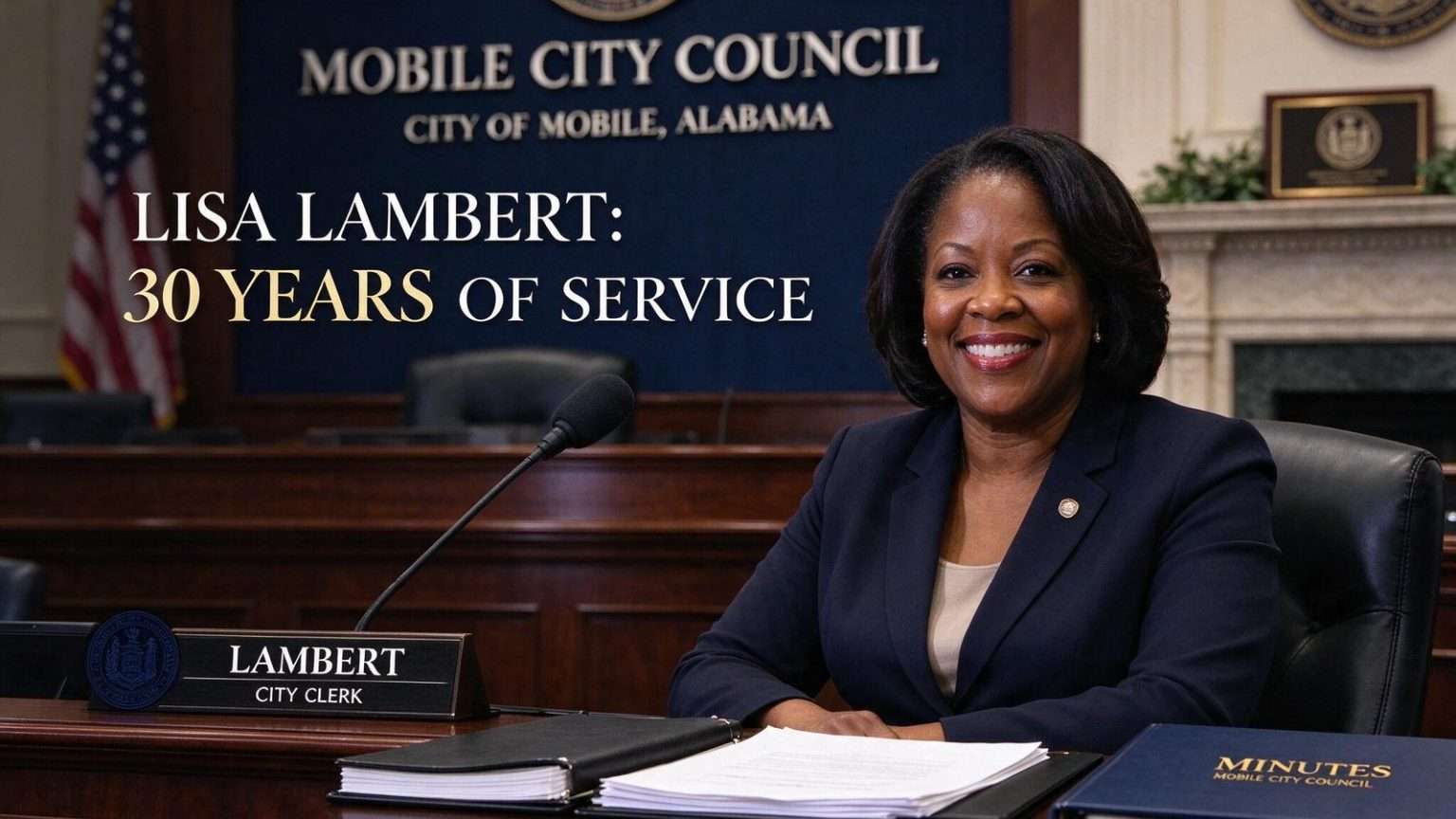
Mobile City Clerk Lisa Lambert, recently recognized as one of the hardest-working officials in city government, says she plans to retire from her post in December after more than three decades of service to the city. Her departure will close out a career that includes two historic firsts and a legacy of modernizing the way Mobile keeps its public records.
A native of Mobile, Lambert made history in 1994 when she joined the city clerk’s office, becoming the first Black woman to serve as Mobile’s assistant city clerk. She made history again in 2008, when she was sworn in as the city’s first Black female city clerk. Both milestones came in a city government whose leadership looks very different today than it did when she began, and both reflected a career built steadily upward through the ranks rather than a single appointment.
From Law School Plans to Public Service
Lambert said she originally studied political science at Southern University and A&M College in Louisiana with plans to attend law school. She later changed course and pursued a master’s degree in public administration instead — a pivot that steered her away from the courtroom and toward the machinery of government itself, where she would spend her career making the system work for others.
Lambert worked for a health care company in New Orleans before returning to Mobile to be closer to her aging parents, and it was that homecoming that led her to apply for an opening as assistant city clerk. The move turned out to be a permanent one. What she expected to be simply a job closer to family became a calling, and the clerk’s office became the place where she would spend the rest of her working life.
Her path also reflects a truth about municipal government that residents rarely see: the professionals who run the administrative side of city hall usually arrive by unexpected routes. Very few people set out to become a city clerk. The job finds them through a combination of circumstance and aptitude — an eye for detail, a tolerance for procedure, and the patience to serve a public that only notices the office when something goes wrong.
What a City Clerk Actually Does
City clerks are responsible for maintaining a municipality’s public records, supporting the work of city councilors and overseeing local elections. The job description sounds simple and is anything but. Every ordinance, resolution, contract, minute and official notice that passes through city government flows through the clerk’s office, and each one carries legal requirements about how it must be recorded, published and retained.
Lambert said her office’s workload follows the City Council’s agenda, swelling and shrinking with the volume of items the council takes up each cycle. Preparing agendas means assembling supporting documents, confirming legal notices have been properly published, and making sure the public record reflects exactly what was considered and decided — work that happens days before any meeting the public attends.
The clerk’s role in meetings themselves is equally demanding. Accurate minutes are the legal memory of the city, and disputes about what a council decided years ago are settled by the record the clerk’s office kept. Lambert’s three decades in the office mean that much of Mobile’s recent governmental history exists in the form she and her staff created.
Election Season: The Job’s Biggest Test
Lambert said organizing and executing Mobile’s municipal elections remains the most demanding part of the job, requiring roughly a year of advance preparation. Municipal elections touch nearly everything her office does at once — candidate qualifying, polling logistics, legal advertising, ballot preparation and the training that ensures every vote in the city is cast and counted according to state law.
The year of preparation is not padding. Alabama’s election code sets firm deadlines for qualifying periods, notice requirements and equipment testing, and a single missed step can invite legal challenges that cast doubt on an entire election. The clerk’s office begins its planning long before candidates qualify, coordinating with the probate office, state officials and the city attorney’s office to make sure every requirement lands on time.
For voters, the visible part of an election is the polling place and the ballot. Behind it sits the work Lambert’s office does: verifying candidates’ paperwork, publishing notices, preparing poll workers and answering the hundreds of questions that arrive in the weeks before Election Day. A smooth election, in the clerk’s world, is the goal — because a boring election is a well-run one.
A Staff of a Dozen
Lambert credited her staff of about a dozen employees with helping the clerk’s office run smoothly through its busiest stretches. Twelve people, in practice, handle the records, agendas, meetings and elections of a city of nearly 200,000 residents, which means every member of the team has to operate across multiple responsibilities rather than a single specialty.
Managing that team is its own skill, and one that Lambert’s successors will inherit along with the office itself. Clerks’ offices run on institutional knowledge — knowing which file holds which document, how a particular notice must be worded, who to call when a question crosses into legal territory. Preserving that knowledge through a leadership change is one reason retirements like Lambert’s matter more than the title suggests.
Beyond her historic firsts, Lambert is credited with digitizing and preserving roughly two centuries of the city’s municipal records, work she said has made public information more accessible to city employees and residents alike. The project transformed records that once existed only on paper or microfilm into searchable digital archives, protecting Mobile’s governmental history from fire, water and decay while making it available to anyone with a question about how the city reached its present.
Two Centuries of Records, Made Public Again
The digitization effort deserves its own note in the city’s history. Mobile is one of the oldest cities in America, and its municipal records reach back through generations of government under multiple flags — French, Spanish, British and American — before Alabama even became a state. Records that old are irreplaceable originals, and every year they spent in paper form increased the odds that fire, humidity or simple aging would claim a piece of them.
Digitizing that archive serves more than historians. Residents researching property questions, attorneys tracing ordinances, journalists checking what a past council decided, and city employees answering daily questions all draw on the same records. Putting them in a searchable digital form turned work that once took days of archive-pulling into minutes, and Lambert’s office absorbed that effort on top of its regular duties rather than as a separate project.
Preservation of that scale also carries civic meaning in a city that has, at times, struggled to protect its historic assets. A government that can show its own records back through the centuries is a government that can prove its continuity, and the clerk’s office is where that proof lives.
Advice for Whoever Comes Next
Lambert said she has taken the greatest satisfaction in knowing her work has helped the city function at its best, and she encouraged whoever succeeds her to always follow the law above all else. The advice is characteristically plain, and it captures the clerk’s position in city government: the office sits closest to the legal requirements that keep a city’s actions valid, and shortcuts there are the kind that show up later in court.
Her retirement in December will hand the office to a successor who inherits both a modernized operation and a standard of service built over three decades. City officials have not announced the process for selecting the next clerk, but the transition comes at a moment when the office’s systems — digital records, refined election procedures, a trained staff — are stronger than at any point in the city’s history. Continuity, not reinvention, is the task ahead.
For the city’s Black residents and for young people considering careers in public administration, Lambert’s two firsts remain part of her legacy. She joined the clerk’s office in 1994 as the first Black woman to serve as assistant city clerk and rose to become the first Black female city clerk in 2008, a progression that mirrored the diversification of Mobile’s government leadership over the same period.
As December approaches, the city’s council members, staff and residents who have worked with her over the years will get the chance to mark the occasion in council chambers — the same room where her office has kept the record of Mobile’s decisions for more than thirty years. Her career ends where it functioned: in the paperwork, procedure and quiet competence that make a city work, noticed mostly in the moment it is no longer there.