Mobile City Council Approves 100-Year Lease for Six-Story Army Corps Headquarters Downtown
The Mobile City Council approved a century-long lease letting the Army Corps build a six-story, 800-employee headquarters on Civic Center property.
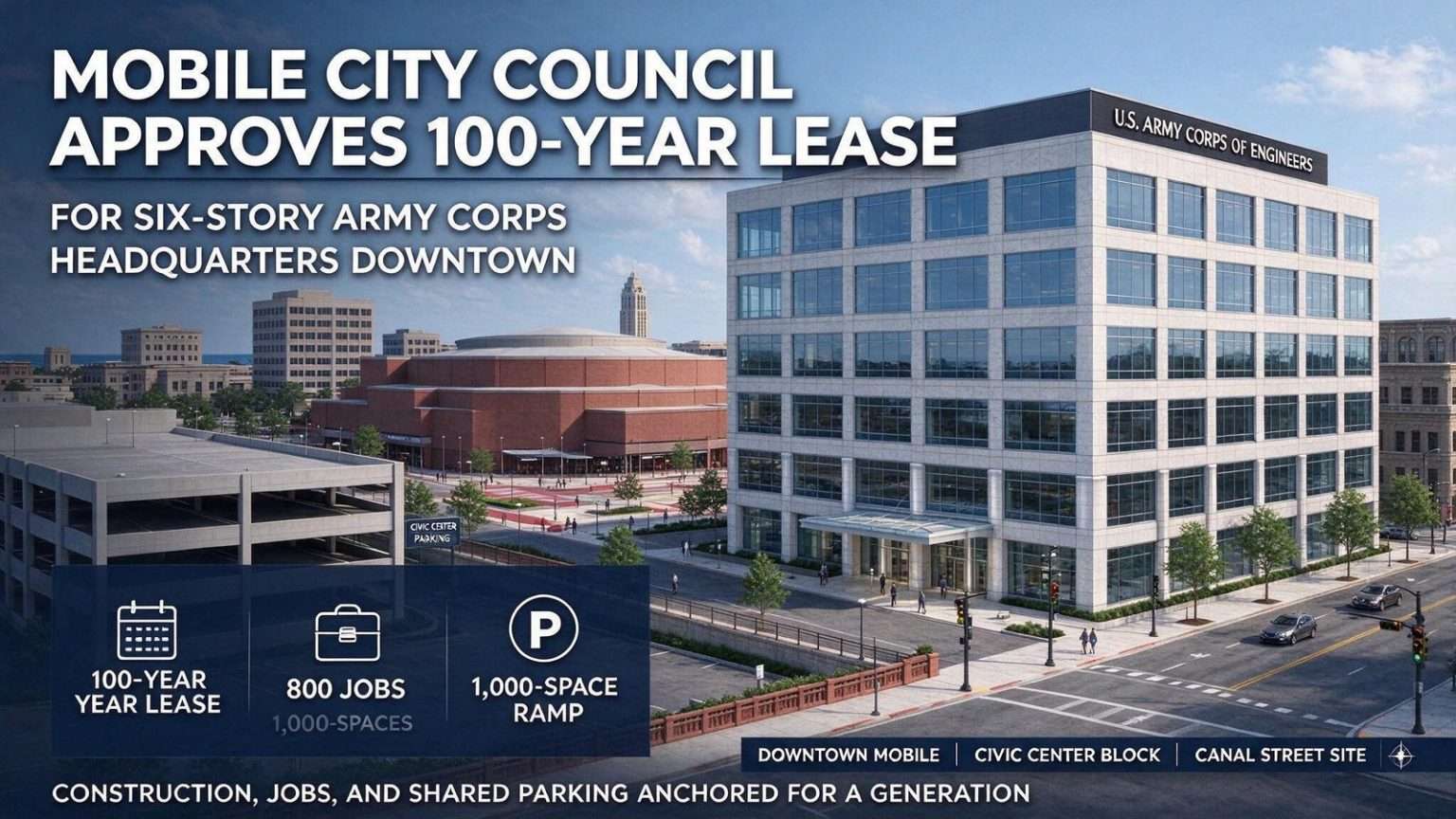
The U.S. Army Corps of Engineers is staying in downtown Mobile — and getting a new building for it. The Mobile City Council approved a 100-year lease clearing the way for the Corps to construct a six-story regional headquarters on a portion of the Civic Center property, locking one of the city’s largest federal employers into the urban core for the next century.
The building will rise at the southeast corner of the current Civic Center parking lot, facing Canal Street, and about 800 employees will work there once it opens. As part of the deal, the Corps will also build a 1,000-space parking ramp that can serve both its staff and visitors attending Civic Center events — a shared benefit city officials pointed to in backing the agreement.
The lease terms, decade by decade
The lease terms start modestly: the Corps pays just a dollar a year for the first ten years, steps up to $100,000 annually in years eleven through twenty, and then pays market rate for the remainder of the century-long term. In effect, the city trades rent revenue now for construction investment and job stability that will compound across generations — the federal government fronts the cost of a building and a parking deck, and the city keeps the land, the tax-generating activity around it and the workforce in place.
Mayor Sandy Stimpson and a majority of council members argued the arrangement was worth it to keep the federal agency — and its hundreds of jobs — anchored in downtown Mobile rather than losing them elsewhere in the region. The alternative, officials noted, was a real possibility: federal agencies routinely weigh relocations when their facilities age, and a regional headquarters that leaves downtown takes paychecks, lunch traffic and professional activity with it.
The structure also insulates the city from the classic risk of federal building deals. Because the Corps is building rather than the city, Mobile does not carry construction debt, and the escalating rent schedule means the land generates meaningful revenue long before the century lease runs out.
What the Army Corps does in Mobile
The Corps’ Mobile District is one of the most consequential federal installations in the region, overseeing civil works and military construction across a swath of the Southeast that includes Alabama, Mississippi and the Florida Panhandle. Its missions run from deep-draft navigation — dredging and maintaining Mobile Harbor and the ship channel that serves the Port of Mobile — to flood control, hurricane and storm damage reduction, environmental restoration and emergency response after Gulf storms.
That portfolio makes the district a fixture of Gulf Coast life whether residents realize it or not. The harbor’s depth and channel maintenance underpin the container business at the Port of Mobile, one of the fastest-growing deepwater ports in the country; the district’s flood-control and shoreline projects shape how coastal communities weather hurricane season; and when storms hit, Corps teams are among the first federal assets marshaled for debris, temporary roofing and infrastructure assessment.
Eight hundred employees — engineers, project managers, planners, contracting officers and support staff — represent a dense concentration of professional employment that cities across the Southeast compete to hold. Federal jobs are stable, well-paid and resistant to economic cycles, and they generate exactly the daytime population that downtown merchants and restaurants build their business around.
Why downtown Mobile wanted to keep them
The decision to trade Civic Center parking lot land for a century of Corps presence fits the city’s broader downtown strategy. Mobile has spent two decades rebuilding its urban core — investing in the Historic District entertainment zone along Dauphin Street, courting residential development in formerly vacant blocks and positioning downtown as the region’s center for entertainment, dining and professional activity.
A regional headquarters full of daily workers is a cornerstone of that ecosystem. Office buildings and federal installations put thousands of people on downtown sidewalks between 8 a.m. and 5 p.m., the hours that keep coffee shops, lunch counters and service businesses viable — the base layer of foot traffic on which the evening economy is built. Cities that lose their daytime populations to suburban campuses almost always watch retail follow.
The parking ramp adds a piece of infrastructure downtown Mobile has needed for years. Event parking around the Civic Center has long been a pinch point — aging surface lots, scattered garages and the crunch of sellout nights — and a modern 1,000-space deck serving double duty, Corps employees on weekdays and Civic Center crowds on event nights, relieves pressure that would otherwise require the city to fund a deck on its own.
The Civic Center context
The lease also intersects with the long-running question of the Mobile Civic Center itself. The facility that anchors the block — an arena, theater and expo hall opened in the 1960s — has aged past the standard of mid-sized arenas across the Southeast, and city leadership has spent years studying how to replace or redevelop it. The six-story headquarters rising on the parking lot’s southeast corner will share the block with whatever the Civic Center’s future holds, and the shared parking deck was designed with exactly that mixed future in mind.
City officials framed the two projects as complements rather than competitors. A new federal headquarters brings 800 workers to the block every weekday; a revitalized Civic Center brings thousands on show nights. Shared parking ties the economics together, letting the deck earn its keep across both calendars instead of sitting empty on weekends.
How the deal came together
Federal building projects of this scale require coordination well beyond a city council vote — congressional appropriations, federal design and procurement processes, environmental review — and the city’s role was to make the land available on terms that satisfy federal real-estate rules. The 100-year term is standard practice for federal leases on locally owned land, giving the government long-term tenure while leaving the underlying property in the city’s hands.
The dollar-a-year opening decade drew discussion, but supporters on the council framed it as the cost of admission for a deal that brings a new building, a parking deck and nearly a thousand jobs without the city spending a dollar of capital. By the time the lease reaches market rate, the land will be hosting a headquarters district rather than an empty corner of a parking lot — a trade council members described as obviously favorable.
Mayor Stimpson’s administration has emphasized federal recruitment as an economic development tool throughout his tenure, and the Corps deal is among its most durable results: unlike a private employer that can relocate on business cycles, a federal district headquarters moves only with an act of Congress and years of budget process. The 100-year lease makes the anchor that much harder to lift.
What construction brings in the meantime
Before the 800 employees ever badge in, the project puts construction crews, contractors and suppliers to work. A six-story federal office building and a 1,000-space parking deck represent years of construction activity on a single downtown block — site work, foundations, structural steel, facade systems, interior fit-out — much of it awarded to regional contractors and staffed by the Gulf Coast’s deep construction labor pool.
That phase carries its own local payoff, and cities typically see it as the down payment on the deal’s long-term value: wages spent locally, materials sourced through area suppliers and a finished asset that would otherwise have been built — and taxed — somewhere else.
The regional stakes
Mobile’s competition for the headquarters was never theoretical. Federal agencies weigh sites across a region when facilities age or leases lapse, and the Corps’ Mobile District could plausibly have relocated to a suburban office park, another city on the central Gulf Coast or a federal campus elsewhere in Alabama. Every one of those outcomes would have moved hundreds of professional households out of the city’s tax base and its downtown economy.
Keeping the district downtown also preserves something subtler: the professional density that attracts other tenants. Law firms, engineering consultancies, financial advisors and contractors that serve the Corps cluster near their client, and a headquarters district tends to pull more of that ecosystem around it over time. The six stories rising on Canal Street will not just house 800 workers; it will anchor the orbit of businesses that follow federal work.
What residents should expect next
With the lease approved, the project moves into the federal side of its timeline — design, contracting and then the October-of-approval construction phases that will make the headquarters visible from the street. Downtown commuters and Civic Center event-goers should expect construction traffic and intermittent parking changes on the block as the corner lot converts to a job site, with the parking ramp designed to eventually restore capacity the surface lot currently provides.
City officials have presented the deal as a century-long win: land the city already owned, converted into a headquarters, a deck and 800 reasons for the federal government to stay. The council’s vote closed the deal-making chapter; the decades of paychecks, lunch traffic and event-night parking that follow are the return on it — and for a city that has spent twenty years rebuilding its downtown, keeping its largest federal employer at the center of it was, in the mayor’s telling and the council majority’s vote, the trade worth making.