Mobile Council Delays Vote on Handing History Museum to Nonprofit Board
Mobile city leaders postponed a vote on turning management of the History Museum of Mobile over to its board, a move that would lay off 19 city employees.
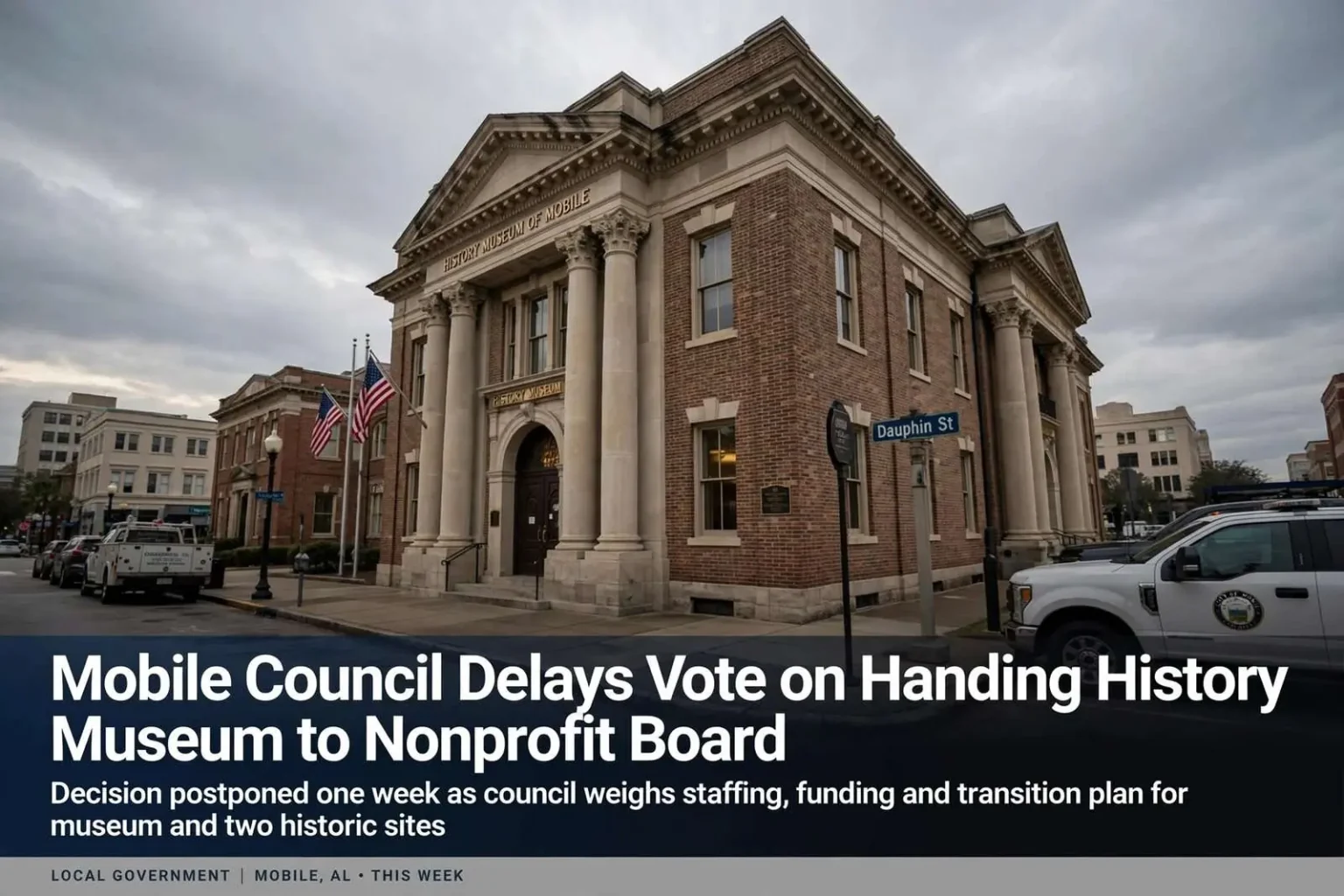
Mobile city leaders held off on a decision this week that would shift day-to-day management of the History Museum of Mobile from a city department to the museum’s own nonprofit board, a change that would affect nearly two dozen city employees. The delay came as council members weighed questions about staffing, funding and the pace of a handover that would remake how one of the city’s flagship cultural institutions is run.
The proposed resolution, sponsored by the mayor’s office, would authorize the museum’s nonprofit board to operate several city-owned cultural sites, including Fort Conde, the Phoenix Fire Museum and the historic building that houses the main museum collection. The measure also includes roughly $210,000 in city funding to help the board cover operating costs through the end of September as the transition takes place. Under the arrangement, the museum’s board would take on full responsibility for finances and personnel, shifting the institution away from its current status as a city department.
Nearly two dozen jobs in transition
Roughly 19 city employees connected to the museum were previously notified that their positions would be eliminated at the start of August to make way for the handover, with the board expected to conduct its own hiring for replacement staff. A board member said interviews for the newly created positions would begin as soon as this week, though the exact number of jobs available has not yet been finalized. The timeline leaves current workers facing weeks of uncertainty about whether they will have a place in the new structure, even as the board moves to fill the posts the transition creates.
The board also plans to launch a nationwide search for a new executive director to replace the museum’s longtime director, who was among those informed of the layoffs. Recruiting a director from outside the region is a sign of how thoroughly the handover resets the institution’s leadership, from the top of the organization to its front-line staff.
“We’re just pleased that the administration and the council has enough trust in the board to put us in charge,” one board member said, adding that a hiring committee will conduct interviews and recommend candidates for the board’s final approval. The board’s chairman said the process for determining staffing levels and identifying new leadership candidates is still being worked out, with more details expected to firm up in the coming week.
What the handover would change
The shift would move the museum complex from the city’s payroll and budgeting systems into an independent nonprofit structure. In practice, that means the board would set salaries, manage hiring and handle finances for the sites, while the city’s role would recede from daily operator to property owner and funder. Museums across the country have made similar moves in recent decades, arguing that private governance allows faster decisions on exhibits, fundraising and admissions, while cities benefit from shifting personnel costs off the municipal budget.
For the employees affected, the change is more than administrative. City personnel carry years of municipal service credit and benefits structures that do not automatically transfer to a private employer, and workers notified in advance of the August elimination date have been left to weigh whether to apply for the new nonprofit positions or seek other city jobs. The board’s hiring process, run through its own committee, is expected to fill the recreated positions on terms the nonprofit sets rather than the city’s personnel rules.
The sites involved
The collection of sites at the center of the deal spans much of Mobile’s public history apparatus. The main museum occupies one of downtown Mobile’s most significant historic buildings, where exhibits trace the city’s story from its colonial founding through its centuries as a Gulf Coast port. Fort Conde, the reconstructed colonial fortification that anchors the city’s waterfront district, and the Phoenix Fire Museum, which preserves the city’s early firefighting history in a restored firehouse, round out the portfolio that would pass to board management.
Those sites draw school groups, tourists and cruise passengers who pass through downtown, and their daily operations — from scheduling docents to maintaining exhibits — currently run through city departments. Moving them under a single nonprofit board consolidates management that is now split across city structures, giving the board authority over admissions, programming and staffing decisions that once required city approval.
Concerns about the pace
Not everyone at the meeting was fully at ease with the pace of the transition. A longtime volunteer at Fort Conde told council members he was concerned about uncertainty facing museum workers in the weeks leading up to the handover, urging officials to move carefully given how much is riding on the outcome for current staff. The warning captured the tension at the heart of the proposal: council members broadly support the museum’s independence, but the employees whose positions are being eliminated have watched the details of their future shift from meeting to meeting.
Council members ultimately chose to delay a final vote by one week to allow more time for questions to be resolved before formally approving the management shift. The week’s pause gives the board time to clarify how many new positions will exist and how current employees will be considered for them, and it gives council members time to satisfy themselves that the $210,000 in transition funding is properly scoped.
A model used elsewhere
The approach Mobile is weighing follows a path taken by other Southern cities that have converted their history museums from municipal departments into independent nonprofits backed by city funding agreements. Supporters of such transitions argue that nonprofit status opens fundraising doors that city agencies cannot walk through, including private grants, corporate sponsorships and individual gifts that would otherwise be unavailable to a municipal operation. The trade-off is that the city must rely on a contract and a board rather than direct control to ensure the sites are managed to public standards.
In Mobile’s case, the proposed $210,000 commitment through the end of September represents the bridge between the two structures, covering operating costs while the board stands up its own financial systems, payroll and staff. Once the transition matures, the institution’s budget would depend on a combination of admissions, memberships, donations and grants supplemented by whatever ongoing support the city negotiates, a structure that puts a premium on the fundraising capacity the new executive director will be hired to build.
The nationwide search for that director is expected to run alongside the staffing process for the rest of the organization, and board leaders have said the hiring committee’s interviews will produce recommendations the full board must approve. Until those decisions are made, the museum complex continues to operate on its regular schedule, with exhibits open and school programs proceeding while the governance questions are sorted out upstairs.
The coming week’s vote will determine whether the handover proceeds on the timeline the mayor’s office proposed. Whatever the council decides, the debate has already clarified the stakes for the people involved: a nonprofit board preparing to take charge of a collection that tells Mobile’s story, a longtime director and nearly two dozen employees facing elimination notices, and a city deciding how much of its history it wants to run itself and how much to entrust to private hands.
For visitors, the practical effect of the transition is expected to be minimal in the short term — the sites remain open, and admissions operate as before. The lasting changes will show up over months and years, in the exhibits the new leadership chooses to mount, the events the board schedules at Fort Conde’s gates, and the fundraising campaigns that an independent History Museum of Mobile can pursue for the first time in its history as a city department.
The delay also reflects the practical questions a governing body asks before handing a public asset to a private operator. Council members wanted clarity on how the $210,000 would be administered, what obligations the board assumes for maintaining the city-owned buildings, and what protections exist for the museum’s collection, which remains a public trust even under private management. Those details determine whether the partnership works in practice, and council members have treated the one-week pause as time for the administration and the board to answer them in writing.
The affected workers, meanwhile, continue to navigate the transition’s uncertainty. Some are veterans of city service with decades in municipal positions, and the board’s hiring committee has said the new structure will fill positions on the nonprofit’s terms. Whether enough of those jobs materialize to absorb the employees being displaced is one of the questions the council expects answered before it votes, alongside the board’s plan for interviewing candidates this week.
A final approval next week would start the clock on all of it: the August elimination of the city positions, the board’s interviews for the recreated roles, and the nationwide director search, all funded in the short term by the city’s transition appropriation. Council members have signaled broad support for the concept, and the vote now hinges on whether the remaining staffing and funding questions can be resolved to their satisfaction in the days before the meeting.