Mobile City Council to Weigh Feasibility Study for a Public Marina or Docking Facilities
The Mobile City Council is set to consider a resolution that would fund a $48,900 feasibility study for a public marina or docking facilities, alongside measures for the South Broad Street project and transit fleet graphics.
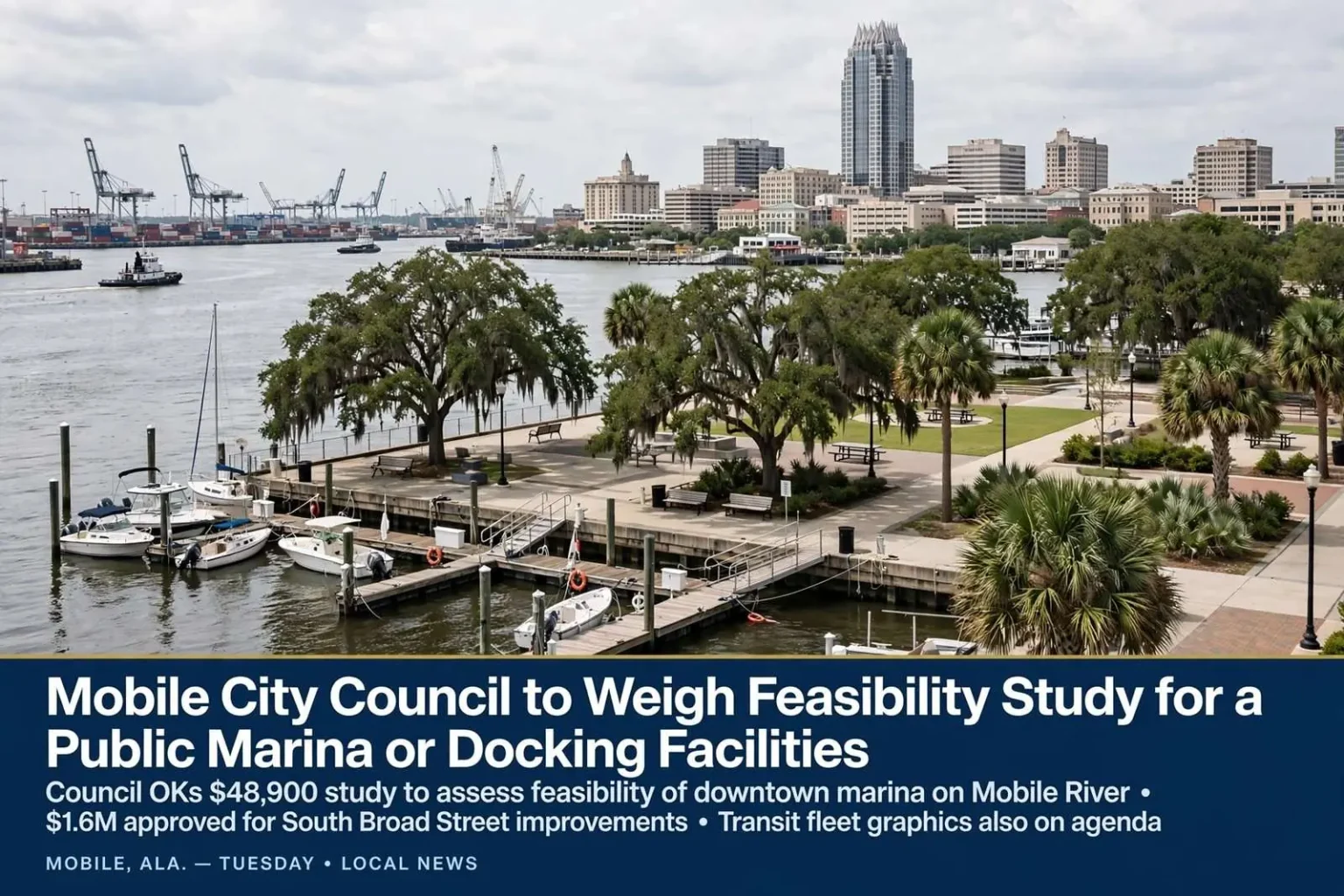
MOBILE, Ala. – The Mobile City Council is set to take up a resolution at its next meeting Tuesday that could pave the way for a study of a public marina or docking facilities along the city’s waterfront.
A $48,900 feasibility study
The resolution would approve a purchase order to Covington Civil & Environmental, LLC for a public marina or docking facilities feasibility study at a cost of $48,900. Such studies typically assess whether a project is practical and worthwhile before a city commits to design or construction, weighing factors such as site conditions, demand and cost.
Investment in the South Broad Street corridor
Another resolution up for introduction would appropriate money from the Fiscal Year 2027 Rebuild Alabama Allocation to the TIGER/South Broad Street project at a cost of $1,600,000. According to the agenda, Phase III of that work includes improvements on Broad Street from the traffic circle at Canal Street to Garrity Street.
The scope covers reconstruction of the road bed, curb and gutter, inlets, landscaping, sidewalks and bike infrastructure. City documents describe the streetscape and roadway reconstruction as a significant improvement to traffic flow, aesthetics and safety for pedestrians and cyclists along the corridor.
Where the road money comes from
The Rebuild Alabama Act, passed by the Legislature in 2019, raised the state gasoline and diesel tax by 10 cents a gallon, phased in over three years, and sends a share of the revenue to cities and counties each year for road and bridge work. The “TIGER” in the South Broad Street project’s name refers to the U.S. Department of Transportation’s Transportation Investment Generating Economic Recovery grant program, which has since been renamed BUILD and later RAISE.
New graphics for the transit fleet
A third resolution set for introduction would approve a purchase order to Star Graphics, Inc. to replace transit fleet vehicle graphics at a cost of $230,950 – part of the city’s ongoing updates to its public transportation system.
Each of the measures is scheduled to be introduced at Tuesday’s meeting, where council members will have the opportunity to discuss the proposals before any final votes.
Why a marina study matters
Mobile sits at the head of Mobile Bay, where the Mobile River empties into the bay, and its history as a port has shaped everything from its economy to its culture. A public marina or docking facilities could give residents and visitors a place to moor boats, access the waterfront, and connect with the bay’s recreational and tourism opportunities.
The feasibility study is the first, cautious step – a way to determine whether such a facility makes sense before the city spends significant capital.
Council approves the study
That cautious first step became official on Tuesday morning, when the Mobile City Council approved the study unanimously. The measure had been introduced the previous week, and the council’s vote set in motion a three-month process that city officials hope will answer the central question: can a public marina work on a working waterfront?
District 4 Councilman Ben Reynolds raised a procedural objection before the vote, telling colleagues during the city’s work session that he was uncomfortable with the study being procured as a purchase order rather than a full contract with the firm doing the work. “We don’t need to be getting into situations where we are working on trust,” Reynolds said. “I don’t think that securing a purchase order for the study is a good public policy. This is not the right way to do it.”
Reynolds struck a different tone when the measure came up for a vote later in the meeting at Government Plaza, saying other cities enjoy a similar amenity and Mobile should explore whether it can as well. “The first step in seeing if it makes sense, or if it’s possible, is to engage with someone who knows these things and have them conduct a feasibility study,” he said.
According to the council agenda, Covington Civil & Environmental, LLC will be paid nearly $49,000 for the work. The study will identify potential locations around the city that could host a marina and estimate what it would cost to build and operate the facility. Mayor Spiro Cheriogotis has said the goal is a location close to downtown, but the biggest obstacle is obvious: the Mobile River is a working port, and commercial traffic shares the water with everything else that floats on it.
Cheriogotis defended the spending after the vote, arguing the city has to protect its port industry while still finding room for recreational boaters. “We have a lot of waterfront assets we need to protect,” he said. “We need to protect the industry of the port, but I believe there is a way for recreational boaters and the activity of the port to coexist.” He pointed to boaters crossing the bay from the beaches and travelers on the Great Loop, the inland waterway route that passes through Mobile, as the kind of visitors a downtown dock could draw. “Get out and enjoy some of the nightlife, the food, the restaurants of Mobile,” he said.
The study is expected to take about three months. Its findings will shape whether the city moves ahead with a specific site, a design, and eventually a budget — or decides that a public marina is one amenity Mobile can do without.