Mobile City Council Salutes 37-Year City Veteran Ann Rambeau With Her Own Day
The Mobile City Council proclaimed June 23, 2020 as Ann Rambeau Day, honoring her 37 years organizing MoonPie Over Mobile and other events.
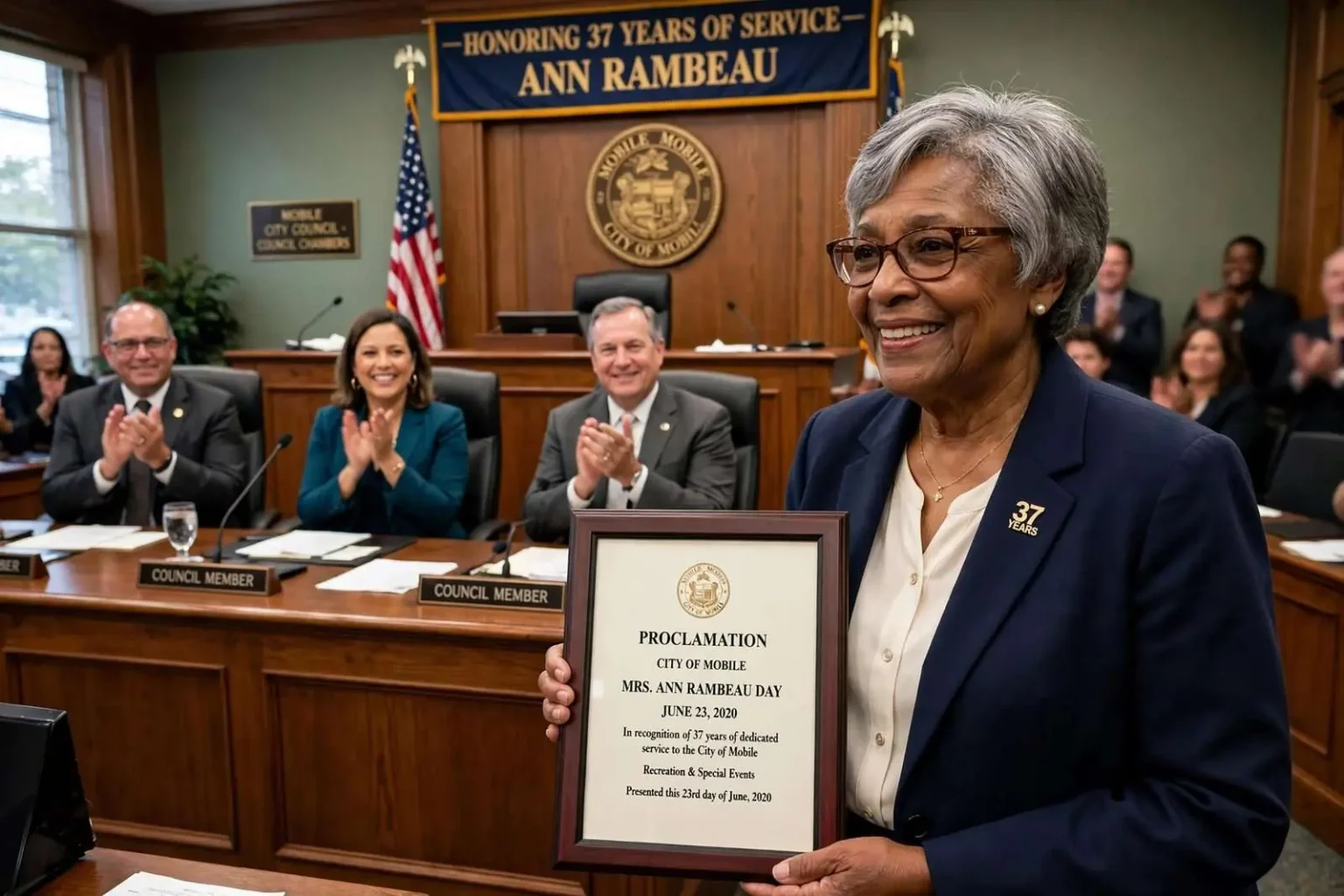
The Mobile City Council gave a standing ovation to longtime city employee Ann Rambeau, proclaiming June 23, 2020 as “Mrs. Ann Rambeau Day” in the city — an honor reserved for the people whose work most residents enjoy without ever knowing whose hands built it. Rambeau has spent 37 years working for the City of Mobile, beginning her career with the city’s recreation department as a fitness specialist before becoming one of the steady hands behind Mobile’s signature public events.
Over the course of her tenure, Rambeau helped organize many of downtown Mobile’s best-known special events. Her work has touched celebrations including MoonPie Over Mobile, the LODA ArtWalk, Market in the Park, the city’s July 4th festivities and the Dauphin Street Beer Festival, among others. Council members used the proclamation to recognize the behind-the-scenes work that keeps Mobile’s civic calendar running year after year — the permits, the staging, the street closures, the logistics that turn an idea into an event thousands of people can attend.
Thirty-seven years in city service
A 37-year career with one employer is an achievement in any field, and in municipal government it spans entire eras of a city’s development. Rambeau’s start in the recreation department as a fitness specialist placed her on the front line of city services — the parks, programs and community centers where residents actually encounter their local government. Mobile’s recreation department has long run programs across the city’s community centers, from youth sports to senior fitness, and employees who start there tend to know the city street by street.
From that foundation, Rambeau moved into the world of special events, where the city acts less as a regulator and more as a producer. Someone has to reserve the streets, arrange for police and fire coverage, coordinate vendors, hire stages and sound, plan for weather and anticipate crowds — and in Mobile, for decades, Rambeau was one of the people who did it. Colleagues in event production across the Gulf Coast know the work as equal parts logistics and diplomacy.
The events she helped build
MoonPie Over Mobile stands as the most visible item on her resume. Mobile’s New Year’s Eve tradition — in which a giant electric moon pie descends over downtown at midnight — began in 2008 as the city’s answer to bigger cities’ ball drops and a playful claim on the moon pie, the snack cake with deep Mobile roots as a Mardi Gras throw. The event draws thousands of revelers to the streets around the RSA towers each Dec. 31, complete with live music and a second-line flavor that only Mobile can produce. Behind the confetti stands months of coordination with vendors, entertainers, public safety agencies and city departments.
The LODA ArtWalk belongs to a different rhythm: a monthly evening when the Lower Dauphin entertainment district’s galleries, studios and shops open their doors and the neighborhood fills with pedestrians. The art walk helped anchor the revival of the LODA district, turning blocks west of downtown into an arts destination. Market in the Park, meanwhile, brought a farmers market and craft vendors to Cathedral Square and later Bienville Square on Saturday mornings, part of a national wave of downtown markets that Mobile embraced as its residential population grew.
The city’s July 4th festivities and the Dauphin Street Beer Festival round out the list. Independence Day in Mobile means crowds and fireworks downtown, and the beer festival fills the Lower Dauphin corridor with attendees sampling from dozens of vendors — events that operate at very different scales but demand the same underlying machinery of permits, safety planning and vendor coordination.
Why cities celebrate their own
Council proclamations naming a day for an individual are among the oldest ceremonies in municipal government, and they serve a purpose beyond sentiment. Cities run on institutional memory — the knowledge of how to close a street safely, how to plan for a hurricane season while running a festival calendar, how to work with parade societies, churches, bars and neighborhood groups. Employees like Rambeau accumulate that knowledge over decades, and honoring them publicly underscores how much of a city’s character rests on career staff rather than elected officials.
Special events staff work in the shadow of every parade route and festival stage, and their contributions are measured in things that go right invisibly. A moon pie drop that lands on schedule, an art walk that flows safely through six blocks, a Fourth of July crowd that gets home without incident — each represents hundreds of small decisions made months in advance. Event professionals often describe the job as anticipating problems no one will ever know nearly happened, which is precisely why the council’s recognition of “the behind-the-scenes work” resonated with anyone who has staged a public event.
The timing of the honor — June 2020 — gave it an extra weight that no one in the council chamber would have chosen. Mobile’s festival calendar had been emptied by the coronavirus pandemic: Mardi Gras society balls had been canceled earlier in the year for the first time in generations, MoonPie Over Mobile had gone virtual or scaled back, and the art walks and markets that Rambeau spent decades organizing were on hold. A career defined by bringing crowds together was being celebrated at a moment when bringing crowds together was exactly what the city could not do.
That context also made the recognition a reminder of what the city was waiting to get back. Event staff across Mobile spent the pandemic months navigating cancellations, rescheduling and health protocols, work that continued even when the events themselves could not. The council’s standing ovation doubled, in effect, as encouragement to the department that would be tasked with rebuilding the calendar once public health conditions allowed — restarting traditions that depend on institutional knowledge accumulated over decades.
Mobile’s civic calendar as an economic engine
The events on Rambeau’s resume are more than celebrations; they are economic infrastructure. Downtown Mobile’s revival over the past two decades — new residents in upper-floor apartments, restaurants and galleries filling formerly vacant storefronts — was built partly on a strategy of programming public space. Art walks put pedestrians on Lower Dauphin on weeknights. Markets drew shoppers to the parks on weekends. New Year’s Eve and July 4th filled hotel rooms and restaurants. Each event sends customers to nearby businesses and gives the district a reputation as a place worth visiting after dark.
Cities that lose their special events staff often rediscover, mid-festival, how much goes wrong without them: permits processed late, vendors left without power, safety plans that don’t match the street grid. Municipal event professionals also serve as the institutional bridge between generations of volunteers, nonprofit boards and business owners who come and go. When a council honors a 37-year employee, it is in part acknowledging that continuity — the person who knows why a route changed in 1998, which intersection floods, which vendor has never missed a setup.
Rambeau’s career also tracks the changing role of women in municipal leadership. Beginning as a fitness specialist in the recreation department — a frontline, community-facing job — and rising to help direct a major city’s signature celebrations mirrors a pattern seen across Mobile’s government, where longtime employees have shaped the city’s cultural identity from positions the public rarely sees. The “Mrs. Ann Rambeau Day” proclamation put a name to that contribution, and the standing ovation from the council chamber suggested how widely it was felt among the people she worked with.
For residents, the proclamation is also a small lesson in how their city works. The festivals that define Mobile’s public life do not assemble themselves, and they are not primarily the work of outside promoters. They are run by city employees — planners, recreation staff, public safety coordinators and maintenance crews — who answer to the mayor and council and who measure success by crowds that go home safe. When the council names a day for one of those employees, it pulls back the curtain on that machinery for a moment.
Rambeau’s route from fitness specialist to special events also reflects the distinctive role recreation departments play in Southern cities. Long before downtown revitalization became a municipal priority, recreation departments were the arm of city government most visible in neighborhoods — running summer leagues, holiday events and community center programs on modest budgets. Many of the skills those departments cultivate, from crowd management to volunteer coordination, transfer directly to the festival economy that Mobile later grew downtown.
The list of events tied to her career reads, in effect, as a tour of what makes Mobile distinct. MoonPie Over Mobile speaks to the city’s Mardi Gras heritage, older than New Orleans’. The LODA ArtWalk speaks to its arts community and the galleries that anchored the Lower Dauphin district’s revival. Market in the Park speaks to the parks-and-public-space movement that reshaped Cathedral Square and Bienville Square into gathering places. July 4th and the Dauphin Street Beer Festival speak to the city’s appetite for big, walkable downtown celebrations.
Council members used the June 23 proclamation to recognize the behind-the-scenes work that keeps Mobile’s civic calendar running year after year, and the standing ovation that accompanied it suggested the sentiment extended well beyond the dais. Thirty-seven years is long enough for an employee to become part of the institution she serves; on June 23, 2020, the City of Mobile made that relationship official, setting aside a day for the woman whose career helped the city know how to celebrate.