Mobile Closes Sage Park Basketball Court Amid COVID-19 Concerns
Mobile Parks and Recreation shut the Sage Park basketball court over COVID-19 concerns, with the closure set for reassessment on April 6.
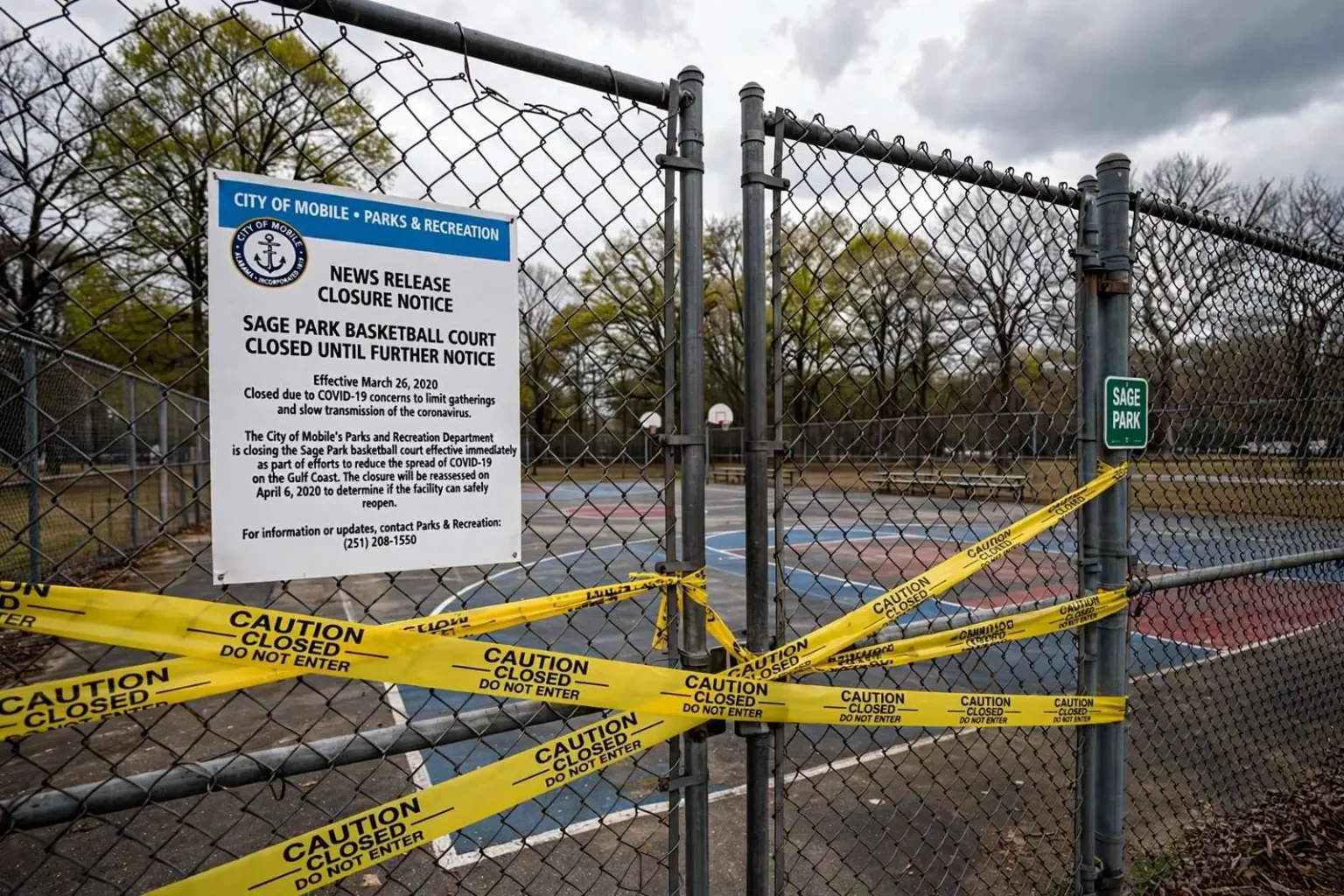
The basketball court at Sage Park is closed until further notice, the City of Mobile’s Parks and Recreation department announced as the coronavirus outbreak spread across the Gulf Coast in late March 2020. The closure is part of the city’s effort to limit gatherings and slow transmission of the virus through its public recreation facilities. Parks and Recreation officials said the closure will be reassessed on April 6, with a decision then on whether the court can reopen or restrictions will remain in place. Residents looking for updates on the closure or other park facilities can contact the department directly for more information.
The announcement arrived in the weeks when the pandemic was transforming daily life in Mobile, as state and local officials shut down the gatherings that make up public life one by one. Basketball courts occupy a particular place in that sequence: they are among the most heavily used facilities in any city park system, and the pickup games that fill them involve exactly the close, sustained contact that public health guidance was telling everyone to avoid.
Why the Courts Went First
A basketball court in use looks nothing like the social distancing that March 2020 demanded. Ten players running a full-court game share the air for hours, swap sweat in every scramble for a rebound and handle the same ball hand to hand. Even half-court games and casual shooting draw crowds of onlookers on the benches, and parks rarely have the staff to referee who is playing and who is watching. Closing the court, rather than posting guidelines and hoping, was the enforcement-free option the city chose.
Sage Park’s court is one node in a network of recreation facilities the department maintains across the city, from neighborhood playgrounds and ball fields to community centers. As the outbreak grew, cities across the country faced the same question about their parks: which facilities could stay open with natural distancing — trails, green space, golf — and which had to close because their ordinary use defeated distancing entirely. Basketball courts, playground equipment and tennis courts generally fell in the second group.
Late March 2020 on the Gulf Coast
The timing placed the closure within the first wave of pandemic restrictions in Alabama. Schools had closed, restaurants and bars had been ordered to shut their dining rooms, and the first stay-at-home orders were taking shape as the region’s case counts climbed. Mobile, the largest city on the central Gulf Coast, was adjusting to an emptied downtown, closed beaches on the coast and a public health message built on one idea: keep people apart long enough to slow the virus’s spread.
Parks sat in the middle of that message. Public health officials did not want people sealed indoors; outdoor activity, walks and exercise were encouraged as safe when done at a distance. But the places where people congregate in parks — playgrounds, courts, picnic shelters — had to be managed differently. The City of Mobile’s approach, closing the court at Sage Park until further notice while promising a reassessment on April 6, reflected that balance: restrict the gathering spaces, keep the reassessment date close enough to reopen quickly if conditions allowed.
The closure announcement also fit the communication pattern of those weeks. Cities were issuing notices about one facility after another — city halls limiting visitors, libraries closing, recreation centers suspending programs — and each announcement carried the same reassurance that the situation would be monitored and adjusted. Residents had learned to read dates like April 6 not as promises to reopen but as checkpoints, with the phrase “until further notice” doing the honest work of describing an outbreak whose trajectory no one could yet predict.
What the closure asked of the court’s regular players was patience in service of a goal larger than any single game. The pickup basketball economy of a city park runs on routine and reputation — the same faces at the same hours, the running list of who won last time — and suspending it cost the neighborhood one of its reliable gathering points. Public health officials were asking for exactly that kind of sacrifice across the country, on the theory that breaking up the routines where the virus spreads most easily would slow it everywhere.
What the April 6 Reassessment Meant
The April 6 date gave the closure a built-in review point rather than an open-ended shutdown. Officials said the department would decide then whether the court could reopen or whether restrictions would remain in place, tying the decision to the state of the outbreak as it stood in early April. That two-week window was the rhythm most governments adopted in the pandemic’s first months — restrictions announced in short increments, reviewed as the data came in and extended or relaxed accordingly.
For the players who use the court regularly, the closure meant finding other ways to spend the afternoons that had followed a routine of pickup games. For the neighborhood around Sage Park, it was one more visible sign of the outbreak — a familiar facility, chained or posted against use, joining the closed schools and quiet restaurants that marked the spring.
Sage Park and the City’s Recreation Network
Sage Park serves its section of Mobile as both a sports venue and a neighborhood green space, the kind of park whose basketball court draws a steady rotation of players and whose grounds see regular use beyond the games. Parks like it are maintained by the Parks and Recreation department as part of the city’s commitment to public recreation, and the department is also the point of contact for residents who want updates on closures, hours and programming — the channel the announcement directed people to as the situation evolved.
The department’s role in a pandemic shifts from programming to communication and enforcement. Scheduled leagues, youth programs and community events are suspended or moved, maintenance crews keep grounds up for the visitors still coming, and staff field the calls from residents asking what is open, what is closed and when that might change. The April 6 reassessment was one part of that ongoing conversation with the public.
How Parks Fit Into Pandemic Response
Closing recreational facilities where crowds gather was standard practice for cities across Alabama and the country in late March 2020. The logic was transmission: the virus moves in the close, repeated contact that sports produce, and a city cannot sanction the very gatherings it is asking residents to forgo. The courts, playgrounds and gyms closed early and stayed closed longest, while open lawns and walking paths remained available throughout, part of the argument that outdoor recreation at a distance was safe.
Mobile’s approach mirrored what residents could see in neighboring communities along the Gulf Coast, where municipalities from the Mississippi line to the beaches of Baldwin County made their own calls about parks and recreation facilities as case counts developed. The decisions were coordinated loosely through county and state health guidance, and each city’s park system announced its own closures on its own timeline.
The economics of park maintenance gave the closures a hidden upside for departments operating on tight budgets. With programs suspended and facilities locked, crews could catch up on the deferred maintenance that busy seasons never allow — resurfacing, repainting, repairing fences — so that when the facilities reopened, they reopened better than they closed. Cities that emerged from the spring of 2020 often found their park systems in the best physical condition they had been in for years, even as their use was briefly taken away.
For residents, the practical message from the department was to stay informed through the department directly rather than assume. Closures in the pandemic’s early weeks changed quickly, and the April 6 review meant the status of the Sage Park court could shift either way depending on the outbreak’s trajectory. The department’s phone lines and offices remained the official source for what was open across the city’s parks as conditions changed.
The closure also carried a wider lesson that cities learned through the spring: park systems are public health infrastructure, not just recreation. The facilities where a city’s residents exercise, gather and blow off steam matter to community health in ordinary times, and when a pandemic removes them, the loss is felt most in the neighborhoods that rely on public parks because private alternatives — gyms, club teams, backyard courts — are out of reach.
Sage Park’s court was one of hundreds of similar facilities closed across Alabama that month, each announcement part of the same public health calculation. The reassessment set for April 6 put the decision back on the calendar two weeks out, and the department’s promise to update residents through its office meant the neighborhood would hear the outcome when it came.
As the city worked through the weeks that followed, the closure stood as a small, visible piece of the larger response to the outbreak — a reminder that the pandemic reached into the ordinary routines of Mobile life, down to the evening pickup games at a neighborhood park, and that the city’s institutions were adjusting them in real time as the situation developed.