Mobile Council Approves $61 Million Bond Package After Sharp Council Clash
The Mobile City Council approved a $61 million bond issue covering ThyssenKrupp obligations, an emergency radio system and the downtown Mardi Gras park, but the vote exposed a bitter clash among councilors over dissenting votes and district funding.
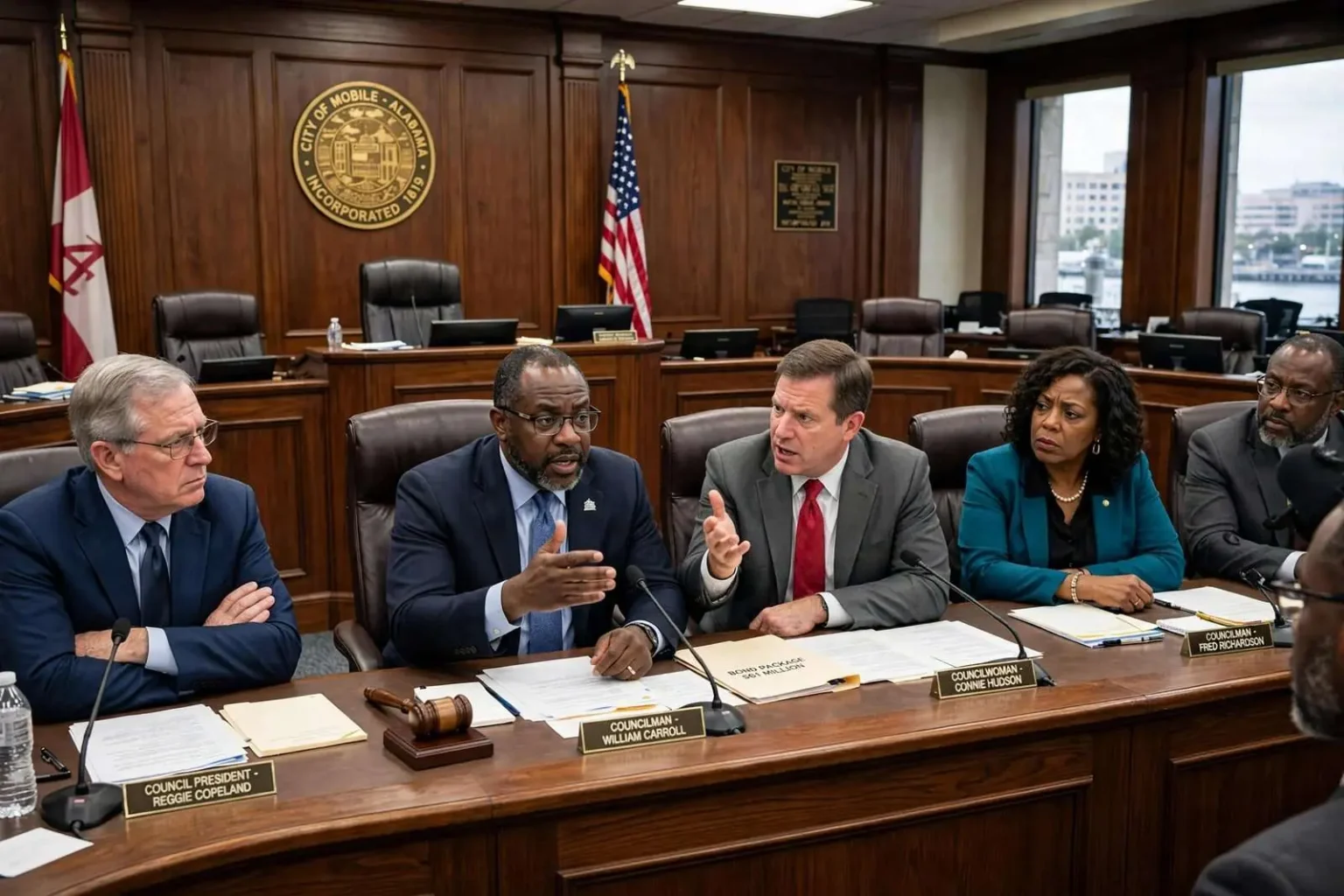
The Mobile City Council approved a $61 million bond issue during a recent Tuesday meeting, clearing the way for the city to cover its financial obligation to ThyssenKrupp, upgrade the city’s aging emergency radio system, build the long-planned downtown Mardi Gras park and fund a batch of drainage projects and road-widening work in newly annexed neighborhoods.
The package included roughly $33.5 million tied to the city’s commitment to ThyssenKrupp’s steel operation, along with money earmarked to fulfill promises made to residents in areas the city has annexed in recent years, including new roads and a fire station. The bond passed on a 5-1 vote, with one councilor voting against the measure and another abstaining.
Councilman John Williams cast the lone vote against the bond issue, while Councilwoman Connie Hudson abstained. Both councilors ultimately saw funding tied to their own districts move forward as part of the larger package, since the bond passed regardless of their votes.
The dissenting votes triggered a tense exchange on the council floor. Councilman William Carroll argued that if colleagues were not going to support the bond issue, the individual projects benefiting their districts should be stripped out of it. “Their issues should be taken out if they aren’t going to vote for them,” Carroll said during the meeting.
Council President Reggie Copeland intervened repeatedly to admonish Carroll for what he characterized as personal attacks directed at Williams, at one point giving Williams the floor to respond. Williams said he was surprised the council president felt he needed to defend himself, adding, “I am not a politician.”
Carroll also pointed to money the city had previously borrowed to build a senior center championed by Hudson, suggesting she had not objected to borrowing then. Hudson responded that she had attempted to secure funding for the senior center through other sources but was ultimately directed by the administration to borrow the money in order to get the project built.
The friction carried into a separate vote later in the same meeting, when Carroll and two allied councilors, Clinton Johnson and Fred Richardson, voted down a proposal to fund traffic-calming devices in Williams’ district, causing the measure to fail. Hudson called it “a sad day in the city of Mobile” after the vote.
The traffic-calming funding returned to the council agenda the following week, and with tempers cooled, the council approved it unanimously.
Despite the sharp words exchanged during the meeting, city officials said the overall outcome delivered on most of the competing priorities at stake. ThyssenKrupp is set to receive its promised funding, the emergency radio system upgrade is moving forward, the Mardi Gras park in downtown Mobile has its financing in place, and residents in newly annexed areas are slated to get paved roads and a new fire station. Not every request was resolved, however: Richardson has noted that dozens of open drainage ditches remain unaddressed in the Trinity Gardens neighborhood.
The bond issue and the accompanying debate underscored ongoing tension on the seven-member council over how competing district needs are weighed against citywide obligations such as the ThyssenKrupp incentive package, one of the largest economic development commitments in the city’s history.
The ThyssenKrupp Commitment and the Council
ThyssenKrupp announced in 2007 that it would build a steel processing complex near Calvert in north Mobile County. At the time it was the largest private economic development investment in Alabama history, and the state and local governments offered incentives to land it.
The Mobile City Council has seven members, each elected from a single district. That system dates to 1985, when Mobile replaced its at-large city commission with a mayor-council government.