Mobile Council Approves Darby Creek Annexation as West Mobile Warms to City Life
The Mobile City Council has voted to annex the Darby Creek subdivision from unincorporated Mobile County, a modest move that officials say could be the start of a larger wave of West Mobile neighborhoods seeking to join the city.
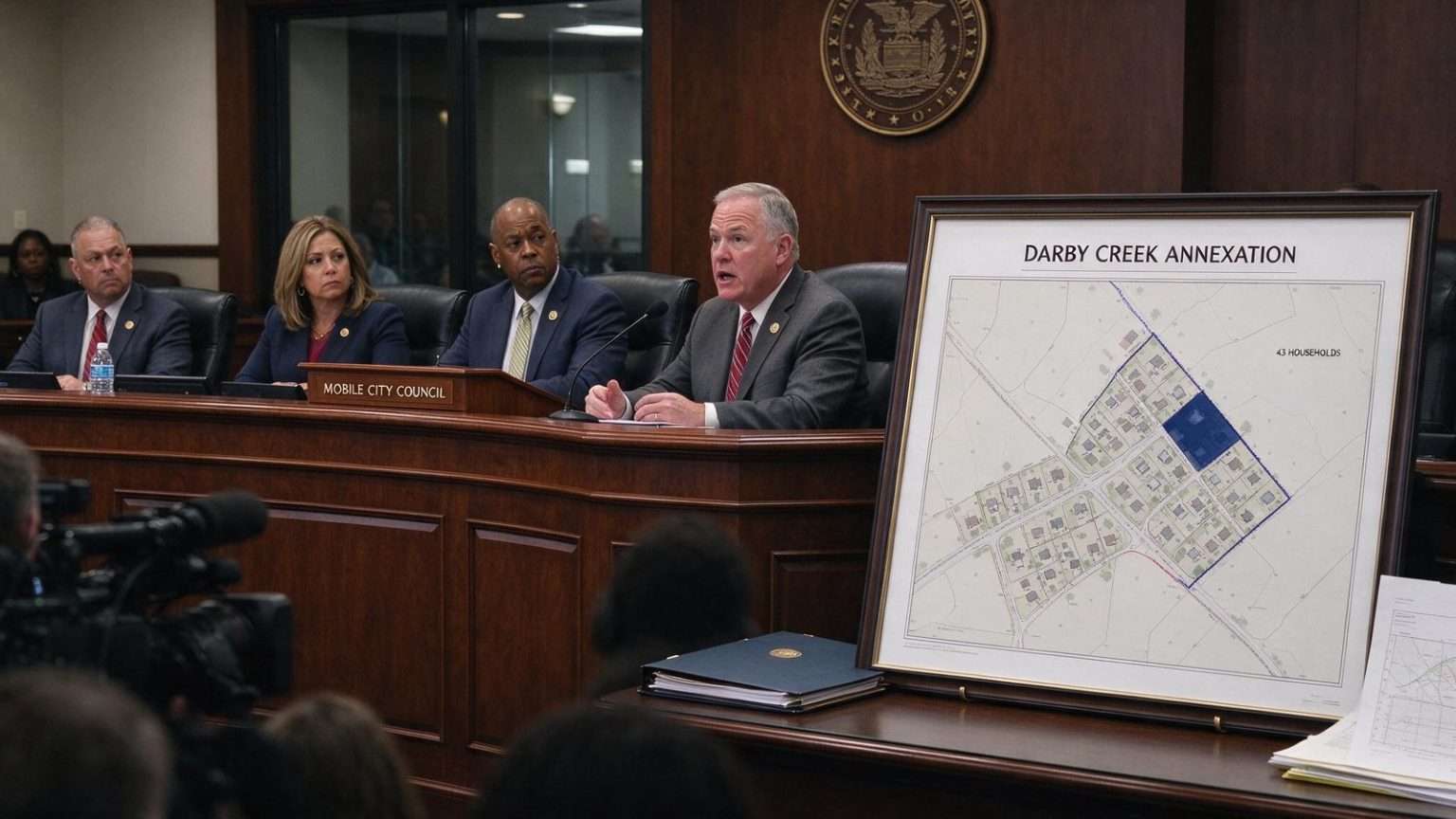
The Mobile City Council has approved bringing 43 households in the Darby Creek subdivision into the city limits, adding another neighborhood to a growing list of unincorporated areas seeking to join Mobile rather than remain in the county.
The vote marks a small but notable shift after the city scaled back fire and emergency medical response outside its boundaries earlier this year, a change that appears to be nudging more West Mobile residents toward annexation.
The Darby Creek addition itself is modest in scale, moving fewer than four dozen households from unincorporated Mobile County into the city. But local officials say it may be the leading edge of a much larger wave, as residents accustomed to city police, fire and ambulance service increasingly petition to formalize what has effectively already been the case for years: reliance on Mobile’s public safety infrastructure.
That reliance is the quiet story behind Alabama’s police jurisdiction law. Cities in Mobile’s position have long extended police and, by custom, fire and EMS service up to three miles beyond their boundaries — a shadow service area where residents pay county taxes but dial city dispatchers. When Mobile scaled that back, it did not just trim a budget line; it forced thousands of households to confront which government actually protects them. Darby Creek’s answer was to join the city outright.
The Friction on the Council
The annexation did not pass without friction. When the Darby Creek proposal first reached the council, District 1 Councilman Fred Richardson signaled he would oppose any residential-only annexation that didn’t bring new commercial development and tax base along with it, arguing that adding neighborhoods without businesses would strain city finances.
City Finance Director Paul Wesch pushed back on that argument with data showing the area generated only three fire and EMS calls over the 38 months before the city’s police jurisdiction pullback, suggesting the annexation would likely be a modest net financial positive rather than a drain on city resources.
Wesch’s numbers reframed the debate. A subdivision that calls for an ambulance once a year costs the city almost nothing to serve, while the property and sales taxes its households pay flow into the general fund regardless. Residential annexations are not automatically the budget burden they appear to be — the math depends entirely on the demand profile of the neighborhood and the cost of extending services, and Darby Creek’s profile was as light as annexation requests come.
When the council took its final vote, Richardson ultimately supported the annexation, leaving Councilman C.J. Small as the lone vote in opposition. Small argued the city’s budget was already stretched covering existing city limits and expressed skepticism about taking on more territory.
Both councilmen have been consistent skeptics of expanding the city’s footprint through annexation in recent votes, and Darby Creek was the latest test of that position. Richardson’s eventual yes — against his own stated rule about residential-only annexations — suggested that the Wesch data, or the momentum building behind the requests, had moved at least one of the council’s annexation skeptics.
Critics of that stance point out that the same two councilmen, along with then-Councilman Levon Manzie, previously blocked a proposal from Mayor Sandy Stimpson’s administration to reduce the police jurisdiction from three miles to 1.5 miles outside city limits. At the time, the objections centered on preserving relationships with the Mobile County Commission rather than on cost concerns, raising questions about whether fiscal caution is the primary motivation behind resistance to new annexations now.
The record creates an awkward contrast. A jurisdiction reduction that would have saved the city money and clarified its service obligations was rejected on diplomatic grounds; annexations that add households are now resisted on fiscal grounds. Annexation advocates read that history as evidence that the opposition is less about arithmetic than about who benefits from the region’s map staying as it is.
The Population Question
The broader debate touches on Mobile’s decades-long struggle with stagnant population figures. The city’s population has remained roughly flat for more than 40 years, with annexations carried out under the Jones administration providing most of what modest growth the city has seen.
That stagnation has consequences beyond civic pride. Population figures determine how state and federal funding is apportioned to Alabama cities, how the city ranks in national statistics and site-selection comparisons, and how seriously Mobile is treated in discussions of regional institutions. A city that cannot grow its count, advocates argue, cannot grow its share — of highway money, of grants, of employers choosing where to locate.
Municipal officials and civic leaders have increasingly framed annexation as a matter of long-term competitiveness, since population figures factor into how state and federal funding is apportioned to Alabama cities. Every neighborhood that joins the city adds a few hundred people to the count; a sustained wave of West Mobile annexations would add tens of thousands.
Communities west of Mobile have grown substantially in recent years, with Semmes offering a visible example of how quickly formerly rural areas can develop. Once a farming crossroads, Semmes incorporated and grew into a full-service city within a generation, demonstrating that the population Mobile has failed to capture through annexation has not disappeared — it has simply organized under other municipal flags.
The Incorporation Scenario
Some observers have noted that if unincorporated areas west of the city were to organize and incorporate as their own municipality, the resulting city could rank among the eight largest in Alabama by population, a scenario that would permanently reshape the region’s political and economic landscape and limit Mobile’s ability to grow through future annexation.
The hypothetical is not fantasy. Alabama’s incorporation laws allow densely populated unincorporated areas to form cities, and the population base west of Mobile is already large enough to support one. Semmes’ success showed the template: organize, incorporate, collect municipal taxes, and a new city arrives with its own council, its own claims on county services and its own veto over Mobile’s expansion. If that happened, the census count that Mobile has protected for decades would not merely stagnate — it would be counted against the city, in a rival column.
For annexation advocates inside the administration, that scenario is the strongest argument of all: every year the city declines to grow, the alternative grows more likely. The residents of West Mobile are not waiting to be annexed; they are watching Mobile’s service decisions and Semmes’ trajectory and drawing conclusions about which government serves their interests.
Services Already Rendered
City leaders have generally supported continuing to pursue annexation opportunities as they arise, citing the practical reality that the city has effectively been providing services to many of these areas for years even without formal annexation.
The Darby Creek episode made that dynamic explicit. Fire and EMS calls in the subdivision were answered — three of them in 38 months — by city crews operating under the old police jurisdiction arrangements. The residents’ petition to annex was, in a sense, an offer to start paying for a service they were already receiving, a proposition the finance department found easy to endorse.
Under the Stimpson administration, city hall has treated each annexation petition as a discrete business decision — send the finance team, review the demand data, report the numbers — rather than an ideological question about the size of government. Darby Creek passed that test without difficulty. Other neighborhoods now lining up may not have profiles as clean, and the council’s annexation skeptics have made clear they will inspect each one.
What Comes Next
Additional annexation requests from West Mobile neighborhoods are expected to come before the council in the months ahead, continuing a debate over how aggressively Mobile should pursue growth beyond its current boundaries.
The stakes compound with each petition. A handful of subdivisions adds population and tax base without measurably changing the city’s character; a sustained wave would redraw school discussions, council district lines and the region’s political map. Council members who have resisted annexation in the past will face the question again and again, with each request accompanied by its own version of the Wesch analysis — and with the knowledge, after Darby Creek, that a residential-only annexation can win a council majority even over the objections of its most consistent skeptics.
The pattern is one that has repeated across the South for three decades: central cities whose boundaries froze in the 1960s watching growth settle in suburbs they cannot tax, until either annexation law, incorporation or irreversibility settles the question. Mobile’s leaders have watched Birmingham, Montgomery and other peers navigate the same arithmetic with mixed results, and the lesson drawn inside Government Plaza has been that the window for growth-by-annexation does not stay open indefinitely.
For the 43 households of Darby Creek, the change arrives in practical increments: a city sticker, city garbage service, Mobile addresses that finally match their government. For the city, it is one more entry in a ledger it hopes will finally begin to grow.