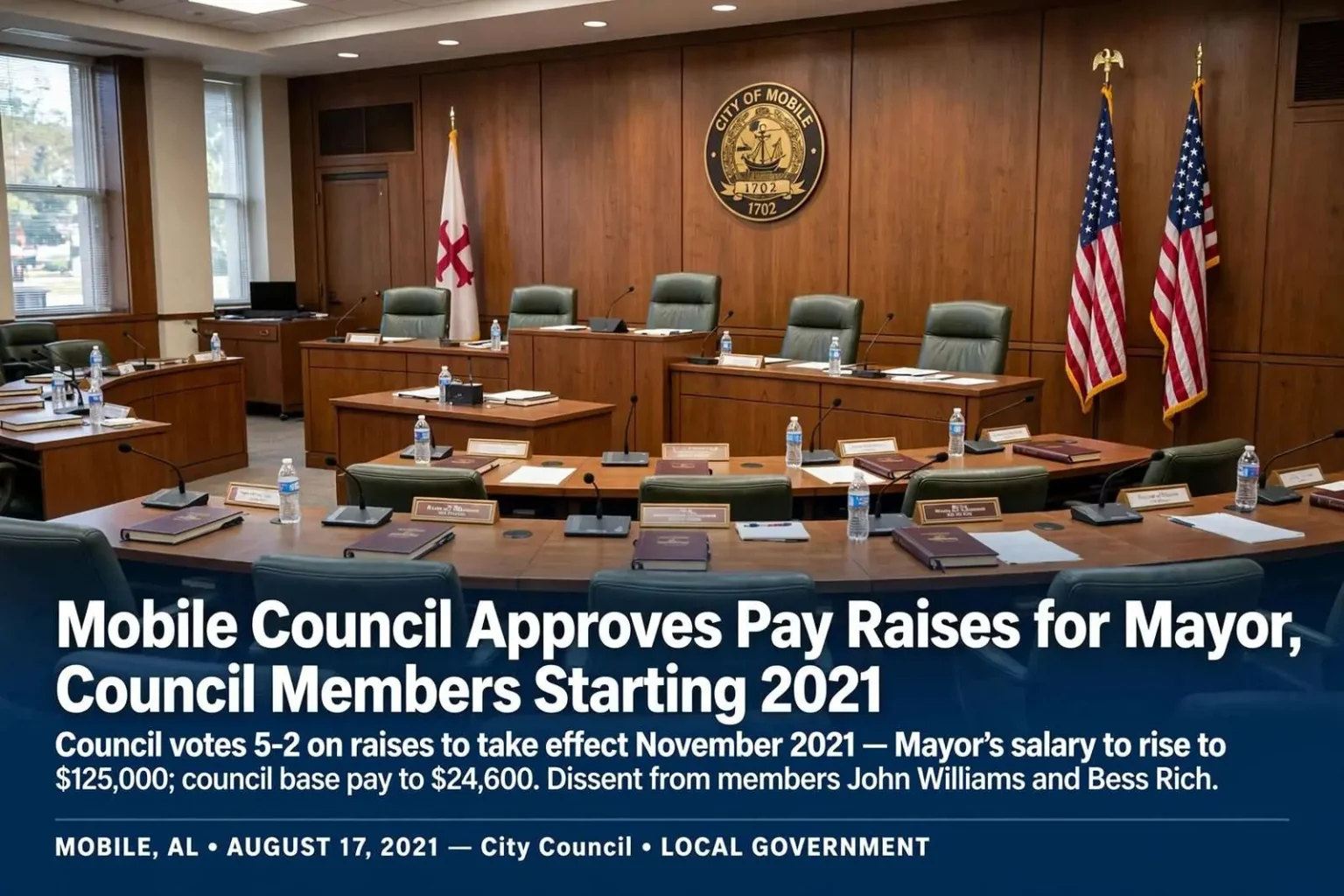
Mobile City Council members voted 5-2 Tuesday to approve an ordinance raising the salaries of the city’s elected officials beginning in November 2021, even as the two dissenting members, John Williams and Bess Rich, voiced reservations about the size and timing of the increase.
Under the current pay structure, Mobile’s mayor earns $89,000 annually, while council members receive a $19,800 base salary plus $175 for each regular and special meeting attended, along with a flat $325 monthly expense account.
The new ordinance, sponsored by Councilman Joel Daves, raises the mayor’s salary to $125,000 a year and increases council members’ base pay to $24,600, with the per-meeting stipend rising to $300. The measure also adds a $500 monthly stipend for whoever holds the council presidency.
The timing follows Mobile’s pattern of setting pay for a new term of office. Because the raises take effect in November 2021 — after the city’s municipal elections that summer — the new salaries will attach to the elected officials who take office for the next four-year term, not to the council members voting on the ordinance for their remaining months. That sequencing is standard practice among Alabama cities, where state law lets councils set compensation for their successors while restricting what sitting members can award themselves.
Alabama’s largest cities operate under a mayor-council form of government in which the council is, in law, a part-time body: seven district members who hold ordinary jobs or businesses outside City Hall and gather for regular meetings, committee work and constituent cases. Whether the job is genuinely part-time — or has grown into something more — is the recurring argument behind every pay debate in Mobile, and it framed the discussion again this week.
The Case Against, and For
Rich, explaining her opposition, said she had pushed instead to cap council pay at $500 above the starting salary of a Mobile Police Department patrol officer. “It’s in line, and it’s somewhat of an improvement,” she said during the council’s work session, adding that the benchmark dated back to her own first term on the council in 1997 and still felt appropriate to her today.
When Rich asked whether colleagues wanted to formalize her proposal as a motion, Councilman Fred Richardson pushed back, arguing the math would have left council pay far behind the cost of living. He noted that if Rich’s 1997 benchmark had been adopted then and left untouched, council members would be earning only about $25,000 a year today.
“The point I’m making is that the police officers are going to be getting raises and the council is going to be frozen in time,” Richardson said.
Rich responded that her intent was to keep council pay proportionate to what the job actually demands without pushing it beyond what she considers a part-time role. “If you are concerned about the salaries freezing, you can write it where when those salaries (police officers) increase, so will the council’s salaries,” she said.
The exchange captured the two poles of the debate. Tying council pay to a patrol officer’s starting salary appeals to members who want the pay to stay modest and automatically linked to a well-understood public benchmark — police salaries are negotiated, publicized and periodically raised, so a linked formula would adjust without future council votes. Critics respond that police pay is designed to attract full-time labor to a dangerous and demanding job, and that anchoring a legislative salary to it drags council pay upward or downward for reasons that have nothing to do with the council’s own workload.
Richardson’s cost-of-living argument carries its own weight in a city that has grown steadily through the past two decades. Mobile’s population, hovering around 190,000, has seen housing costs, insurance rates and general prices rise markedly since the 1990s, and council members who serve seven districts each — attending meetings, answering constituent calls, reviewing rezonings and budgets — have seen their nominal stipend hold nearly still since the 1990s.
The meeting-pay structure itself reflects the part-time design. A council member’s income depends partly on how many meetings they attend, which rewards presence but means the base salary alone understates what a diligent member earns, while a member who misses sessions earns proportionally less. The expense account — $325 monthly under the old structure — covers the office costs members absorb, from mileage around their districts to communications and supplies.
The mayoral raise is larger in both dollars and proportion. Moving the mayor’s salary from $89,000 to $125,000 brings the city’s chief executive closer to the compensation of mayors in comparable Southern cities and reflects the reality that the Mobile mayoralty is a full-time executive job: the mayor runs a city government with thousands of employees, a police and fire department, a port city’s infrastructure obligations and an annual budget measured in hundreds of millions of dollars. Council members, by contrast, remain legislatively part-time under state law even as their practical workload — evening meetings, district problems, regional boards — has grown.
The new council presidency stipend also reorganizes an existing duty. The council elects one of its members as president, who runs meetings, sets agendas with the mayor’s office and represents the body in formal functions. Paying that role separately, at $500 a month, recognizes that the presidency is more work than a district seat, a structure several Alabama cities have adopted.
Salary-setting for elected officials is among the most politically delicate votes a city council takes, precisely because the members are voting on pay for the office they hold. Alabama law channels that delicacy by limiting when increases can take effect, so a council raising its own pay can at least say the money goes to its successors. Cities across the state have wrestled with the same arithmetic — council salaries set in an earlier era have drifted far from the work in places such as Huntsville, Birmingham and Montgomery, prompting similar debates over benchmarks, part-time status and cost-of-living adjustments.
In Mobile, the last major update to council pay came decades back, which is why Rich could cite a 1997 benchmark as her reference point and why Richardson could describe the current stipend as frozen in time. The 5-2 vote, with Williams joining Rich in dissent, sends the ordinance into effect for the term that begins in November 2021, and it closes a discussion that will almost certainly return — compensation for elected office in a growing city is never settled for long.
The ordinance’s practical arithmetic is easiest to see member by member. Under the old structure, a council member attending every meeting earned $19,800 in base pay plus meeting stipends and $3,900 a year in expense account money — a total in the mid-$20,000s for a year of service that included weekly council sessions, committee assignments, budget hearings and the constituent work that never appears on a calendar. Under the new structure, the base rises to $24,600 and each meeting pays $300, pushing a fully attending member’s annual earnings several thousand dollars higher, and a council president adds $6,000 a year on top.
Members who opposed the raise made their case with that arithmetic in hand. Williams, a longtime member whose district includes west Mobile, has consistently positioned himself as a fiscal conservative on the council, and his vote against the increase followed a pattern of skepticism about spending measures he regards as unjustified. Rich’s position, laid out in the work session, rested on her longer view of the office: she has served since the 1990s and remembers when the police-officer benchmark was the accepted way to size council pay.
Supporters of the ordinance argued that Mobile’s elected pay had fallen behind peer cities around the region and that a city of Mobile’s size — with its port, its hospital systems, its aerospace and shipbuilding employers and a budget that has grown with the population — should pay its elected leaders at a level that lets working residents consider the office at all. A council salary in the high five figures for the mayor and low five figures for members, they argued, is not extravagant by the standard of comparable cities, where council stipends and mayoral salaries have moved with the times.
Mayor Sandy Stimpson’s office was not the sponsor of the raise; the ordinance moved through the council on Daves’ sponsorship, and the mayor’s compensation will rise under the same measure to $125,000. The mayoralty’s pay has been an issue of long standing in Mobile, with candidates and observers periodically noting that the city’s chief executive earns less than executives of far smaller organizations the city deals with routinely.
The vote also lands in a budget cycle shaped by rising costs. Mobile’s general fund has grown with sales tax receipts, but the city has simultaneously absorbed pay raises for police and fire, infrastructure spending and the costs of growth in West Mobile. Council members weighed the optics of raising their own pay against the same budget backdrop, and the two dissenting votes reflected the judgment that the increase asked too much, too soon, however justified the underlying arithmetic.