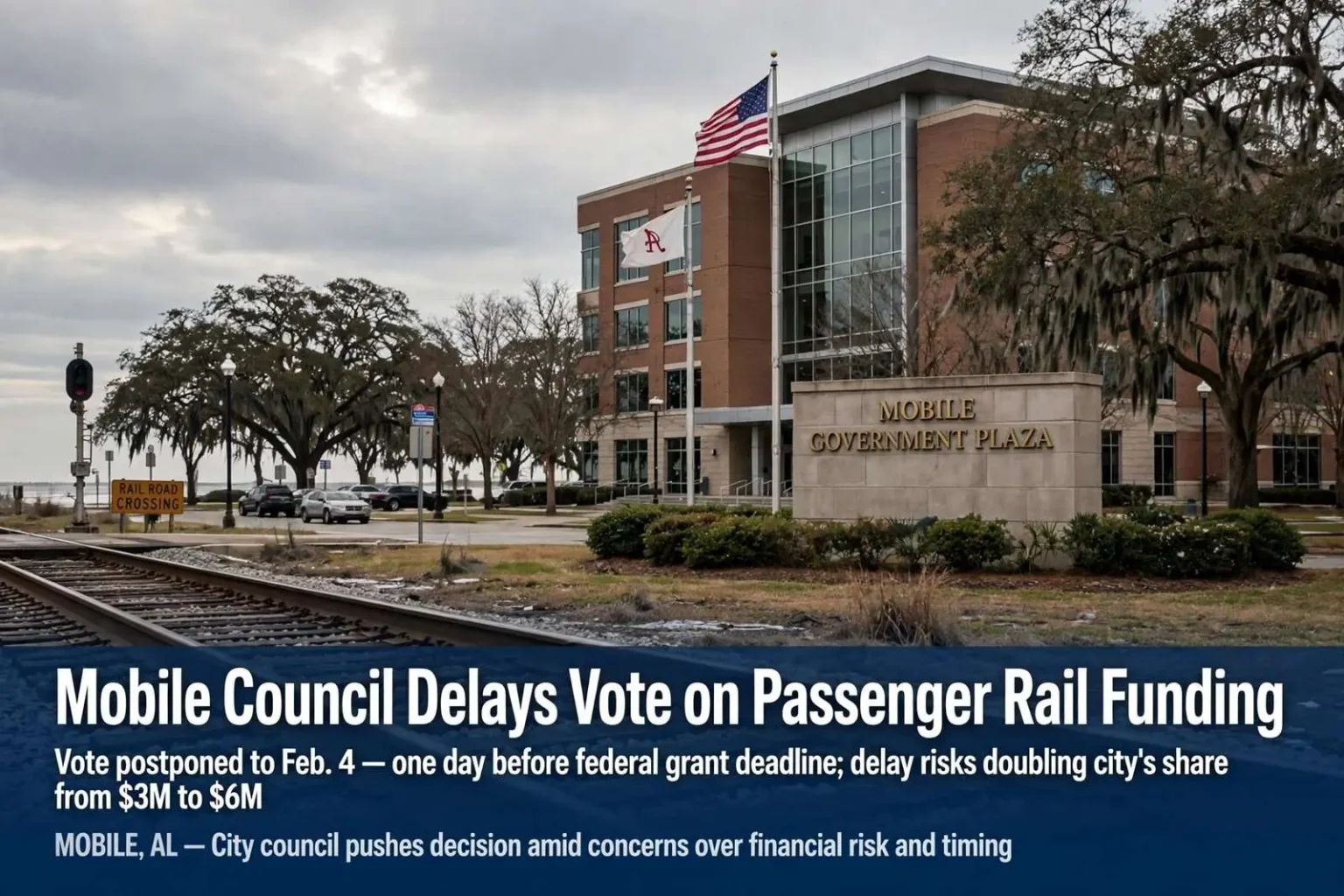
MOBILE — A vote on whether Mobile will formally commit funding toward restoring passenger rail service to the city has been pushed back a week, after several city council members raised questions about the financial risk the city could be taking on. The Mobile City Council was set to vote this week on a Letter of Support to the U.S. Department of Transportation backing a grant application from the Southern Rail Commission to help restore passenger rail service through Mobile. Under the proposal, Mobile would commit $3 million spread over three years. Council members instead postponed the vote to their Feb. 4 meeting to allow more time to weigh the city’s financial exposure.
The new date carries its own urgency: Feb. 4 falls just one day before the deadline for the Southern Rail Commission to submit its letter of support and qualify for the federal grant. According to Stephen McNair, a member of the SRC, missing that deadline would raise the price for the city considerably — Mobile’s share for the first three years of operation would jump from $3 million to $6 million. The one-day margin left the council balancing two risks against each other: committing millions without the safeguards some members wanted, or running out the clock and doubling the city’s eventual share of the cost.
Councilman Joel Daves was the most vocal skeptic during the council’s work session, arguing that the city needed firmer safeguards before signing on, including relying on a feasibility study conducted by Amtrak to set realistic expectations for the project’s chances of success. “Once we’ve made the commitment, we’re bound to the contract,” Daves said. “I’ve talked to my constituents and they are opposed. It makes no economic sense for the city of Mobile. I think it’s important to use a conservative assumption to determine if it’s a good idea.” His argument reflected a long-running frustration among some council members with grant-driven projects that arrive on the city’s books with their operating costs attached.
Not every council member agreed that caution was warranted. Councilman Fred Richardson and council president Levon Manzie both said they were ready to vote and saw no reason for further delay. “I have not received one negative comment from citizens in District 1,” Richardson said. “They want Amtrak. If it failed all over the country, then we shouldn’t pursue it.” The split set the council’s familiar fault lines: the city’s fiscal caution against the ambitions of its districts, with a federal deadline forcing the question faster than anyone at the work session preferred.
Why passenger rail stopped at New Orleans
The fight over the letter of support sits on a decade of history. Before Hurricane Katrina in 2005, Amtrak’s Sunset Limited ran across the Gulf Coast, linking Mobile with New Orleans and points west. Katrina wrecked the coastal rail infrastructure, and Amtrak never resumed service east of New Orleans — leaving Mobile, for all its rail heritage, without passenger service even as every freight line through the city stayed busy. For nearly two decades since, restoring Gulf Coast passenger rail has been a standing goal of planners in the three Gulf states, and the Southern Rail Commission — the federally chartered body that represents Louisiana, Mississippi and Alabama on rail matters — has been the vehicle for pursuing it.
The commission’s case for the New Orleans-to-Mobile route rests on the corridor’s fundamentals: the track exists, the freight hosts along the line have been the subject of long negotiations, and the intermediate cities — Slidell, Bay St. Louis, Gulfport, Biloxi, Pascagoula — are exactly the tourist-and-work destinations a short-haul corridor serves well. Mobile would be the eastern terminus, giving the region’s largest city a direct rail connection to the Mississippi coast and New Orleans. The grant application now before the U.S. Department of Transportation is one stage of that long effort, and the letter of support the council is being asked to approve — with its attached $3 million local commitment — is the local-government price of entry.
That local match is standard federal practice, and it is where the council’s hesitation comes from. Federal transportation grants rarely cover full project costs; the applicant community commits its own money to show skin in the game, and operating subsidies for the first years of service typically fall to the jurisdictions that benefit. Mobile’s $3 million over three years is the proposed version of that contribution. Daves’s point was that a commitment made under deadline pressure is still a commitment: the contract binds regardless of whether the assumptions in the grant application — ridership, host-railroad cooperation, the federal share — hold up.
The council’s math and the city’s ambitions
The skeptics’ case rests on the arithmetic of operating subsidies. A city that commits $3 million for the first three years of rail service is, in effect, prepaying for an outcome it does not fully control: ridership projections depend on the host railroads’ on-time performance, on ticket prices the city does not set, and on the corridor performing as the feasibility study projected. Daves’s call for conservative assumptions was a demand that the council price the downside — service that underperforms and requires larger subsidies, or a route that fails to launch — before signing, not after. His reference to the Amtrak feasibility study pointed to the one independent estimate of the route’s costs and ridership that exists, and he wanted the council anchored to it rather than to the more optimistic projections that accompany most grant applications.
The other side of the dais answered with politics and constituency. Richardson’s observation that he had received no negative comment from District 1 — the district stretching from downtown’s western neighborhoods through parts of the city’s African-American communities that would anchor the route’s local ridership — reflected a genuine base of public enthusiasm for rail’s return. For many Mobilians, passenger service is not a subsidy line but a missing piece of the city’s identity: the Port City was built by rail and water, and a generation of residents has never ridden a train east of the city. Manzie, as council president, weighed the institutional view — that Mobile’s growth as a Gulf Coast economic center argues for the connectivity, and that a city that passes on federal matching money for infrastructure is rarely offered it twice.
The deadline arithmetic complicated everyone’s position. Postponing to Feb. 4 kept the vote one day ahead of the SRC’s submission deadline, but it left no room for a second delay: if the council deadlocked on Feb. 4, the letter would miss the grant window, and McNair’s warning about the cost doubling — $3 million becoming $6 million for the same three years of service — would become the operating assumption for any future application. In practice, the one-week delay converted a contested vote into a final one.
What the service would mean for Mobile
Should the route be restored, Mobile’s role would be significant. The city’s rail history runs deep — as a port terminus for lines running north to the interior and west along the Gulf — and a rebuilt passenger platform would tie downtown to a corridor carrying millions of annual visitors between the coast’s casino towns, beach communities and New Orleans. Downtown interests have argued that a rail terminus is economic development in its own right: visitor spending around the station, mobility for Mobile workers traveling the coast, and a link that makes the city’s convention and tourism marketing easier to sell across the region.
The freight railroads’ cooperation remains the fundamental variable. Passenger service on the corridor runs on tracks owned and dispatched by freight companies, whose operational priorities and liability terms have been the quiet obstacle in Gulf Coast rail negotiations for years. Any grant application of the kind the SRC is pursuing carries with it the assumption that those agreements — trackage rights, scheduling, insurance — are either settled or close to it. Council members weighing the letter of support were, in that sense, being asked to trust a process whose hardest negotiations happen in rooms the city does not occupy.
The council’s decision, whatever its outcome, marks the moment Mobile’s local government formally chooses whether Gulf Coast passenger rail is a civic priority with a municipal price tag or an aspiration it supports from the sidelines. The $3 million question was always about more than three years of subsidies: it is about whether the city stakes its own money on a corridor that planners have been trying to revive since the tracks washed out in 2005, and whether the council trusts the feasibility study, the SRC and the federal process enough to bind a future council to the contract Daves warned about. On Feb. 4, with one day on the clock, the council had to answer — and the answer would price Mobile’s seat on the Gulf Coast rail map for years to come.