Mobile Council Postpones Annexation Vote Covering 13,000 Residents
The Mobile City Council voted 6-1 to delay a vote that would let about 13,000 residents in three county corridors decide on annexation, amid disputes over city spending on police and fire protection outside the city limits.
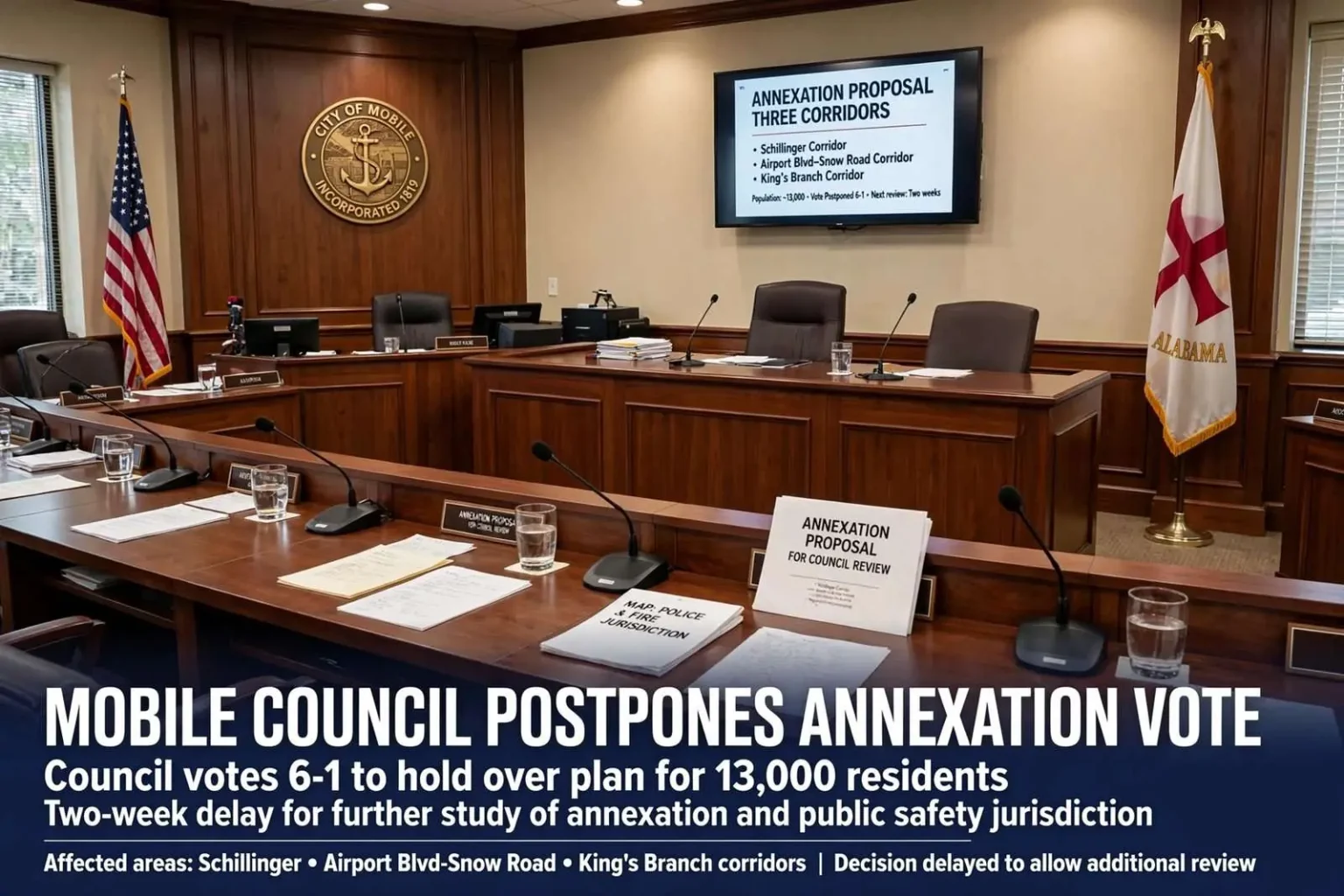
The Mobile City Council voted 6-1 on Tuesday to hold over a proposal that would let residents in three unincorporated areas of Mobile County decide for themselves whether to be annexed into the city, giving council members and the mayor's administration two more weeks to study the plan before it comes back up for a vote.
Under the plan being considered, roughly 13,000 people living along the Schillinger corridor, the Airport Boulevard-Snow Road corridor and the King's Branch corridor would have been given the chance to vote on whether their neighborhoods should become part of the city of Mobile. Those three referendums had been scheduled to go before the council Tuesday, but a series of objections from council members pushed the matter to a later date. Councilman C.J. Small, who opposed putting off the vote, argued that money already being spent on police and fire protection in the areas targeted for annexation would be better used addressing problems inside the existing city limits, particularly in his own district.
Using a brief slide presentation, Small pointed to blighted lots, potholes and other infrastructure problems in neighborhoods he represents. "Several neighborhoods (in my district) are suffering and you have trash overflowing," Small said. "Stop putting a Band-Aid on these problems so we can correct our problems and get it right. We've got to fix ourselves inward." Councilman Fred Richardson and council president Levon Manzie echoed Small's concerns about unmet needs inside the city, with Richardson warning that Mobile could not afford to take on new territory without careful planning. "If we're not smart where we annex, it would be an albatross around our necks," Richardson said. Debate over the annexation plan was complicated by a mailing campaign in the districts represented by Manzie and Small.
A pro-annexation organization called the Mobile Policy Forum sent flyers to residents in those districts urging them to pressure the two council members into supporting the annexation push. One flyer featured an image of a check written for $27 million along with the message "You're paying for someone else's bill," implying that people living outside the city limits were receiving city services without paying for them. Council members said the flyers also contained conflicting figures for how much revenue annexation would actually generate for the city. Manzie called the flyer campaign "gutter politics." "The people in my district didn't appreciate it," he said. "What's the agenda behind it? The citizens in my community didn't appreciate it. If there was one good thing about it, it woke up a sleeping giant."
Small was similarly unhappy with the mailers. "I refuse to be bullied by a postcard," he said during the council's work session. "It was not only wrong for them to send a postcard, but it also has misinformation."
The annexation debate is closely tied to a separate issue: the boundaries of the city's police and fire jurisdiction, which extend three miles beyond the official city limits and currently cover about 70,000 people who live outside Mobile proper but still receive city police and fire coverage.
During Tuesday's regular meeting, Manzie announced plans to introduce legislation that would scale back those jurisdictional boundaries and reduce how much the city spends serving residents who live outside the city limits but don't pay city property taxes. "Right now, according to our public safety director, we're spending $27 million for those areas outside of the city," Manzie said. "I want to reduce it to $2 (million). The other $25 million spent could be spent in the corporate boundaries of the city of Mobile. That's exactly my plan. Now whether it takes a gradual change, I'm open to it, because I don't want to leave anybody high and dry. But subsidizing areas outside of the city to the tune of $27 million is unsustainable and I hope to have legislation on the agenda Thursday."
Public Safety Director James Barber cautioned that pulling back city police and fire coverage that abruptly would leave a major gap in protection for people living in the police and fire jurisdiction. "With that kind of reaction that he (Manzie) has given is that you've got 70,000 people without fire suppression in those areas, so that's not really an option," Barber said. "The 1½ mile proposal was a phased rollback that would have kept 80 percent of the population in our jurisdiction, allow the sheriff to take over 20 percent, and then we can begin the systematic phasing. That withdrawal would have been phased so that we don't leave anybody uncovered."
Barber said the density of development just outside the city limits, unlike areas such as Theodore that maintain their own fire station, means residents there depend on the city for fire suppression they would not otherwise have. "The reason we continue to provide fire suppression is because they (people living in the affected area) do not have fire suppression," he said. "It's a different situation than Theodore (which has its own fire station), so when you come into this area, you can't tell that you left the city of Mobile, because it's so densely populated. If you pulled all the police and fire out of there, you basically left 70,000 people in our county without coverage."
Mobile Mayor Sandy Stimpson noted that his administration had proposed a similar rollback of the police jurisdiction years earlier, an idea the council rejected at the time. "I'm a little surprised, actually," Stimpson said. "Go back a few years and we had talked about us spending too much money in the police jurisdiction. He (Manzie) said it, they woke a sleeping giant up and now they realize what we were trying to say."
City projections presented alongside the annexation proposal estimated the three corridors would generate nearly $1.5 million in new sales tax revenue for Mobile in the first year alone, with that figure expected to grow to about $2.2 million annually within five years.
The referendums would not have been unprecedented for Mobile; the City Council has authorized similar annexation votes in 1992, 1993, 2002, 2007 and 2008, with varying results each time.
City figures on the demographic makeup of the three corridors show the areas are home to an estimated 8,539 white residents, 3,330 black residents and 1,057 residents of other backgrounds. Adding that population to Mobile's rolls would leave the city's overall racial breakdown at roughly 49 percent black and 47 percent white, preserving Mobile's status as a majority-black city even though the newly annexed areas skew whiter than the city as a whole. Some annexation opponents have suggested the push is designed to benefit Stimpson politically by adding more white voters to the city, a claim supporters reject by pointing out that earlier annexations carried out under Mayor Sam Jones, Mobile's first black mayor, also reshaped the city's voter rolls without preventing Jones from losing his bid for a third term.
Beyond the added tax base, supporters of the annexation have pointed to secondary benefits, including the possibility of pushing Mobile's population back above 200,000 for the first time in years, a threshold that could help restore its standing as Alabama's second-largest city and increase eligibility for certain federal funding, including U.S. Department of Justice grants that help pay for local policing. They have also drawn comparisons to Birmingham, whose population has declined for years in part because it is hemmed in by fully incorporated suburbs, in contrast to fast-growing Huntsville, which has continued to expand its city limits alongside its population.
The council is expected to revisit the annexation referendums, along with any legislation on the police and fire jurisdiction boundaries, at a future meeting after city officials have had additional time to review the proposals.
How annexation by referendum works
Alabama law gives cities several routes to annexation, including a local act of the Legislature, a petition signed by every property owner in the area, or an election. Under the election method, the city council adopts a resolution describing the territory, and the county probate judge then calls a special election in which only qualified voters living in that territory decide whether to join the city.
The police jurisdiction at the center of Manzie’s proposal is a separate creation of state law. Alabama cities with at least 6,000 residents may exercise police powers up to three miles beyond their corporate limits, and smaller towns up to a mile and a half, which is why Mobile provides police and fire coverage to tens of thousands of people who do not live inside the city.