Mobile County 911 Director Not Charged With DUI After Spanish Fort Public Intoxication Arrest
Mobile County 911 Director Charlie McNichol was arrested for public intoxication after his county vehicle was found stopped on a Spanish Fort highway, but was not charged with DUI, and the 911 board says it has no plans to take action against him.
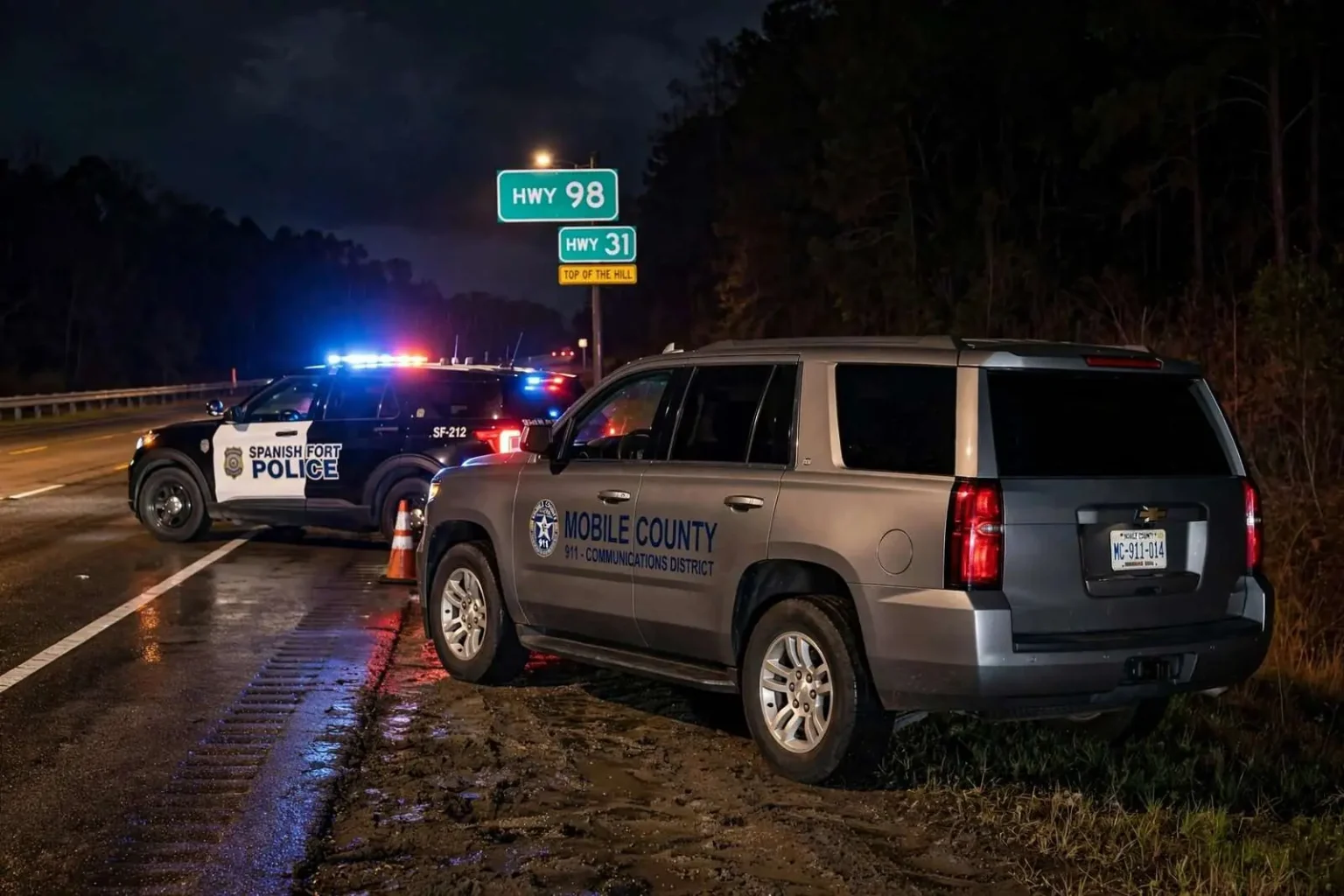
The director of Mobile County’s 911 system was arrested for public intoxication early on Oct. 12 after his county-issued vehicle was found stopped along a Baldwin County highway, according to authorities familiar with the case, though he was not charged with driving under the influence.
Charlie McNichol, who has led the Mobile County Communications District since 2016, was taken into custody by Spanish Fort police after officers found his gray Chevrolet SUV, marked with a municipal tag, stopped near the intersection of highways 98 and 31 — an area locally known as “the top of the hill” — around 12:35 a.m. Spanish Fort Police Chief David Edgar said the vehicle appeared to already be stopped when officers arrived, and gave no indication of why McNichol would have pulled over in that location.
Edgar said the arrest report does not reference any passengers, and while it was not explicitly documented, he believes McNichol was seated in the driver’s seat at the time officers approached. McNichol was booked into the Daphne Jail following his arrest and released after posting a $400 bond.
It remains unclear whether McNichol underwent a field sobriety test, a detail that could help explain why he was charged with public intoxication rather than DUI if alcohol impairment played a role in the stop. Under Alabama law, a person can be convicted of driving under the influence if they are found to be operating, or in “actual physical control” of, a vehicle with a blood alcohol content of .08 percent or higher. Courts in Alabama have upheld DUI convictions in cases where an officer did not directly witness a suspect driving, so long as evidence supported a finding of physical control over the vehicle.
A public intoxication charge carries a lower evidentiary bar. Under state law, the offense applies when a person appears to be under the influence of alcohol, narcotics or other drugs to a degree that endangers themselves, another person or property, or when they engage in boisterous or offensive conduct that disturbs others nearby. Unlike DUI, prosecutors do not need sobriety test results to pursue the charge.
Edgar said the decision on which charge to file ultimately rested with the arresting officer. “They’re faced with discretion on when to make an arrest and when not to, as well as what the proper charges should be,” Edgar said. “You have to prove those charges, and some charges are easier to prove than others.”
McNichol acknowledged the arrest when reached by email, saying he was “embarrassed” by the incident. He said he met with Mobile County 911 Board President Steve Bowden on Oct. 12 to discuss what happened. “This was a mistake that I made. I make no excuse for my poor judgment,” McNichol said. “I have had some life stressors with health issues recently, and I obviously did not handle this well. I will seek assistance and work through this terrible event.”
McNichol is scheduled to appear in court Nov. 15. Spanish Fort police policy calls for the release of body and dash camera footage from the arrest once the criminal charge against him is resolved, Edgar said.
Members of the Mobile County 911 Board, which oversees the Mobile County Communications District, signaled they intend to stand behind McNichol as director. Bowden said in an email that the board plans to meet soon to review the facts of the case, but for now is supporting “Charlie” and does not plan to take any disciplinary action. “He’s been a great asset to the 911 center, and we hope to resolve this issue in his favor,” Bowden said, referring additional questions to board member Robert Adams.
Adams, who specializes in conflict resolution, confirmed McNichol was in his county-issued vehicle when he was arrested but said McNichol was not driving at the time. Instead, Adams said, McNichol had “pulled over and fell asleep.” Like Bowden, Adams suggested McNichol’s job with the 911 center remains secure for now. “Mr. McNichol is a very principled individual who we hold in high regard,” Adams said. “This was an off-duty incident, and at this time there’s no action being taken. We don’t see the need for it, and two, we’ll wait for our regularly scheduled meeting to give further information.”
McNichol’s Background
McNichol brings a lengthy background in law enforcement and public safety administration to the 911 director’s post. Before joining the Mobile County Communications District, he served as assistant chief of the Daphne Police Department and later worked as a law enforcement coordinator for the Southern District of Alabama under then-U.S. Attorney David York.
That tenure ended in 2007, when McNichol resigned from the U.S. Attorney’s office after being accused of leaking details of an ongoing public corruption investigation in south Baldwin County — a probe that eventually led to the indictment of former Orange Beach Mayor Steve Russo and several others. A special prosecutor from Pensacola was assigned to oversee the case after investigators determined McNichol had shared details of the investigation, including advance notice of a scheduled news conference announcing a planned indictment, with a friend.
McNichol ultimately pleaded guilty to one count of theft of public property. As part of a plea agreement with federal prosecutors, he was sentenced to a year of unsupervised probation, fined $25 and agreed to resign from the U.S. Attorney’s office.
After a brief stint in the private sector with DRC Group Inc. in Louisiana, McNichol returned to public safety work, joining the Mobile County 911 center as assistant director in 2013. He was promoted to director in 2016 following the ouster of his predecessor, former state Rep. Garry Tanner, whose departure capped several turbulent years for the agency. Adams credited McNichol with implementing cost-saving administrative changes since taking over. “He’s made some money-saving changes,” Adams said. “There were some issues with the previous director, which we’ll leave at that, and he’s helped clean those up. Now we’re building an additional building, and we’re very pleased with his work. He’s working out well.”
McNichol’s starting salary as director was just over $100,000, and he has since received at least one raise. Tanner, his predecessor, was earning more than $126,000 before his removal.
What the Arrest Means for the Communications District
The Mobile County Communications District is the agency that runs the county’s 911 dispatch operation, and the director’s position is one of the most sensitive in the local public-safety infrastructure. The board’s decision to stand behind McNichol, at least pending its own review, reflects both the agency’s relatively limited public profile and the practical difficulty of removing a director mid-incident. McNichol’s court appearance on Nov. 15 will produce the first formal public record in the case, and Spanish Fort police have committed to releasing body and dash camera footage once the criminal charge is resolved.
For residents who rely on the 911 system, the immediate question is whether the arrest will affect day-to-day operations. The Communications District’s dispatch staff and call-takers handle emergency calls across Mobile County, and any disruption in leadership during a high-volume period would be visible to the public. McNichol’s statement that he has “sought assistance” and intends to “work through” the incident suggests he expects to remain on the job through the court process, and the board’s public support gives him space to do so.
How the Communications District Is Structured
The Mobile County Communications District is governed by a board that includes representatives from Mobile County, the city of Mobile and other participating municipalities, and the director reports to that board rather than to the county commission directly. The structure is designed to insulate 911 operations from political turnover, and it means that personnel decisions like McNichol’s rest with the board members rather than with elected officials who might otherwise face pressure to act quickly in the wake of a high-profile arrest.
The Communications District’s role is broader than most residents realize. Beyond answering emergency calls, the agency coordinates radio communications for multiple police, fire and EMS agencies across Mobile County, manages the computer-aided dispatch system that routes calls to the appropriate first responders, and maintains the records that flow from those calls. Disruptions in leadership at the agency can therefore ripple across the entire local public-safety ecosystem, which is why the board’s measured approach to McNichol’s arrest is likely to continue until the criminal case is resolved.
What the Public Will Eventually See
Spanish Fort police policy calls for the release of body and dash camera footage from McNichol’s arrest once the criminal charge against him is resolved, which means the public will eventually get a clearer picture of what officers encountered when they found the county-issued SUV stopped near the intersection of highways 98 and 31. That footage is likely to address several unanswered questions: whether McNichol was in fact in the driver’s seat, whether he was conscious and responsive, and whether there were any signs of impairment that officers could have documented at the scene.
Until that footage is released, the public narrative around the arrest will continue to depend largely on the differing accounts already on the record. McNichol, through board member Adams, has said he pulled over and fell asleep. Police, through Chief Edgar, have indicated only that the vehicle appeared to already be stopped when officers arrived. The court process on Nov. 15 will not resolve those accounts definitively, but it will produce the first formal findings of fact, and the body camera release afterward will fill in the rest of the picture for a public that depends on the 911 director every time it dials for help.