
Handicapping the June Primary: A Look at the Mobile County Commission Races
With the Republican primary set for June 1, one veteran observer sized up the Mobile County Commission contests in Districts 2 and 3, where a federal trial loomed over a three-term incumbent.
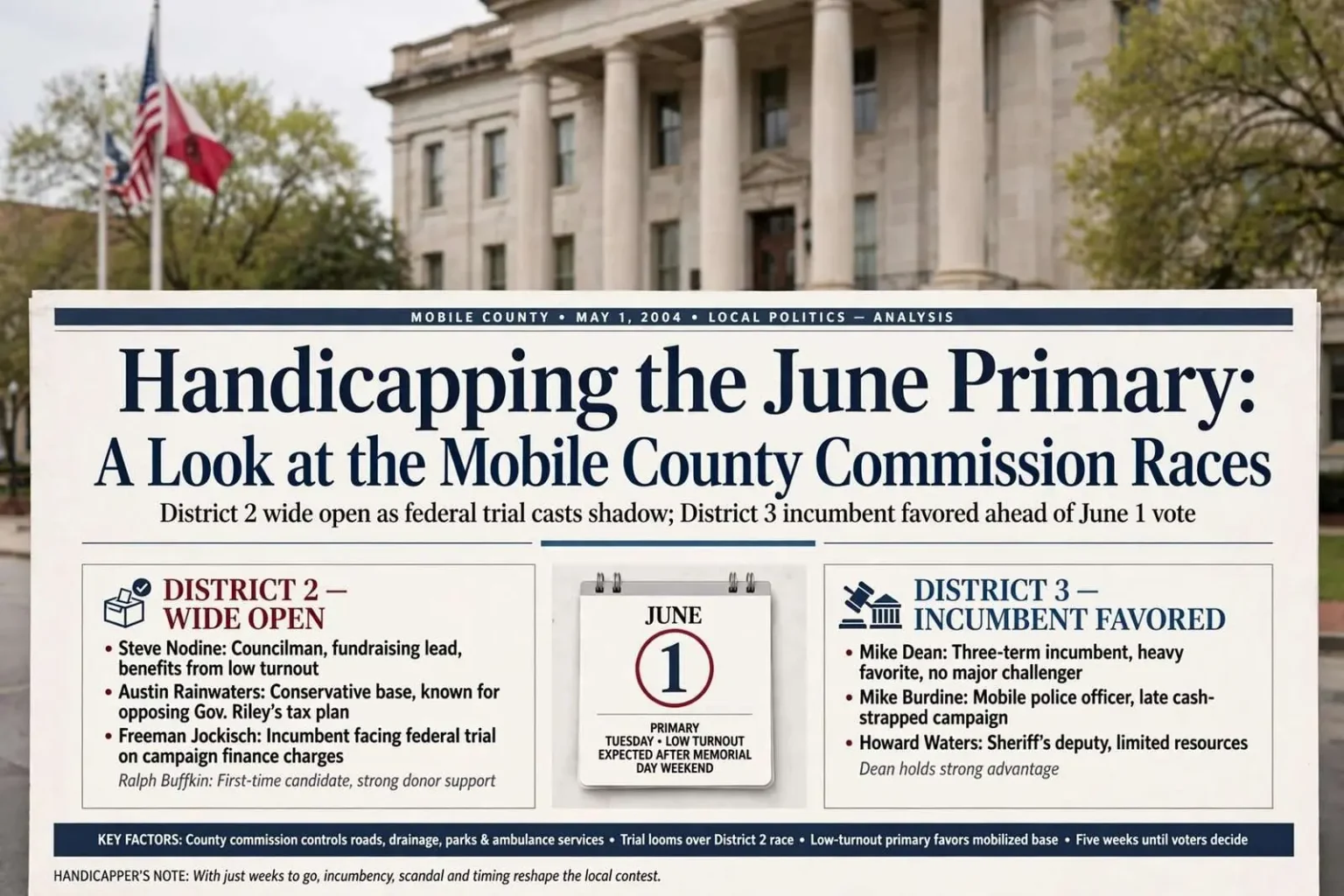
With the Republican primary set for June 1, the contests for the Mobile County Commission were beginning to take shape, and one long-time observer offered a handicapper’s view of the field from the rail. The races — one wide open in District 2, one largely settled in District 3 — offered a study in how incumbency, scandal and timing reshape a local election. With just weeks to go before voters went to the polls, the picture was forming around a handful of familiar names, a pending federal trial, and a calendar that threatened to keep most voters home.
The Mobile County Commission is the county’s governing body, a three-member panel whose commissioners each represent a geographic district while standing for election countywide. The commission controls major services residents touch directly: road and drainage projects, the county’s parks, ambulance contracts and the budget that funds them. Races for its seats rarely draw the attention that legislative or statewide contests command, but the commission’s decisions reach further into daily life in unincorporated Mobile County than almost any other elected board’s.
District 2: A Field Built Around a Trial Date
City Councilman Steve Nodine entered the race with several advantages: strong name recognition from his 2001 council campaign, an early start on fundraising and a district that fit his candidacy well. In a low-visibility race for a county seat, that kind of head start is often decisive — the candidate voters already recognize starts the campaign with a base that challengers must spend time and money simply to reach. Nodine’s early money and council profile positioned him as the field’s natural front-runner before the first advertisement ran.
A recent dispute over public housing had, if anything, worked in his favor. As a champion of the opponents of the project, Nodine scored points with many constituents, and his 6-1 loss on the council spared him the fallout that a victory and a protracted, racially charged appeal might have brought. The episode was a study in the odd arithmetic of local politics: taking a high-profile losing position on a divisive issue can burnish a candidate’s standing with his base at no cost, provided the loss comes on someone else’s watch.
The calendar also seemed to favor Nodine. With the primary falling the day after the Memorial Day weekend and fundraising lackluster across the board, a light turnout appeared possible, a circumstance that generally benefits front-runners. Low-turnout elections reward candidates with committed, already-mobilized supporters and penalize challengers whose path depends on reaching occasional voters. For a race in which no campaign had broken through with heavy spending, the long holiday weekend before the primary looked likely to keep turnout thin.
Although Freeman Jockisch was nominally the incumbent, his pending federal trial had left Nodine functioning as an “incumbent lite.” Incumbency is normally the most durable advantage in local politics, but it works only as long as the officeholder’s standing holds; a sitting commissioner awaiting a federal trial on charges tied to his campaign finances converts the usual advantages of the seat into a liability that rivals inherit by default. That dynamic reordered the entire District 2 field around Nodine’s candidacy.
Austin Rainwaters brought appeal to the Republican base as a long-established voice for less government and lower taxes, along with higher name recognition than a typical challenger owing to his prominent opposition to Gov. Bob Riley’s rejected tax plan. The Riley proposal — a sweeping tax and accountability package that Alabama voters rejected overwhelmingly the previous fall — had made its loudest opponents into familiar figures among conservative primary voters, and Rainwaters had been among them. In a Republican primary, that visibility among the party’s most reliable voters is a currency all its own.
He had the means to get his message out and a track record of outperforming predictions, having narrowly lost a 1994 state Senate race despite being heavily outspent. Candidates who exceed expectations once develop a reputation that shapes how opponents and observers treat them the next time, and Rainwaters’ history of running ahead of his money made him the field’s most dangerous underdog. His challenge was converting a conservative base into a countywide plurality in a district where Nodine held the council-earned name recognition.
Ralph Buffkin, a retired Ciba-Geigy executive and first-time candidate, surprised some with better-than-expected name recognition. A late entry, he leaned on strong fundraising, including a well-attended event, and on goodwill carried over from his work in the 2001 campaign of Mayor Mike Dow and the 2002 Riley campaign. First-time candidates usually struggle to introduce themselves to voters in the compressed window of a county race; Buffkin’s late start was cushioned by the network of donors and volunteers he had built while working on other people’s campaigns.
Three-term incumbent Freeman Jockisch had been reduced to a long shot. His poll numbers and campaign finances were both thin, and he was scheduled to stand trial in federal court on fraud and tax charges tied to his handling of campaign money. Absent an acquittal before the election, his path to another term appeared narrow. An incumbent running third in a primary needs his rivals to split the vote precisely, his own trial to disappear, and voters to separate his service from his legal troubles — a set of conditions no campaign can count on.
District 3: An Incumbent, Two Underdogs
Incumbent Mike Dean stood as a heavy favorite, with no well-funded challenger drafted against him despite some grumbling among the party faithful. The absence of a serious opponent is itself a signal: prospective challengers and the donors who would fund them had concluded that unseating a sitting commissioner in a friendly primary was not a fight worth joining. Grumbling among activists, however loud, rarely converts into a credible race without a candidate willing to spend a year raising money and attending every fish fry in the district.
Mobile police officer Mike Burdine and sheriff’s Deputy Howard Waters mounted late, cash-strapped challenges; both faced steep odds against a sitting commissioner. Law-enforcement backgrounds carry genuine appeal in county races, where sheriff’s deputies and police officers are familiar figures at civic club meetings and community events. But a challenge built on personal credentials rather than money and organization faces a mathematical problem in a district-wide race: there are simply too many doors and too few weeks before June 1 to close a name-recognition gap without advertising.
Beyond the Commission Races
Attention also turned to the federal bench, where U.S. District Judge Randy Butler planned to take senior status the following spring, opening a vacancy that Alabama’s U.S. senators would help fill depending on the outcome of the November presidential election. The mechanics of a federal district court vacancy run through Washington: a senator from the president’s party traditionally submits recommendations to the White House, which nominates a successor for Senate confirmation. If the November presidential election changed parties, the selection would pass to a different senatorial handshake entirely — which is why local lawyers and judges tracked the presidential race with as much interest as any local contest.
On another front, Sheriff Jack Tillman remained officially undecided about seeking re-election in 2006, though he was widely reported to be leaning toward retirement. A sheriff’s decision about a race more than a year away sets off quiet maneuvering among deputies and municipal police officials who would consider the office, since an open sheriff’s race in Alabama’s largest county draws a field every time it comes open. Until Tillman made his intentions formal, the potential candidates would remain officially informal.
A November referendum would let voters correct a gap in state law that had left the sheriff out of the state retirement program. The situation was an odd artifact of statute: the officeholder charged with running the county’s jail and law enforcement had been left off the list of officials covered by the retirement system, forcing the county to work around the omission. The referendum offered a straightforward fix that voters across the political spectrum had little reason to oppose, and local officials had pushed for the change precisely because recruiting for the office otherwise carried a hidden penalty.
As the handicapper cautioned, it was still early — just the first of May. Five weeks is an eternity in a primary race that nobody is paying attention to yet, and the ingredients were in place for the picture to change: a federal trial looming over the nominal favorite in District 2, a coming wave of television advertising that could introduce the candidates to voters who had heard of none of them, and the inevitable campaign sparring that surfaces in the final weeks of any contested race. Poll numbers taken on the first day of May would look different by the first day of June, and the only question was which way.
What the District 2 and District 3 contests shared was the shadow of larger forces. The June 1 primary sat at the intersection of a federal courthouse calendar, a countywide turnout problem, and the first local elections since the Riley tax fight rearranged the state’s political coalitions. Candidates who understood those currents — who the low-turnout calendar favored, who the trial helped, whose base was already mobilized — held advantages no amount of money could buy in the final weeks. The voters of Mobile County would render their verdict June 1, and the handicapper, for one, was not yet ready to guarantee the form chart.