Mobile County Confirms First COVID-19 Case: A Child Isolated at Home
Mobile County confirmed its first COVID-19 case on March 19, 2020 -- a child isolating at home under a pediatrician's care -- as ADPH reported 68 cases statewide and issued new health orders covering the county.
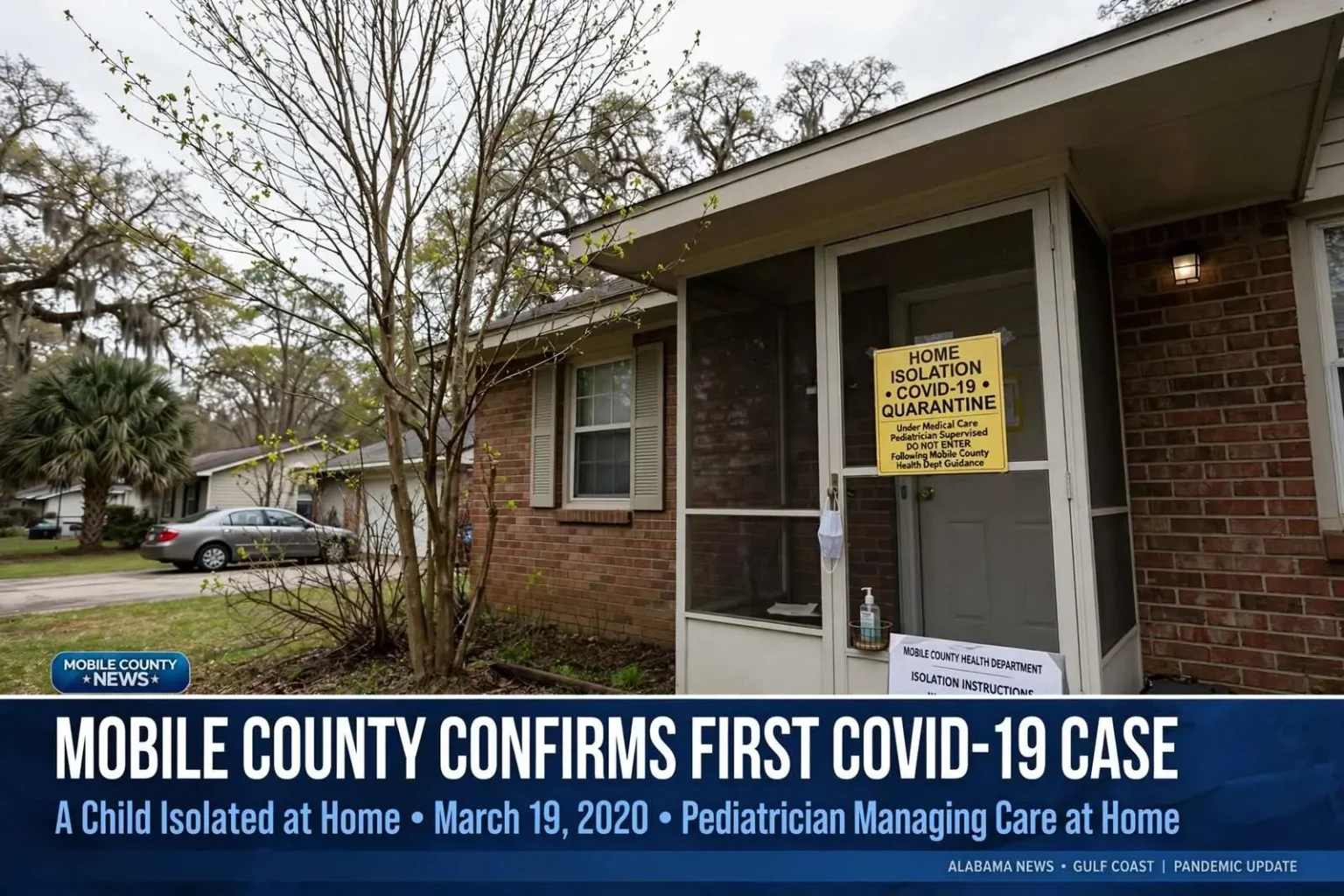
Mobile County recorded its first confirmed case of COVID-19 on Thursday, March 19, 2020, according to results released at 1 p.m. that day. The patient is a child who is being cared for by a pediatrician and is isolating at home rather than in a hospital setting — a detail that immediately set the Port City’s first brush with the pandemic apart from the pattern officials had been bracing for. The announcement, coming at the end of a week in which public life across Alabama had been upended almost overnight, confirmed what health leaders had been warning for days: the virus had reached the Gulf Coast.
The Mobile County case arrived in addition to 68 cases reported statewide earlier that same morning by the Alabama Department of Public Health, reflecting how quickly the virus was spreading across the state in the early weeks of the outbreak. Local testing had been conducted in line with federal and state public health guidelines, which at that stage of the pandemic still restricted testing largely to patients with known exposure or travel history and clear symptoms. Public health officials had spent weeks cautioning that limited test availability meant confirmed counts almost certainly understated the true spread of the virus in every county.
Because the patient is a minor, no identifying details about the child were released, consistent with the privacy rules that govern public health reporting. Officials emphasized that home isolation — rather than hospitalization — reflected the clinical picture in the case, and that the child’s pediatrician was managing care directly. The choice of pediatrician-led care at home also illustrated the guidance health leaders were giving statewide: most suspected cases did not require emergency evaluation, and hospitals needed to preserve capacity for the patients who did.
The confirmation landed on a day when southwest Alabama residents were already absorbing waves of disruption. Schools across the region had announced closures, houses of worship were rethinking services, and businesses downtown and along the Causeway were confronting the first days of empty schedules. The first case turned those abstract precautions into a local reality, and it arrived sooner in the outbreak than many residents had expected.
A week of escalating orders
The announcement followed closely on the heels of local action taken by Mobile County Health Officer Dr. Bernard H. Eichold, who on Wednesday, March 18, issued an order suspending certain public gatherings in the county because of the risk posed by COVID-19. Eichold, a longtime leader of the Mobile County Health Department, acted as caseloads in neighboring and metropolitan counties climbed and as national health authorities urged local officials to move ahead of the transmission curve rather than behind it.
That local order had come a day after the state health department imposed similar restrictions on Jefferson, Blount, St. Clair, Shelby, Tuscaloosa and Walker counties — the Birmingham metro area and the Tuscaloosa region, where Alabama’s earliest clusters had appeared. The sequencing made the direction of the outbreak plain: restrictions that began in North and Central Alabama were rolling toward the coast as testing caught up with the virus’s actual footprint.
By Thursday afternoon, ADPH issued new statewide health orders that superseded the Mobile County Health Department’s Order of the Health Officer No. 01-2020, extending state-level restrictions to cover all of Mobile County and every other county in Alabama. The superseding orders meant that local rules Eichold had issued just one day earlier were folded into a uniform statewide framework, an approach designed to eliminate the patchwork of county-by-county rules that had complicated compliance in the outbreak’s opening weeks.
As part of the guidance, ADPH recommended that gatherings of more than 25 people be postponed or canceled as a precaution against further spread. The threshold, drawn from federal modeling that assumed community transmission was already underway in much of the country, reached far beyond the large-venue events most people associated with closures: it touched church services, club meetings, funeral receptions, and the ordinary gatherings that anchor civic life in communities across south Alabama.
What health officials told the public
Health officials reiterated basic facts about the virus as case counts grew. Most people infected with COVID-19 experience mild respiratory symptoms, including fever, cough and shortness of breath, though some cases become severe enough to require hospitalization. The range of outcomes — from symptoms easily mistaken for a seasonal cold to pneumonia requiring intensive care — was the central fact driving public health strategy, because a virus mild for most patients can still overwhelm hospitals if large numbers of severe cases arrive at once.
Anyone experiencing symptoms was urged to contact a healthcare provider first, rather than going directly to a clinic or emergency room, so that appropriate precautions could be arranged in advance. The instruction was repeated in daily updates across the state because unannounced arrivals at emergency departments risked exposing other patients and staff, and because providers needed time to arrange masks, isolation rooms, and testing logistics before an evaluation.
As with influenza, the common cold and other respiratory illnesses, residents were encouraged to take standard precautions to limit the spread of disease: practicing good hand hygiene, avoiding close contact with people who are sick, staying home when ill, covering coughs and sneezes, and regularly cleaning and disinfecting frequently touched surfaces. Health leaders stressed that those familiar habits, unremarkable in ordinary flu seasons, were the most effective tools available to the general public before any vaccine or treatment existed.
Public health officials also emphasized that certain groups faced a higher risk of serious illness from COVID-19. People age 65 and older, along with those managing heart disease, lung disease, diabetes or other conditions that weaken the immune system, were advised to limit close interaction with anyone showing respiratory symptoms. Nursing homes, assisted living facilities, and other congregate settings across Mobile County began restricting visitors as those warnings circulated.
Why the child’s case resonated
The child’s case marked a notable early milestone in Mobile County’s experience with the pandemic, underscoring that COVID-19 was not confined to older adults or those with existing health conditions, even as public health guidance continued to stress that those groups faced the greatest risk of severe illness. Early in the outbreak, pediatric cases were uncommon enough that each one drew attention, both because of unanswered questions about how children transmit the virus and because of the anxiety any pediatric case generated among parents.
For health officials, the message was careful and consistent: children appeared less likely to suffer severe illness, but they were part of the transmission picture, and families needed to apply the same precautions regardless of a household member’s age. The fact that the county’s first confirmed case was managed entirely at home, under a pediatrician’s care, reinforced the guidance that hospitals were not the default first stop for suspected infections.
The case also illustrated the practical machinery of outbreak response in its early days. Confirmation required coordination between the local provider who ordered testing, the laboratories processing samples under evolving federal criteria, and the health department epidemiologists who verified results, initiated case investigation, and began the contact tracing work that would define the following months. Each confirmed case in March 2020 represented hours of investigative work by public health staff who were, at that point, still scaling up operations designed for outbreak response of a very different scale.
Mobile County’s pandemic footing
The Mobile County Health Department, one of Alabama’s oldest county health agencies, found itself coordinating with schools, the port, municipal governments in Mobile, Prichard, Saraland and the surrounding communities, and hospital systems across the region. Dr. Eichold’s order the day before the first case was confirmed had already signaled the department’s posture: act on the best available national guidance rather than wait for local confirmation to justify precautions.
In the days that followed, the count of local cases grew as testing capacity expanded, and the 25-person gathering recommendation gave way to tighter statewide restrictions, school closures extending indefinitely, and the gradual reshaping of daily life that defined the pandemic era. But the March 19 announcement remained the reference point — the moment the outbreak stopped being news from elsewhere and became a local public health event, announced in a single afternoon release, involving a single child recovering at home.
Officials closed the week by returning to the same guidance they had repeated since the outbreak began: stay informed through official channels, call before seeking care, protect older family members and neighbors, and treat everyday hygiene as a civic duty. The first confirmed case, they noted, would not be the last — and the county’s response in the days and weeks ahead would depend on how seriously residents took the precautions issued before the virus had even appeared on the local count.