
Mobile County DA Candidate Blackwood Disavows Pre-Dawn Robocall, Cries Foul
DA candidate Keith Blackwood denied an Election Day robocall came from his campaign and reported it as possible election fraud; Buzz Jordan denies.
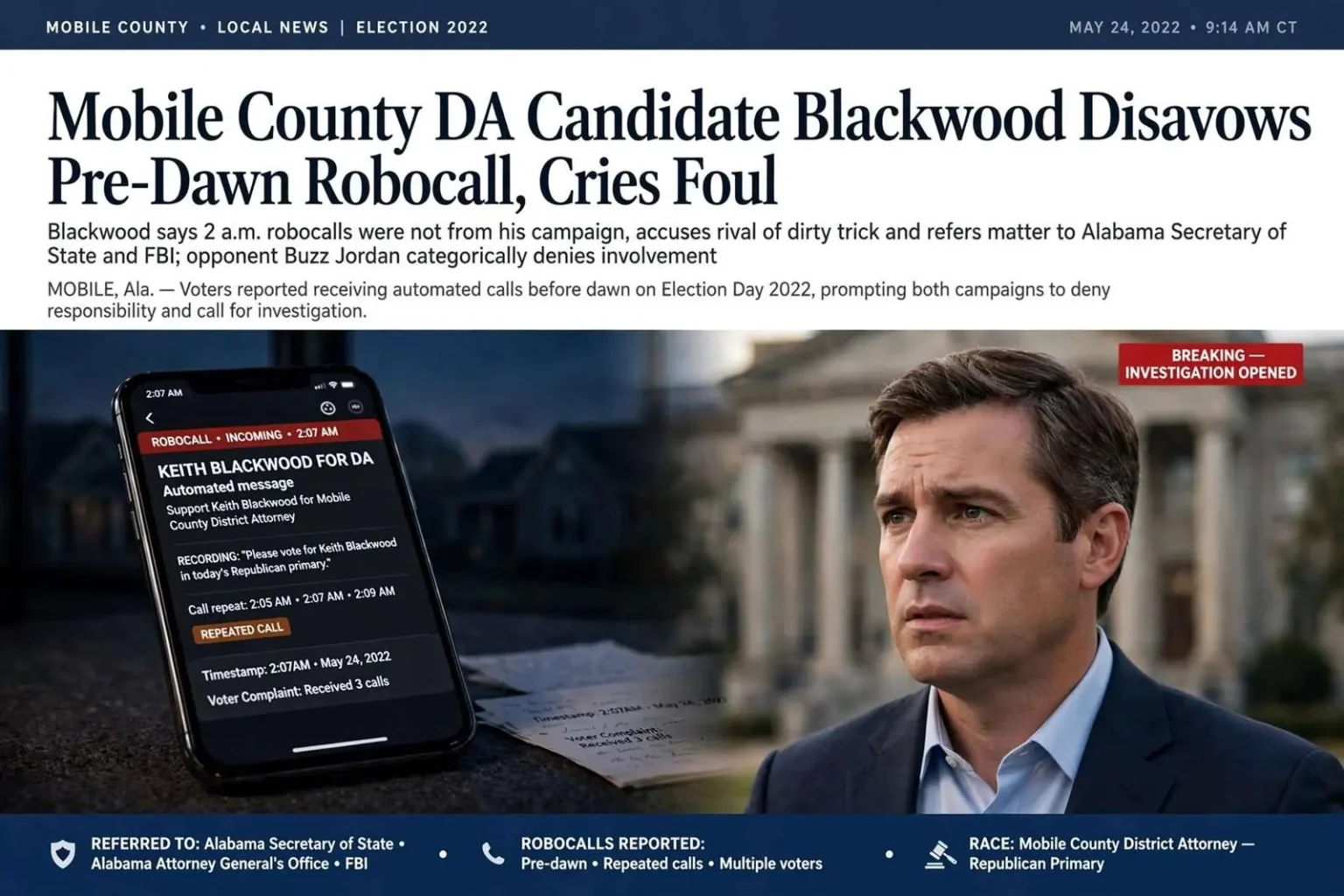
MOBILE, Ala. — Mobile County District Attorney candidate Keith Blackwood said a robocall that jolted voters awake early on Election Day 2022 did not come from his campaign, and he accused his Republican primary opponent of being behind it. The automated call, which reached some recipients as early as 2 a.m. Tuesday, May 24, urged listeners to elect Blackwood — with several voters reporting it arrived more than once.
The timing could hardly have been more provocative. Election Day phone calls are a standard tool of last-hours campaigning, but the window matters: legitimate get-out-the-vote calls run during waking hours, not at two in the morning. Voters who picked up before dawn heard a recorded voice urging them to support Blackwood in the Republican primary for Mobile County’s top prosecutorial office — and then, in several cases, heard it again when the system called back. The repeated pre-dawn contacts transformed what might have been dismissed as an aggressive call program into something voters described as harassment.
In a statement on his campaign’s Facebook page, Blackwood said the audio appeared to be lifted from videos already posted publicly by his campaign. That detail matters both politically and legally: whoever produced the call did not need new recordings of the candidate, only a clipping tool and his published material, which made attribution harder and gave the call a veneer of authenticity for anyone who recognized the voice.
“For weeks now, my opposition has been sending illegal robocalls,” Blackwood wrote. “My campaign has not and never will authorize any robocalls.” He called the tactic “disgusting politics” in a Republican primary. The statement went beyond denying involvement in the May 24 call — it framed the pre-dawn robocall as the latest move in a pattern the campaign had been tracking for weeks, and it put the accusation on the record in the most public forum a modern campaign has: its own social media feed, where primary voters were already scrolling.
Opponent Categorically Denies Involvement
Buzz Jordan, Blackwood’s opponent in the District Attorney’s race, rejected the accusation outright that morning. His campaign, Jordan said, “categorically denies having anything to do with early morning robocalls.” The denial was total — not a hedge about which vendor or volunteer might have been responsible, but a flat rejection of any connection between the Jordan campaign and the calls landing on Mobile County phones before sunrise.
With both campaigns pointing away from themselves, the question of who placed the calls became an official matter. Blackwood said he was referring the call to the Alabama Secretary of State and the state Attorney General’s Office for investigation as potential election fraud. The referral mattered because Alabama law regulates automated campaign calls, and because conduct intended to manipulate an election — including calls made to look like they come from a rival in order to alienate that rival’s supporters — sits squarely within the territory election authorities are charged with policing.
An update attributed to the Blackwood campaign said the matter had also been reported to the FBI, while Jordan continued to deny any involvement. Elevating the complaint to federal authorities signaled how seriously the campaign took the allegation: federal election-crime statutes reach conduct that taints the electoral process itself, and a pre-dawn robocall engineered to damage a candidate by association is the kind of scheme that can cross that line depending on who sent it and why.
The District Attorney’s race gave the episode a bitter irony that voters did not miss. The office the two Republicans were competing to lead is the county’s chief prosecutorial authority — the office that would, in ordinary circumstances, weigh whether a case like this merited charges. Both candidates understood the conflict that would arise if the winner inherited any investigation touching his own race, which made the referral to state and federal authorities outside Mobile County not just prudent but necessary.
For Mobile County voters, the pre-dawn calls landed in a primary season already crowded with contested local races, and the robocall dispute became one of the final-day stories that campaigns cannot control. Election-era political operatives have long understood that the last 48 hours before voting begins are when voters are most engaged and least able to verify a claim — a dynamic that cuts both ways for a tactic like this. A call that drives supporters to the polls can also become the story that defines a campaign’s final day, depending entirely on how the press and the public judge the accusation.
The episode also exposed how robocall technology has changed campaign dirty tricks. Automated dialing systems can place thousands of calls in an hour, spoof caller ID, and retry numbers automatically until someone answers — all with rented equipment and little traceability. Tracing a robocall campaign to its sponsor requires cooperation from telephone carriers, vendor records and subpoenas, which is why such cases move slowly even when authorities take them seriously. By the time investigators establish where a call originated, the election that motivated it is usually long decided.
What remained as polls closed was two sworn denials, two outside referrals and a Republican primary that ended with voters sorting the competing claims on their own. Blackwood’s campaign had staked its position on the record: the call was not theirs, was never authorized, and was part of weeks of what the campaign characterized as illegal robocalls tied to his opposition. Jordan’s campaign had answered with a categorical denial. The truth about the 2 a.m. calls rested, after May 24, with the Secretary of State, the Attorney General’s Office and the FBI — three agencies now holding a piece of a Mobile County campaign dispute that voters woke up to before sunrise.
The robocall fight unfolded against the backdrop of what the District Attorney’s office actually controls, and why the race drew genuine attention. The Mobile County DA prosecutes everything from capital murders to the theft and drug cases that flow through the city and county courts, supervises a large staff of assistant district attorneys and victim services officers, and sets the enforcement priorities that determine which cases get charged and which get diversion. Whoever won the May 24 primary would take charge of an office whose decisions reach into every neighborhood in the county — which is precisely why both campaigns reacted so viscerally to a tactic that touched the integrity of the contest itself.
Campaign lawyers on both sides spent Election Day working the problem from their own ends. A candidate hit by a fake call needs documentation: preserved recordings, timestamps, the phone numbers the calls came from, and statements from the voters who received them. Voters’ social media posts complaining about 2 a.m. calls became informal evidence in exactly that way — each one a timestamped record of what the call said and when it landed. The same records give investigators a map of the calling pattern, which is often the first step in identifying the dialing service behind it.
Alabama’s election authorities have seen robocall disputes before, but the early-morning timing placed this one outside even the usual gray zones. Campaign calls that arrive during waking hours sit in a regulatory space governed by state disclosure rules and federal telephone consumer laws; calls that hammer sleeping households repeatedly before dawn invite scrutiny on every axis at once — the content, the timing, the frequency and the apparent impersonation of a candidate’s own voice. Each of those elements can carry its own consequence depending on what the investigation turns up.
For the voters who answered, the calls also became an accidental stress test of election-season media literacy. A robocall using a candidate’s real voice, drawn from real campaign videos, is designed to sound authentic — and to leave the listener blaming the candidate for the intrusion. The countermeasure is the same skepticism that serves voters in every contested race: check the campaign’s official channels, note who benefits from the outrage, and remember that the loudest stunt on the last day of a campaign is usually meant to be remembered when the ballot is in hand.
Whatever the investigations concluded, the robocall left its mark on the race’s final chapter. The story of May 24, 2022, in Mobile County was not a platform dispute or a debate exchange but a machine dialing strangers before sunrise and two campaigns trading accusations in public before most voters had coffee. It was, depending on which campaign one believed, either a clumsy piece of supporter outreach or a deliberate act of election sabotage — and the gap between those two versions of the same phone call is exactly why the candidate who was named in it sent the matter to three separate law enforcement authorities before the day was out.


