Mobile County DA Keith Blackwood Highlights Support for Domestic Violence Survivors, Bullying Prevention
Mobile County District Attorney Keith Blackwood discusses how his office supports domestic violence survivors and promotes bullying prevention as October's dual awareness observances draw attention to both issues.
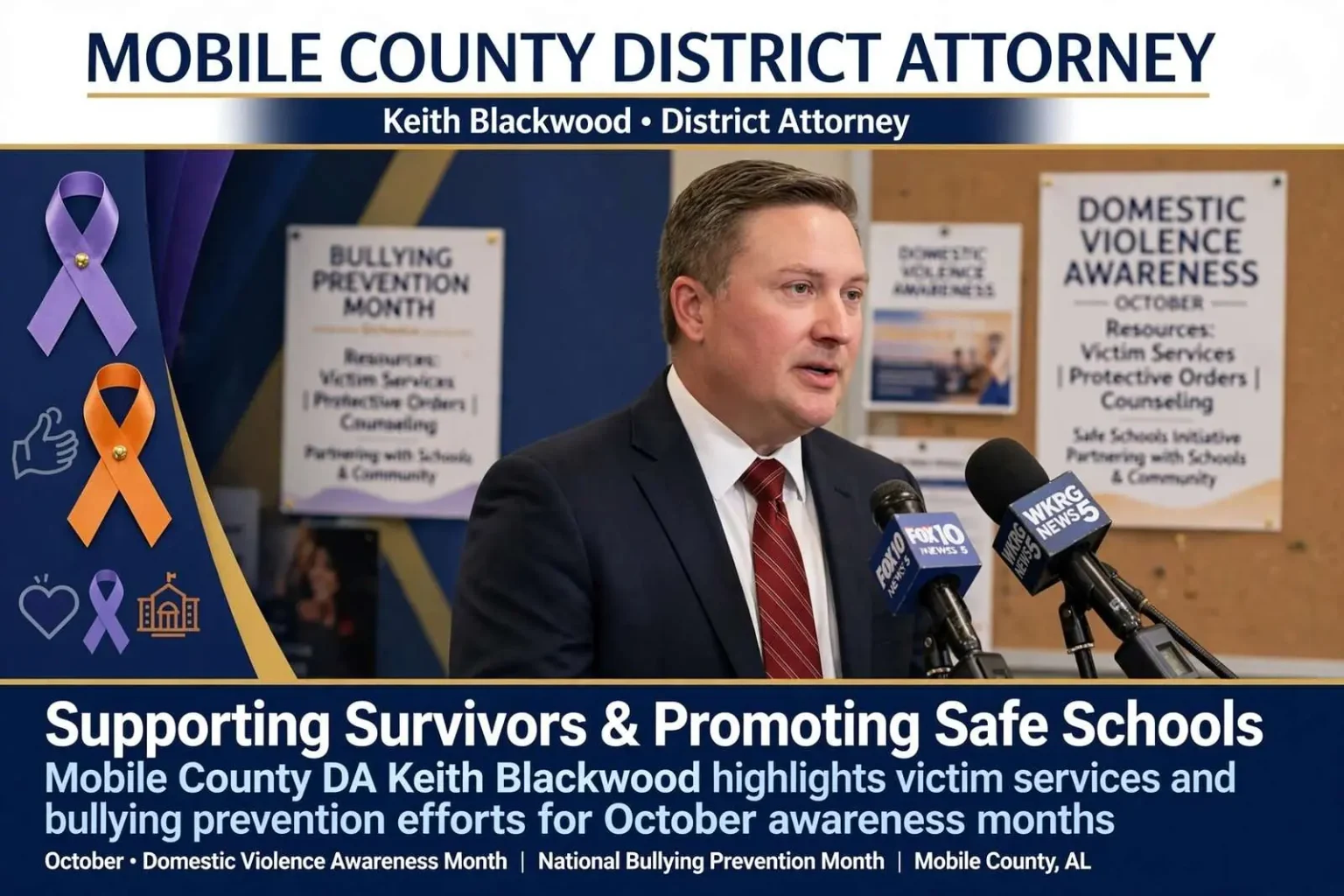
October marks both Domestic Violence Awareness Month and Bullying Prevention Month, and Mobile County District Attorney Keith Blackwood is using the observance to spotlight the work his office does year-round to support survivors and hold offenders accountable. The dual commemoration gives the office a public platform for work that usually happens quietly — in courtrooms, victim interviews and meetings with school officials across the county.
Blackwood discussed how his office helps victims of domestic violence navigate a legal process that can be confusing and intimidating, particularly for those who have never dealt with the court system before. For a victim facing protective order hearings, criminal charges against a partner, and a vocabulary of legal terms that can feel like a foreign language, the experience of pressing a case can itself become a barrier to justice.
Guiding survivors through that process, he said, is central to making sure offenders are held responsible and that victims are not left to face the system alone. The district attorney’s victim services staff — advocates who explain proceedings, accompany victims to court and connect them with shelters and counseling — is the machinery behind that promise, and it is the part of the office most Mobile County residents never see until they need it.
Why domestic violence cases are different
Domestic violence cases present unique challenges for prosecutors. Victims often have ongoing relationships with the people who harmed them, whether through shared housing, children or finances, which can make reporting abuse and following through with a case emotionally and logistically difficult. A victim may depend on the defendant for shelter or income, may co-parent with him, or may face pressure from family members to keep the matter private.
Those entanglements explain why domestic violence prosecutions demand more of prosecutors than most criminal dockets. Cases can stall when victims recant, miss hearings or stop responding to calls, and each of those moments may reflect the danger, dependency or exhaustion a survivor is living with rather than a lack of seriousness about the case. Offices that understand this design their approach around it — maintaining contact, explaining that setbacks are common and keeping the case alive even when the victim’s courage wavers.
A district attorney’s office that prioritizes victim support can make a meaningful difference in whether survivors feel safe enough to see a case through to its conclusion. Research and field experience across the country point the same direction: victims who are informed, supported and treated as partners in the process are more likely to cooperate with prosecution, and prosecutions that proceed are more likely to end in accountability rather than dismissal.
The connection to the courtroom
In Mobile County, that philosophy shapes how cases move from the first 911 call to a final disposition. Advocates and prosecutors work the same files, sharing information so a victim is not asked to repeat her story to a new stranger at every stage. The office’s coordination with law enforcement, shelters and community organizations extends the support beyond the courthouse walls, addressing the housing, safety planning and financial pressures that so often decide whether a victim can leave an abuser for good.
Blackwood’s message during the awareness month observance was aimed at both audiences at once: survivors who need to know help exists, and the general public whose understanding determines whether a reporting victim meets support or skepticism. A community that treats domestic violence as a private matter makes every step of prosecution harder; a community that treats it as a crime with public consequences makes the work of the courtroom possible.
Bullying prevention as public safety
Blackwood also spoke about a second priority for his office: bullying prevention. He described an initiative aimed at keeping children in school every day in a safe environment, reflecting a broader recognition that bullying and school safety are closely connected to both educational outcomes and, in some cases, later patterns of violence.
The framing matters because a district attorney’s office is not the most obvious participant in school bullying prevention. But prosecutors see the far end of the pipeline — the cases that begin with childhood aggression that adults ignored — and the office’s initiative treats every day of safe attendance as a small act of crime prevention. Children who feel safe at school learn; children who are victimized or terrorized disengage, fall behind and too often drop into the juvenile justice system the office works with every week.
Local anti-bullying efforts typically pair schools with outside partners, from law enforcement to mentoring organizations, to address behavior early rather than waiting for it to escalate into assault charges or worse. Blackwood’s initiative places the district attorney’s office inside that coalition, lending its weight to a problem that used to be dismissed as kids being kids.
Why the two observances share a month
The dual focus on domestic violence and bullying prevention during October is not a coincidence. National Domestic Violence Awareness Month has been observed every October since 1987, evolving from a single “Day of Unity” into a monthlong effort to raise awareness of resources available to victims. National Bullying Prevention Month, established in 2006, similarly uses October to encourage schools and communities to address bullying before it escalates.
The two campaigns share more than a calendar. Both grew out of recognition that violence follows patterns, that early intervention works, and that public silence is the ally of abuse. Both target behavior that thrives in private — behind a closed front door, in an unsupervised hallway — and both depend on bystanders willing to act: the neighbor who calls, the classmate who reports, the adult who takes a disclosure seriously.
They also share a thread of intergenerational concern. Children who witness domestic violence carry its effects into their classrooms and, later, their own relationships, which is why advocates treat prevention of one as protection against the other. A prosecutor’s office sees that arc in case files; awareness months exist to interrupt it in the community.
Resources for Mobile County residents
For Mobile County residents, the awareness campaigns serve as a reminder that local resources exist for those affected by domestic violence or bullying, and that the District Attorney’s Office sees both issues as connected to its broader mission of public safety. The office’s victim services program stands ready to walk survivors through protective orders and prosecution, and the county’s schools and community organizations offer channels for reporting bullying before it becomes criminal.
Advocates emphasize that knowing where to call is often the difference between a victim acting and staying silent. Awareness months exist partly for that reason — to put hotlines, courthouse services and school reporting paths in front of people during weeks when the subject is already being discussed on the news, in churches and in classrooms.
Blackwood’s comments came as part of a recurring conversation series highlighting the work of local officials and the issues affecting Mobile County communities. The format gives officeholders a chance to explain their work beyond press releases and campaign seasons, and for a district attorney whose office touches residents at the worst moments of their lives, the chance to explain what help looks like is itself a form of outreach.
How awareness becomes action
Advocates say awareness months like these are most effective when they translate into concrete action, whether that is a victim reaching out for help for the first time, a school strengthening its anti-bullying policies, or a community becoming more familiar with the legal protections and support services already available to those who need them. The purple ribbons and orange shirts of October are means to those ends, not the ends themselves.
The concrete actions available to Mobile County residents are straightforward to describe even if hard to take. A victim of domestic violence can contact law enforcement, the district attorney’s victim services office, or a local shelter to begin safety planning and learn about protective orders. A parent who suspects a child is being bullied can engage the school’s administration, document incidents and, where behavior crosses legal lines, involve law enforcement. A community member who witnesses either form of abuse can report it — the single act that most reliably starts the machinery of help.
Each of those steps relies on the same foundation: a system that responds competently when it is activated. That is why offices like Blackwood’s treat public education as part of the job. A protective order a victim does not know how to seek protects no one; a bullying report that goes nowhere teaches the child who filed it that reporting is futile. The measure of an awareness campaign is whether the system behind it holds up under the demand the campaign creates.
The district attorney’s wider role
Blackwood’s emphasis on victim support and prevention reflects a view of the district attorney’s role that has become common in Alabama and across the country: that prosecutors are not merely case processors but community safety partners whose influence extends beyond the courtroom. Prosecutors decide whom to charge, what to offer and how to treat victims along the way, and those decisions shape whether the community experiences the justice system as protection or obstacle.
In a county of Mobile’s size, the office handles thousands of cases a year spanning everything from traffic offenses to capital murder, and domestic violence dockets occupy a demanding middle ground — high volume, high danger and high emotional cost. The October observance gives the office a chance to describe that work in public terms, and it gives residents a chance to see the people behind the case numbers.
The connection between the office’s two October themes completes the picture. Domestic violence and bullying are not separate social problems so much as different points on the same continuum of coercion and harm, and a community that addresses both — in its homes and its schools — is doing the long, unglamorous work of preventing the crimes that would otherwise fill a prosecutor’s docket a decade from now.
For the remainder of the month and beyond, the office’s message stands: help is available, the legal process can be navigated with support, and no survivor in Mobile County has to face either the abuser or the system alone.