
Mobile County Flu Count Climbs Past 1,000 Cases, Though Numbers Still Beat Last Year
Mobile County's flu count hit 1,074 cases, up about 300 from the last report, though the county remains Alabama's least-affected region.
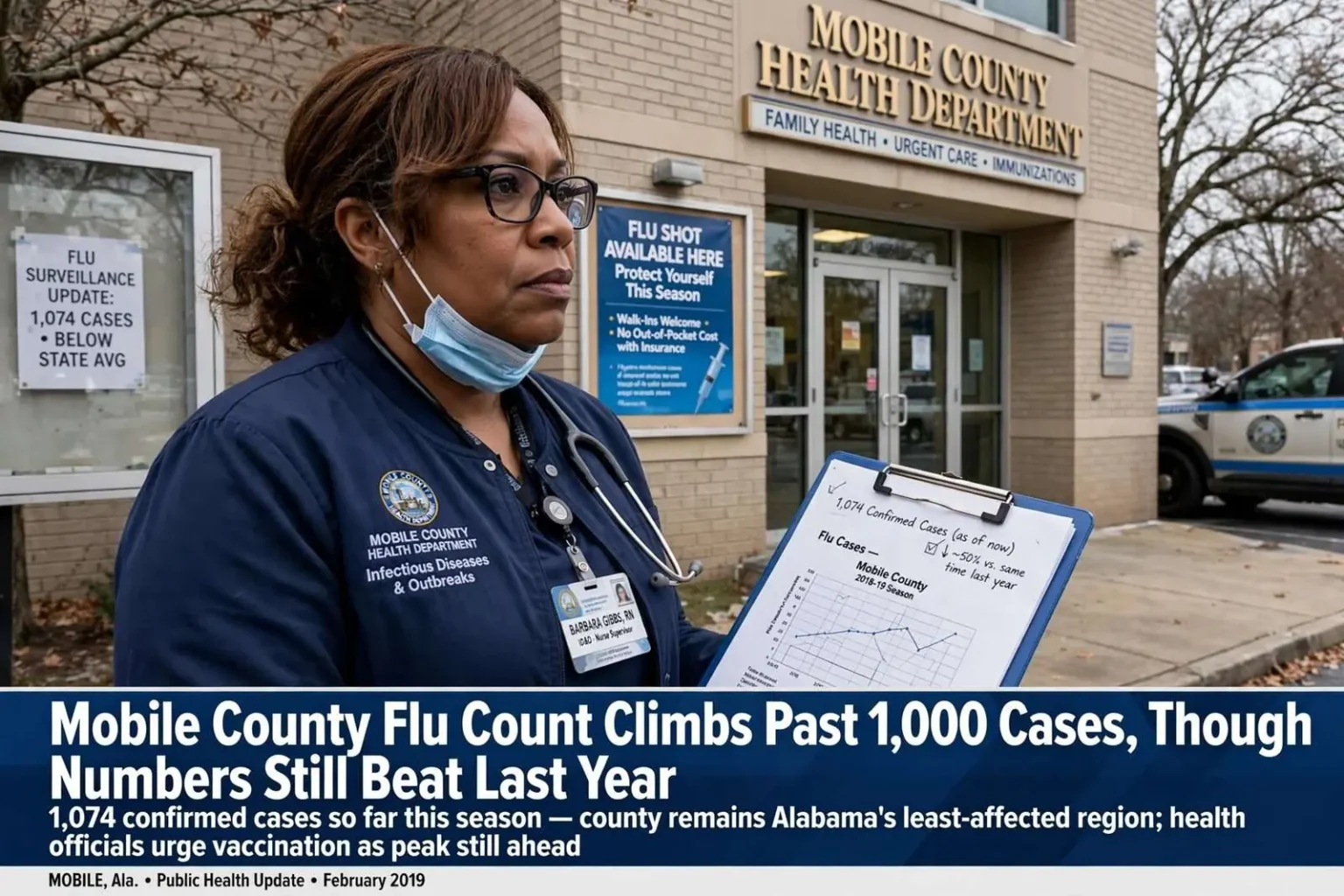
Mobile County has logged 1,074 confirmed flu cases so far this season, according to the Mobile County Health Department’s Infectious Diseases & Outbreaks division — a figure drawn from rapid flu tests at local hospitals and health department facilities. The count offers the clearest snapshot yet of influenza’s grip on the county, and it arrives as health providers across Alabama report a steady climb in respiratory illness.
The latest tally represents roughly 300 more cases than the previous report, a jump that might look alarming on its face. Health officials, however, cautioned against reading too much into the increase. Barbara Gibbs, the nurse leading the ID&O division, said weekly counts swing considerably depending on how quickly providers across the county file their reports, which can make an increase look steeper than it is.
That reporting lag is a familiar feature of flu surveillance everywhere. Rapid flu tests are administered at emergency rooms, urgent care clinics and public health facilities, and the results funnel into state and county dashboards on schedules that vary from one provider to the next. A single week’s haul may include cases that were actually diagnosed days or weeks earlier, and the next week’s report may look flat simply because the paperwork caught up. Officials stress that the trend lines matter more than any single weekly figure.
Mobile County Faring Better Than Most of Alabama
For all the local cases, Mobile County remains the least-affected region in the state for influenza-like illness. State health department data listed every other district under significant influenza activity — Mobile County was the only one spared that designation. The state’s public health districts group counties into regions, and the designation reflects the level of flu-like illness being seen by providers, not just laboratory confirmations.
The picture is also brighter than a year earlier. At the same point in the prior season, case counts were nearly double what they are now — a comparison that gives local health officials reason for measured optimism even as the season’s peak may still lie ahead. Flu seasons in the Gulf South typically build through the winter months, and officials have long urged residents to treat every season as a serious one, regardless of how it begins.
Health workers note that confirmed lab cases represent only a fraction of true flu activity. Many people who catch influenza never get tested, riding out the illness at home or being treated on the basis of symptoms alone. That means the 1,074 confirmed cases are best understood as a barometer of the season’s direction rather than a full accounting of who has been sick.
Clinicians across the county continue to see the usual seasonal pattern: school-age children catching and spreading the virus first, followed by waves of adult cases and, most concerning to health officials, illnesses among older adults and people with chronic conditions, for whom the flu can turn into pneumonia or other complications that require hospitalization.
Vaccine Working ‘About Half’ the Time
Nationally, early estimates from the CDC’s Morbidity and Mortality Weekly Report suggested the 2018-19 flu vaccine cut the risk of getting sick enough to see a doctor by roughly half — and performed even better in children, where effectiveness topped 60 percent. Those interim figures, drawn from the CDC’s ongoing flu vaccine effectiveness studies, put the season’s formulation in line with the performance of flu vaccines in typical years.
Flu vaccine effectiveness varies from season to season because the shots must be formulated months in advance, before the dominant circulating strains fully reveal themselves. Even in seasons when the match is imperfect, health officials emphasize that vaccination still reduces the severity of illness among people who do get sick, lowering the odds of hospitalization, complications and death — particularly for the very young, the elderly, pregnant women and those with asthma, diabetes or heart disease.
Federal surveillance data showed clinical labs tested more than 536,000 specimens for flu between late September 2018 and early February 2019, with about 10 percent coming back positive — overwhelmingly influenza A. Influenza A viruses tend to dominate early in seasons and are generally associated with more severe waves, while influenza B strains often surface later in the winter and spring and can drive a second, smaller peak.
The national data also shape how local health departments respond. When laboratories confirm a heavy circulation of influenza A, providers are quicker to prescribe antiviral medications to high-risk patients who show flu symptoms, because early treatment — ideally within 48 hours of onset — has been shown to shorten illness and reduce complications.
Health Officials: Vaccination Still the Best Defense
Health officials continued to stress vaccination as the most effective defense, with antiviral medications as a secondary tool. Antivirals such as oseltamivir can blunt the course of illness when started early, but they are not a substitute for immunization, and supplies can tighten during heavy flu seasons.
Along with the shot, public health workers continue to preach the familiar habits that blunt respiratory virus transmission: washing hands regularly, covering coughs, staying home when sick and disinfecting commonly touched surfaces. Schools, workplaces and long-term care facilities are frequent points of spread, and officials ask families to keep sick children out of classrooms until fever-free for a full day.
For older residents and people with chronic health conditions, doctors also recommend asking about pneumococcal vaccination, since pneumonia is among the most serious complications of influenza and can follow on the heels of a flu infection.
Where to Get a Flu Shot in Mobile County
The flu shot is available at all of the health department’s Family Health locations as well as its Urgent Care facility in Midtown Mobile. Health department clinics serve insured and uninsured patients alike, and officials urge anyone who has not yet been vaccinated to do so before the season’s peak arrives, since it takes about two weeks after the shot for the body to build full protection.
Residents who use private doctors’ offices, pharmacies and retail clinics also have widespread access to the vaccine across the county, and most insurance plans — including Medicare and Medicaid — cover the annual flu shot with no out-of-pocket cost. For families juggling schedules, walk-in options mean a vaccination can often be completed in a single visit without an appointment.
Health department staff remind residents that the season is not over when case counts flatten or fall. Alabama flu seasons have historically stretched into the spring, and a late wave of influenza B can arrive after an early influenza A season appears to fade. Vaccination remains worthwhile throughout the spring, as long as flu viruses are still circulating.
In the meantime, the Infectious Diseases & Outbreaks division will keep tracking weekly reports from hospitals and clinics across the county, updating the running total that health officials, schools and care facilities use to guide decisions. Residents can expect the numbers to move week to week — up, down and sometimes sideways — but the season’s broader shape will emerge from the trend, not any single report. For now, Mobile County remains better off than most of Alabama, and officials would like to keep it that way.
What the Numbers Do and Don’t Show
The confirmed case count comes exclusively from rapid flu testing — the quick in-office tests performed when a patient walks into a hospital emergency room, an urgent care clinic or a health department facility with flu-like symptoms. Those tests give providers answers in minutes, which is why they drive most treatment decisions, but they are somewhat less sensitive than the laboratory cultures used by researchers, meaning the true burden of illness is almost certainly higher than the confirmed tally suggests.
The surveillance system is also weighted toward people who seek care. Someone who treats a mild fever and body aches at home never enters the data, while someone who is older, sicker or dealing with complications is far more likely to be tested. As a result, confirmed counts tend to skew toward the more serious end of the illness spectrum — useful for tracking severity, but not a full measure of how widely the virus is circulating in schools, offices and households.
That’s precisely why health officials put so much weight on the week-to-week trend rather than the raw total. A sudden spike in one week’s report may simply mean a large provider batch finally landed; a steady climb across three or four consecutive weeks, on the other hand, is harder to explain away and usually signals genuine growth in transmission. County health workers watch those patterns the way meteorologists watch radar — looking for sustained movement rather than isolated blips.
For Mobile County, the current trend lines point the same direction as the district-level designations: influenza is clearly present and growing, but the county has so far avoided the significant-activity threshold that every other public health district in Alabama has crossed. Whether that holds through the rest of the winter depends largely on how many residents take the simple step of getting vaccinated in the weeks ahead — a decision, officials note, that protects not just the individual but the neighbors, coworkers and classmates around them.


