Mobile County health programs push safe sleep as Alabama logs 63 sleep-related infant deaths
The Mobile County Health Department's Fetal and Infant Mortality Review program, known as the Alabama Baby Coalition, has reviewed pregnancy and infant loss cases since 1998. Coordinator Yvonne Baynard says one sleep-related death has been confirmed in Mobile County as of Sept. 3, with eight cases under investigation, and the department is offering free portable cribs to families who complete safe-sleep training.
MOBILE, Ala. — A pair of Mobile County Health Department programs is working to reduce the number of babies who die before their first birthday, and this year the focus falls heavily on one preventable category: infants who die in unsafe sleep environments.
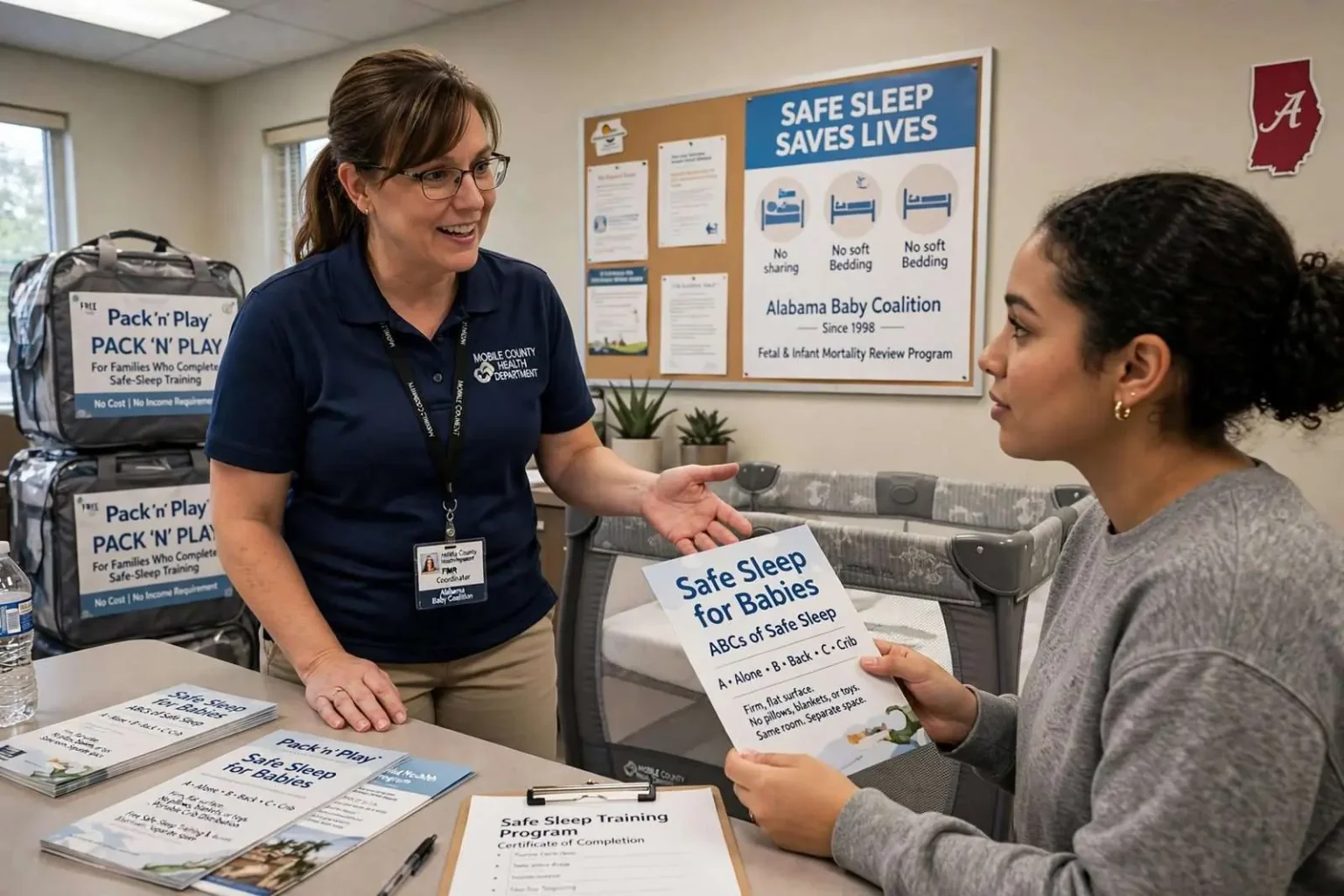
The department’s Fetal and Infant Mortality Review program, known locally as the Alabama Baby Coalition, has been operating since 1998. It works alongside the health department’s Maternal & Child Health program, which delivers safe-sleep education directly to families and distributes free portable cribs to parents and caregivers who complete a training class — at no cost and regardless of income.
The numbers the coordinator describes are the reason for the emphasis. According to the 2024 Infant Mortality report, there were 14 Sudden Infant Death Syndrome cases statewide. As of July 31, however, there had been 63 sleep-related infant deaths in Alabama.
“Although not all of these deaths may be directly caused by SIDS, they were caused by unsafe sleep environments that resulted in strangulation, asphyxiation or entrapment,” said Yvonne Baynard, FIMR Coordinator for the Mobile County Health Department. “As of September 3 in Mobile County, there has been one confirmed sleep-related death thus far, with eight cases under investigation.”
What a fetal and infant mortality review actually does
Fetal and infant mortality review is a specific public health method, and it is worth explaining because it is not what most people picture when they hear that deaths are being “reviewed.”
The program was established to identify critical community strengths and weaknesses, along with the particular health and social issues associated with poor pregnancy outcomes. It is a community-based, statewide initiative designed to improve the health and well-being of women, infants and families through two main activities: the review of deidentified cases of fetal deaths — stillbirths — and infant deaths, and voluntary interviews with mothers.
Two words in that description carry most of the weight.
Deidentified means that identifying information is stripped from a case before it is examined. Reviewers are not looking at a family’s name. They are looking at a sequence of events and circumstances. The purpose is not to assign blame to any parent, provider or agency, and the removal of identifying details is what makes candid examination possible.
Voluntary describes the maternal interviews. A mother who has lost a pregnancy or an infant may choose to speak with the program about her experience — her pregnancy, her care, the circumstances surrounding the loss and what she encountered along the way. No one is required to participate. Those interviews often surface the parts of a story that never appear in a medical chart: a missed appointment because of transportation, a prescription that could not be filled, housing that was unstable, advice that was confusing or contradictory.
What comes out of the process is not a verdict on any individual case but a pattern. If, for example, review after review shows infants dying in adult beds, or shows mothers arriving late to prenatal care for the same practical reason, that pattern points toward an intervention the community can actually make.
Reading the numbers carefully
The gap between the two figures Baynard cited is the most important thing in this story, and it is easy to misread.
The 2024 Infant Mortality report counted 14 Sudden Infant Death Syndrome cases statewide. The 63 figure, current as of July 31, counts sleep-related infant deaths in Alabama. Those are not the same category. SIDS is a specific determination, generally applied when an infant under a year old dies suddenly and the cause cannot be explained after investigation. “Sleep-related infant death” is a broader description covering deaths that occurred in a sleep environment, including those with an identifiable mechanical cause.
That distinction is exactly the point Baynard was making. As she put it, not all of these deaths may be directly caused by SIDS — many were caused by unsafe sleep environments producing strangulation, asphyxiation or entrapment. In plain terms:
- Strangulation can occur when something — a cord, a strap, a gap in furniture — presses on an infant’s neck.
- Asphyxiation occurs when breathing is obstructed, which can happen when an infant’s face is against soft bedding, a pillow, a couch cushion or an adult’s body.
- Entrapment occurs when an infant becomes wedged in a space he or she cannot get out of, such as between a mattress and a wall or between a mattress and a bed frame.
The reason public health workers press on this category is that these mechanisms are, in principle, preventable. They involve the physical setup of the space where a baby sleeps, and that setup can be changed.
The local figures Baynard gave — one confirmed sleep-related death in Mobile County as of Sept. 3, with eight cases under investigation — should be read with care. A case under investigation is not a confirmed sleep-related death. Investigations take time, and some will be classified differently when complete.
The safe-sleep guidance behind the program
The education both programs deliver rests on well-established national guidance for infant sleep, sometimes summarized as the ABCs: a baby should sleep Alone, on the Back, in a Crib.
In more detail, standard safe-sleep guidance holds that infants should be placed on their backs for every sleep, including naps; that they should sleep on a firm, flat surface intended for infant sleep, such as a crib, bassinet or portable play yard, fitted with a tight-fitting sheet and nothing else; and that soft objects should be kept out of the sleep area, including pillows, quilts, comforters, bumper pads and stuffed toys.
Guidance also recommends that infants sleep in the same room as a caregiver but on a separate surface rather than in the same bed, and warns specifically against letting a baby sleep on a couch, an armchair or a recliner, where the risk of wedging and suffocation is elevated. Caregivers are advised to avoid overheating and overbundling.
This article describes general public health guidance, not individualized medical advice. Parents and caregivers with questions about a specific infant, particularly a baby born prematurely or with a medical condition, should discuss sleep arrangements with their pediatrician or another qualified provider.
Free Pack ‘n’ Plays for families who complete training
Guidance is only useful if a family has somewhere safe to put the baby, and that is where the health department’s most tangible offering comes in.
Baynard collaborates with the Maternal & Child Health program to teach families about safe sleep practices that can help reduce infant mortality caused by SIDS. The programs carry that message to community and health outreach events, and they provide free Pack ‘n’ Play portable cribs to families who complete a safe-sleep training — regardless of income.
Families have two routes to that training. They may complete a class provided by the Alabama Department of Public Health, or they may sign up for in-person training through the health department’s Maternal & Child Health program. On finishing the class, a family receives a certificate of completion and becomes eligible for a free Pack ‘n’ Play, which provides a separate, safe sleeping area for a baby.
The design of that offer deserves notice. Making the cribs available regardless of income removes a means test and the paperwork that comes with it, which means no family has to document financial hardship to obtain a safe place for an infant to sleep. Pairing the crib with a completed class means the equipment arrives together with the knowledge of how to use it — a firm, flat surface with a fitted sheet and nothing else in it.
Why cost and circumstance matter
Bed-sharing and other unsafe sleep arrangements are frequently discussed as though they were simply matters of choice. In practice, they often reflect circumstance. A family living in a single room, a household without a crib, a caregiver who falls asleep while feeding a baby on a couch at three in the morning — these are the situations that show up repeatedly in infant death reviews across the country, and none of them is solved by a pamphlet alone.
That is the logic connecting the two Mobile County programs. The review side identifies where the pattern lies. The maternal and child health side responds with education delivered face to face at community events and with a physical crib placed in the home. One program studies the problem; the other addresses it in a way a family can use that night.
A program with a long local record
The Mobile County Health Department’s FIMR program has been running under the Alabama Baby Coalition name since 1998 and remains active in working to improve pregnancy outcomes. Nearly three decades of continuous operation is unusual for a public health initiative of this kind, and that longevity has value: it allows the coalition to track how outcomes shift over long periods and to see which community changes made a measurable difference.
Both programs, as the health department describes their mission, are committed to improving the health, safety and well-being of pregnant women, infants and children.
What families can do
For readers in Mobile County, the practical takeaways from the health department’s work are straightforward:
- Place babies on their backs for every sleep, including naps.
- Give the baby a separate sleep surface — a crib, bassinet or portable play yard — rather than an adult bed, couch or armchair.
- Keep the sleep area bare: a firm, flat surface and a fitted sheet, with no pillows, blankets, bumpers or toys.
- Ask about safe-sleep training. Families can complete the class offered by the Alabama Department of Public Health or arrange in-person training through the Mobile County Health Department’s Maternal & Child Health program, and those who finish receive a certificate and become eligible for a free Pack ‘n’ Play.
- Share the guidance with everyone who cares for the baby — grandparents, relatives, babysitters — because a safe sleep setup only works if every caregiver uses it.
Families interested in scheduling a class or learning more about the FIMR program and the Maternal & Child Health program should contact the Mobile County Health Department directly.
Behind the categories and the counts are families in this county, and the point of the review work is to keep that number from rising. As Baynard’s figures make clear, most of the deaths in question trace back to the environment where a baby was placed to sleep — which is to say, to something a community can change.