Mobile County Health Department to Host HIV Awareness Week With Testing, Faith Community Events
The Mobile County Health Department will hold two HIV awareness events in August, pairing a testing and prevention day with a faith-based community conversation on stigma and healing.
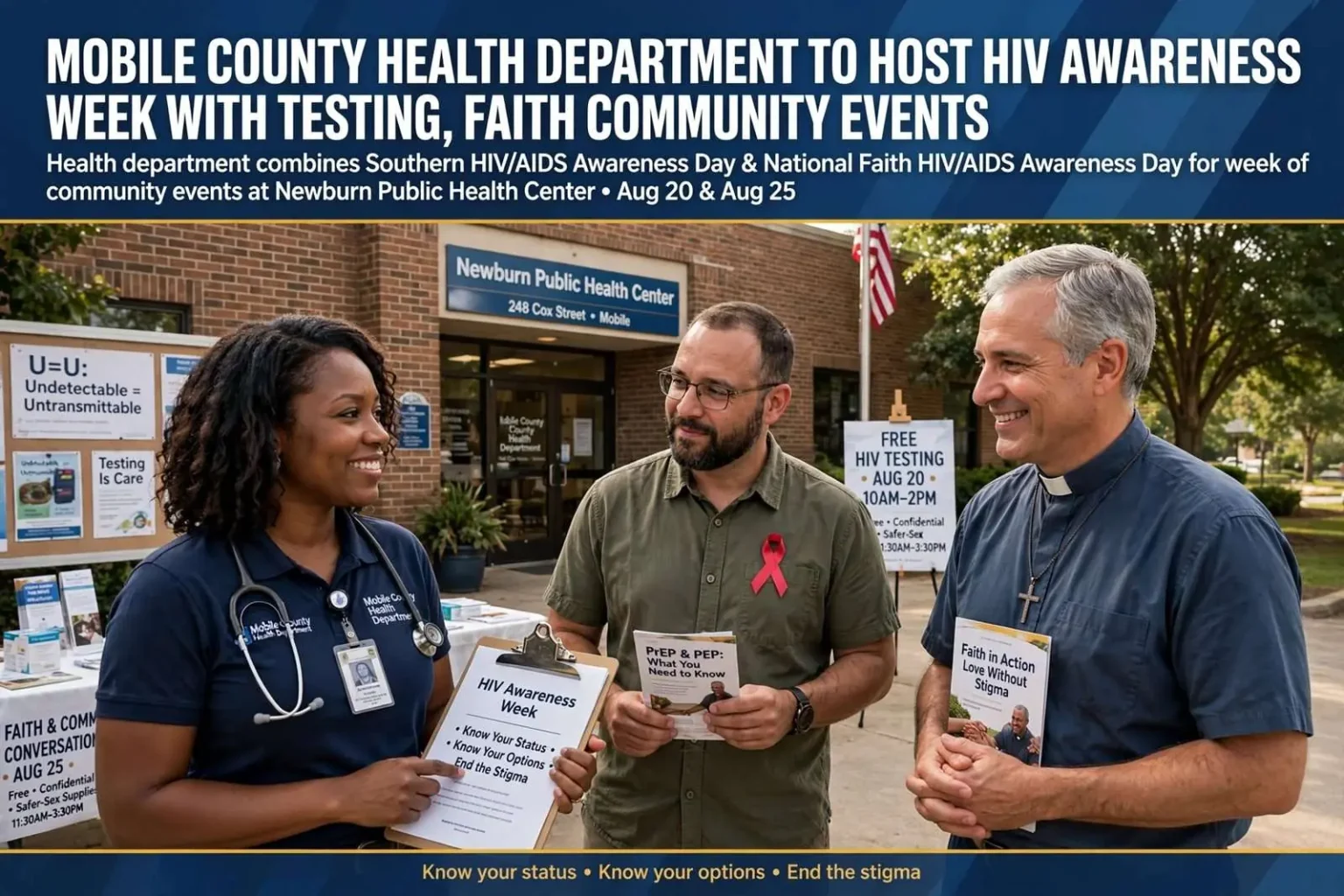
The Mobile County Health Department’s Sexually Transmitted Disease (STD) Surveillance & Control team is hosting a week of events later this month recognizing Southern HIV/AIDS Awareness Day and National Faith HIV/AIDS Awareness Day.
Because the two national observances fall only a few days apart on the calendar, the health department is combining them into what it is calling a “Faith, Health and Community HIV Awareness Week,” giving each date its own dedicated event while keeping the overall focus consistent.
“Since the two awareness days are only a few days apart, we will have a ‘Faith, Health and Community HIV Awareness Week’ while giving each date its own focus,” said Cherrite Peterson, the department’s Public Health Administrator II for the STD team. “The goals are to know your status, know your options, and end the stigma.”
The week’s structure reflects how public health outreach has evolved in the South, where the departments that fight HIV transmission increasingly work through churches, community groups and neighborhood institutions rather than relying on clinics alone. Mobile County’s effort pairs a hands-on testing day with a conversation aimed squarely at the faith communities whose influence shapes how residents think about the disease.
Aug. 20: Testing and Prevention Event
The first event, “Mobile Strong: Awareness, Prevention, Testing, Treatment,” will take place Aug. 20 from 10 a.m. to 2 p.m. at the Newburn Public Health Center, located at 248 Cox Street in Mobile. The event is designed to increase HIV awareness, normalize routine testing, connect residents with prevention and treatment resources, and address the stigma surrounding HIV that persists in many Southern communities.
Planned activities include free and confidential HIV testing, STI testing or referrals where available, and education on PrEP and PEP, medications used to prevent HIV transmission before and after potential exposure. PrEP, taken as an ongoing preventive regimen, has become one of the most important tools in modern HIV prevention, while PEP offers a short-course option after a possible exposure — but both work only when people know they exist and how to reach them.
The event will also include distribution of condoms and other safer-sex supplies, an HIV prevention and resource table, a “Know Your Status” awareness display, and an interactive activity addressing common myths and facts about HIV. Community health partners and resource vendors are expected to participate alongside brief educational sessions held throughout the day.
Organizers say giveaways will be available for participants who complete testing or educational activities, and light refreshments will be provided. The design of the event — walk-in friendly, free, confidential and built around conversation rather than lecture — is intended to lower the barriers that keep many residents from ever walking into a health department building for testing.
Confidentiality has long been one of the decisive factors in whether people get tested. Health department testing is conducted by professionals who handle results privately, and events like this one aim to demonstrate that a test is a routine, quick part of health care rather than an admission or an accusation. Public health officials across the country have emphasized that everyone between the ages of 13 and 64 should know their HIV status at least once, with higher-frequency testing for those at elevated risk.
Aug. 25: Faith and Community Conversation
The second event, “Faith in Action: Love with stigma, knowledge without fear,” returns to the Newburn Public Health Center on Aug. 25 from 11:30 a.m. to 3:30 p.m. Unlike the Aug. 20 event, which centers on testing, this gathering is structured as a faith-and-community conversation about HIV, compassion, stigma, prevention and healing.
The program will open with a welcome and opening prayer, followed by a discussion of the purpose behind National Faith HIV/AIDS Awareness Day. A brief presentation titled “HIV Today: What Our Faith Communities Need to Know” will cover HIV 101 topics including transmission, testing, prevention and treatment, along with a discussion of stigma as it plays out within families, churches and broader communities.
A Faith Leaders Panel titled “How the Church Can Respond to HIV” is also planned, along with a testimonial or lived-experience speaker if one is available. Panels of this kind give congregational leaders a chance to work through, in public, the questions their members bring to them privately — and they signal to residents living with HIV that the church’s response can be one of care rather than judgment.
The event will include education on PrEP, PEP and the concept of U=U, or “Undetectable equals Untransmittable,” which refers to the medical consensus that people living with HIV who maintain an undetectable viral load through treatment cannot transmit the virus to sexual partners. Bringing U=U into a church-hall conversation is significant: the science directly undercuts decades of fear-based assumptions, and faith communities that absorb it are better positioned to welcome HIV-positive members without treating them as risks.
Confidential HIV testing will be available both before and after the program, along with information on community resources and referrals. The event will close with a prayer and a call to action.
Placing testing at a faith-framed event is itself a deliberate choice. Residents who might never attend a clinic-based screening often will accept one when it is embedded in a gathering their congregation endorses, and health departments nationwide have found that trusted institutions can accomplish what advertising campaigns cannot.
Why It Matters Locally
Both events are free and open to the public at the Newburn Public Health Center, giving Mobile County residents two distinct ways to engage with HIV awareness and prevention efforts, whether they are seeking a confidential test or a broader community conversation about stigma and faith.
The health department’s decision to pair a clinical testing event with a faith-based community discussion reflects an effort to reach residents through multiple channels, recognizing that stigma and access to care remain significant barriers to HIV prevention and treatment in many Southern communities.
The South carries a disproportionate share of the nation’s new HIV diagnoses, and public health researchers have repeatedly tied the region’s outcomes to a combination of limited rural health infrastructure, late testing, and the social silence that stigma imposes. The consequences are practical: people who learn their status late start treatment late, and communities where the subject cannot be discussed openly see prevention tools go unused.
Against that backdrop, a week that moves from a syringe-free testing table to a pastors’ panel represents the two halves of the same strategy. Testing finds the people who need care; the community conversation changes the environment those people live in. The health department’s message, as Peterson summarized it — know your status, know your options, end the stigma — is addressed simultaneously to the individual and to the community, because in public health the two cannot be separated.
Residents who want to participate can simply show up at the Newburn Public Health Center on either date. No registration barriers are being emphasized, and both the testing day and the faith conversation are built to accommodate walk-ins — consistent with a week whose organizing purpose is to make engagement as easy, as private and as judgment-free as possible.
The two events also carry practical value for the organizations that will staff them. Community partners that set up resource tables at the Aug. 20 event gain a day of direct contact with residents who may need services far beyond HIV testing — primary care, housing assistance, substance-use treatment — and the health department uses the occasion to make those connections while residents are already in the building.
For the STD Surveillance & Control team, the week represents its most visible public-facing effort of the season. Surveillance work is by nature quiet: case investigation, partner notification, data collection and outreach that rarely makes news. An awareness week inverts that, putting the team’s mission in front of the public in the most accessible form available.
The choice of the Newburn Public Health Center as the site for both events is equally deliberate. Located at 248 Cox Street, the center sits in a part of Mobile where the department’s services are most needed, and holding both the testing day and the faith conversation there removes the travel barrier that separates many residents from care. Residents who attend one event will already know the building, the parking and the check-in process when they need services again.
Health departments across Alabama have been expanding similar outreach as federal prevention strategies shift toward ending the HIV epidemic through early detection and universal treatment access. The model depends on exactly the combination Mobile County is attempting: clinical capacity — testing, PrEP, referrals — joined to community trust. Neither works alone. Testing without community goodwill finds fewer people; goodwill without clinical follow-through helps no one get treated.
The department has not announced plans beyond the week itself, but the events are designed to leave standing infrastructure behind: residents who know where the Newburn center is, faith leaders who have discussed HIV from the pulpit side of the conversation, and community partners who have worked side by side with public health staff. Those relationships tend to outlast any single awareness week, which is precisely the point.