Mobile County Health Officials Highlight Health Benefits of Breastfeeding for Families
The Mobile County Health Department is highlighting the health benefits of breastfeeding for mothers and infants and calling on employers and communities to strengthen support for nursing families.
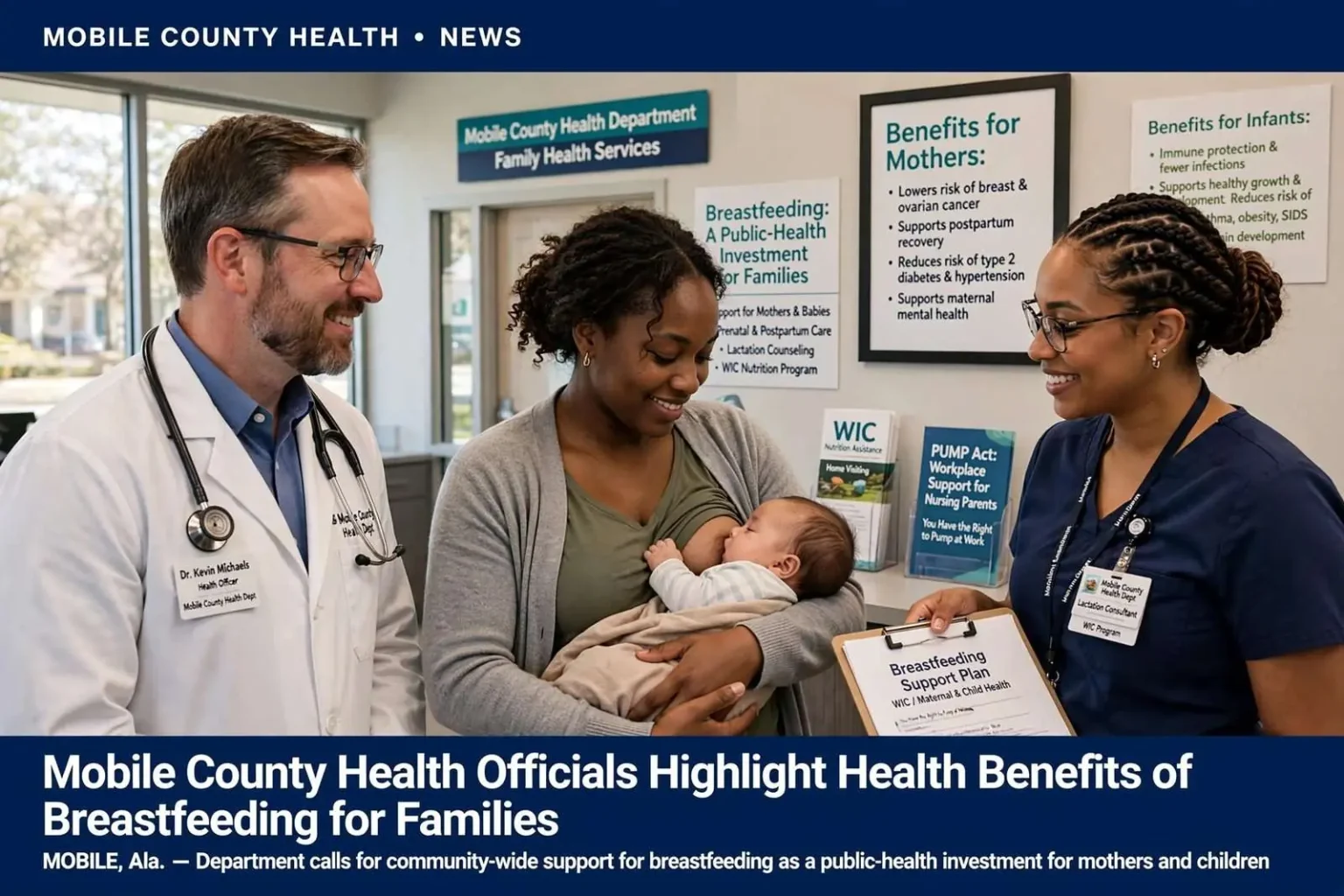
MOBILE, Ala. — The Mobile County Health Department is encouraging families, health care providers, employers and community partners to build stronger support systems for breastfeeding, framing it as more than a feeding method — a public-health investment that can shape the long-term well-being of both mothers and children. The department says every parent who chooses to breastfeed should have access to accurate information, compassionate care and practical support, whether that support comes from a doctor’s office, a workplace or a family member.
Local health officials describe the effort as a community-wide undertaking rather than a message aimed at new mothers alone. Pediatricians, obstetricians, hospital staff, employers, faith communities and extended family members all shape whether a parent is able to start and continue breastfeeding, and the department is asking each of those groups to consider the part it plays. A recommendation from a physician carries little weight if a workplace offers nowhere to pump, and a supportive employer cannot make up for a clinic that never answers a new parent’s questions.
“Breastfeeding can provide meaningful health benefits for both mother and child,” said Dr. Kevin Michaels, Mobile County Health Officer. “Families should never have to navigate feeding decisions alone. When communities support parents — from prenatal care through return to work — we help give babies a healthier start and strengthen the health of the entire family.”
The department’s outreach reflects its long-standing role in the community. The Mobile County Health Department traces its history to 1819, making it among the oldest public health organizations in Alabama, and its family health programs today include maternal and child health services, home visiting and nutrition assistance for thousands of residents each year. Those programs put the department in regular contact with expecting and new parents, which is where officials say the groundwork for successful breastfeeding is usually laid.
Benefits for Mothers
Health officials point to a range of short- and long-term benefits associated with breastfeeding for mothers. Research has linked breastfeeding to a lower risk of certain cancers, and longer breastfeeding duration has been associated with reduced risk of type 2 diabetes and hypertension, offering what the health department describes as cardiometabolic protection. Those protections matter in a state where chronic disease ranks among the leading drivers of illness and health care costs, which is part of why the department frames infant feeding as a matter of lifetime health rather than a private choice made at the hospital.
Breastfeeding also plays a role in postpartum recovery. The act of nursing stimulates the release of oxytocin, a hormone that helps the uterus return to its pre-pregnancy size and can reduce blood loss after delivery. It may also support a mother’s gradual return toward her pre-pregnancy weight. These early physical effects are among the first benefits many mothers notice, often within days of delivery, and they arrive without medication or additional treatment.
For some families, exclusive breastfeeding in the months following birth can delay the return of fertility, contributing to longer intervals between pregnancies. Health officials caution, however, that it should not be relied upon as a sole method of pregnancy prevention unless strict lactational amenorrhea criteria are met. Those criteria generally include that the baby is younger than six months, that the mother has not yet resumed menstrual periods, and that the infant is fed exclusively at the breast with no significant supplementation. When any of those conditions changes, fertility can return without warning, and families are encouraged to discuss family planning options with their health care provider.
There is also an emotional dimension. Breastfeeding has been associated with a lower risk of postpartum depression and can promote relaxation as well as bonding between parent and infant. Health officials note that the relationship runs in both directions: mothers who feel supported are more likely to reach their feeding goals, and reaching those goals is itself associated with better maternal mental health. That is one more reason, they say, that support from partners, relatives and employers is not a courtesy but a health measure.
Benefits for Infants and Children
Human milk is formulated to meet an infant’s nutritional needs while also helping protect against illness during a critical stage of growth and development, according to the health department. Its composition changes over the course of a feeding and across the months of infancy, adjusting as a newborn matures into an older infant, something officials describe as impossible to replicate exactly in any substitute. Colostrum, the first milk produced after delivery, is particularly concentrated with antibodies and nutrients at precisely the moment a newborn’s immune system is least developed.
Breastfed infants tend to experience fewer and less severe infections, including respiratory illness, ear infections, diarrhea and other gastrointestinal issues. For parents in Mobile County, that can mean fewer sleepless nights, fewer urgent care visits and fewer missed days of work during a baby’s first year. Pediatric providers note that even a single avoided hospitalization in infancy carries significance for a family, both emotionally and financially.
Breastfeeding is also associated with lower rates of respiratory illness overall, which can be especially serious for very young infants, and with a reduced risk of sudden infant death syndrome. Respiratory infections are among the most common reasons infants are seen by doctors in their first year, and the protection offered by human milk is considered one of several layers of safety, alongside safe sleep practices such as placing babies on their backs on a firm, bare sleep surface.
The benefits extend beyond infancy. Children who were breastfed are less likely to be overweight or obese later in life and may face a lower risk of chronic conditions such as diabetes and asthma. Researchers have suggested that this may be tied to the way breastfeeding shapes early metabolism and feeding patterns, with infants nursing in response to hunger and fullness cues rather than a measured bottle. Health officials caution that no single factor determines a child’s long-term health, but say breastfeeding is one of the earliest and most accessible opportunities to influence it.
Breastfeeding has also been linked to brain development, with associations to higher performance on intelligence tests and improved school attendance. The fatty acids in human milk support rapid early brain growth, and the close contact involved in nursing is believed to contribute to the developmental advantages researchers have documented. For local education and health leaders, improved school attendance is a benefit that reaches well beyond the family, touching classroom performance and long-term outcomes across the community.
Why Community Support Matters
The health department emphasizes that breastfeeding success is not solely an individual responsibility. It depends on a web of support: prenatal education, skilled lactation assistance, baby-friendly clinical practices, paid leave, private pumping spaces, flexible workplace policies, and encouragement from partners, relatives and community leaders. When one strand of that web fails, officials say, the whole effort can unravel, which is why the department is directing its message to institutions as much as to individuals.
Employers, in particular, are being asked to play a role. The health department is encouraging local businesses and organizations to provide reasonable break time, a clean and private space that is not a restroom, and a workplace culture that respects the needs of breastfeeding employees returning to work. Managers are being reminded that a locked office or a quiet corner can meet the need in many workplaces, and that small accommodations often determine whether a nursing mother continues after returning to her job.
Federal law reinforces that request for many workers. Under the PUMP for Nursing Mothers Act, most employees are entitled to reasonable break time to pump and to a private, non-bathroom space for up to one year after a child’s birth, building on earlier workplace protections. Local officials say many Alabama employers already meet or exceed those requirements, and they are encouraging businesses that have questions about compliance or best practices to reach out for guidance rather than guess.
Clinical practice is another strand. Hospitals and clinics in the Mobile area care for thousands of births each year, and practices associated with baby-friendly care — initiating nursing within the first hour, keeping mothers and infants together, avoiding unnecessary supplementation, and connecting families with lactation staff before discharge — have been shown to improve breastfeeding outcomes. Health officials encourage expecting parents to ask providers ahead of delivery about those practices so they know what support will be available in the first hours and days.
Prenatal education is equally important, according to the department. Parents who learn how breastfeeding works, what a normal feeding pattern looks like and where to turn when problems arise are better equipped to get through the difficult early weeks, when soreness, uncertainty about milk supply and exhaustion lead many families to stop earlier than they planned. Classes offered through hospitals, WIC offices and community organizations aim to reach parents before those challenges arrive rather than after.
The Special Supplemental Nutrition Program for Women, Infants and Children, known as WIC, is one of the largest sources of that support in Alabama. Administered through the Alabama Department of Public Health and delivered locally through county health department clinics, WIC provides nutrition education, healthy foods and breastfeeding counseling to eligible pregnant women, new mothers and young children. Peer counseling and lactation educators within the program offer guidance that continues after delivery, when many families need it most. Participation in WIC also connects families to immunizations, developmental screenings and other services offered through the health department.
Health officials stress that help is available regardless of income or insurance status. Families seeking breastfeeding assistance can speak with their obstetric, pediatric or family-medicine provider, a WIC provider, or a lactation educator for guidance tailored to their situation. Many hospitals in the region employ certified lactation consultants, and community support groups give parents a place to compare experiences and troubleshoot common problems with others who have been through them.
The department is also urging health care providers themselves to keep the conversation going at every visit. A question about feeding at a routine checkup, officials note, can uncover a problem a parent was reluctant to raise — a painful latch, worry about weight gain, or pressure at work — while it is still fixable. Encouraging providers to ask early and often is part of the department’s broader push to make support routine rather than reactive.
For the Mobile County Health Department, the message comes down to the framing it has used throughout: breastfeeding is a public-health investment. Every parent supported through the prenatal months, the postpartum weeks and the return to work, officials say, represents an infant with a stronger start and a family with better long-term health prospects. The department says it will continue working with partners across the county to make that support the norm rather than the exception.