Mobile County Health Officials Highlight Local Resources for Coping With Grief and Loss
Mobile County health officials are reminding residents that support is available for grief and loss, from Employee Assistance Programs and faith-based counseling to the 988 Suicide and Crisis Lifeline.
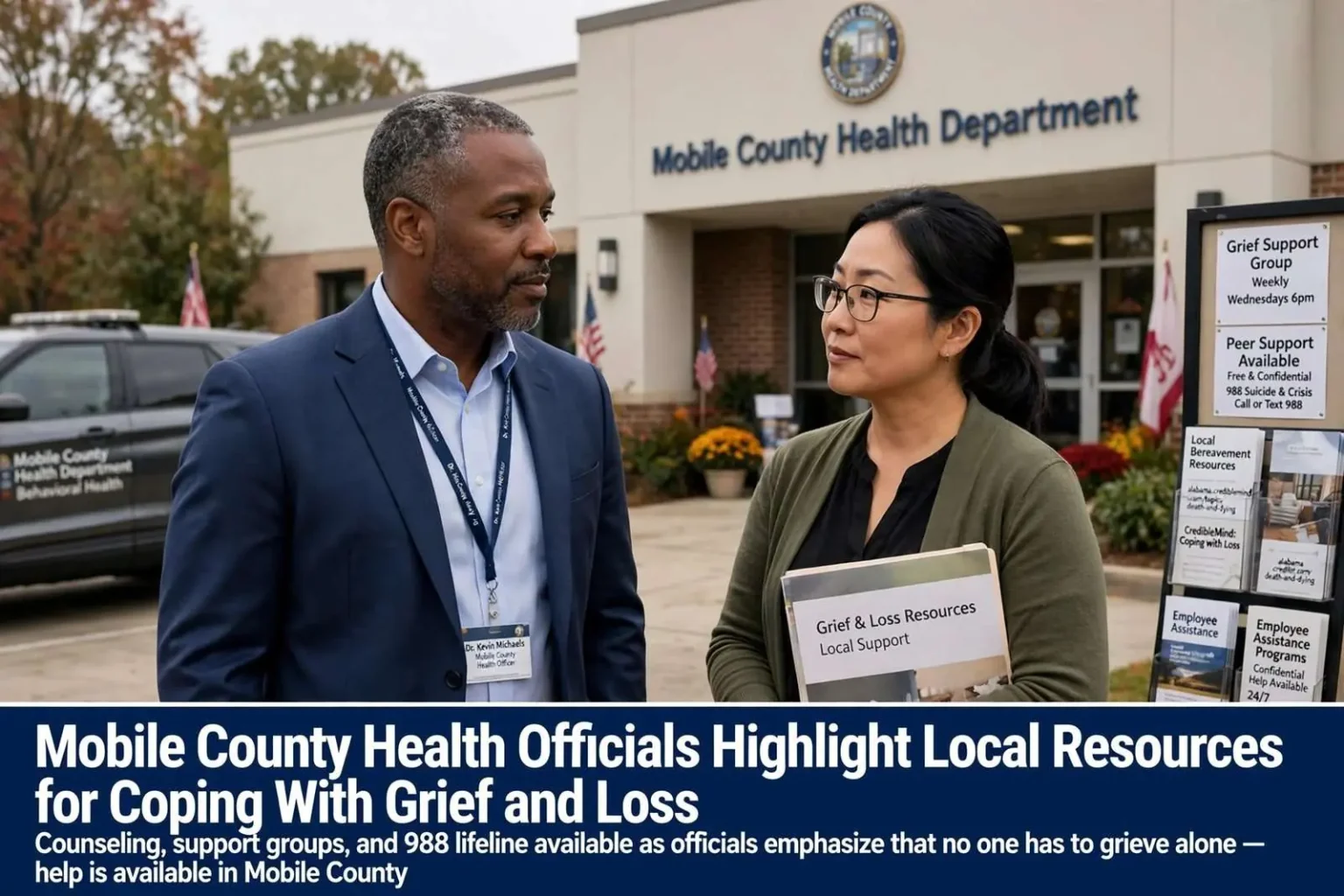
The loss of a family member, friend, colleague or mentor touches every part of life, and grief looks different for everyone. Feelings of sadness, anger, numbness or confusion are all normal parts of the grieving process, and Mobile County health officials say it is important for people to give themselves time and permission to feel those emotions. There is no single right way to mourn, officials emphasize, and the varied ways people respond to loss — from withdrawal to restlessness to unexpected waves of emotion weeks or months later — are all within the range of ordinary grieving.
Dr. Kevin Michaels, Mobile County Health Officer, recently reflected on the reality of loss after a birthday prompted him to think about how many people who shaped his life, including friends, mentors, former colleagues and public servants, are no longer here. His reflection captures an experience familiar to people of every age: the moment when a milestone or an ordinary date on the calendar reveals how many gaps the passing years have left behind. Officials say it can be difficult to imagine a community without the guidance and everyday acts of service those people once provided, and acknowledging that difficulty is part of processing it.
Health officials stress that recognizing grief as a normal response — rather than a problem to be fixed — is the first step toward working through it. Grief can affect sleep, appetite, concentration and physical health, and it does not follow a predictable schedule. Some people feel the sharpest pain in the days immediately after a loss; others find the weight heaviest months later, when the routines of daily life have resumed and the absence becomes permanent in a way it was not at first.
Where Support Is Available
Support for those who are grieving is available in several forms. Many employers offer Employee Assistance Programs that provide confidential counseling and referrals for people coping with loss, and others may find comfort talking with trusted friends, family, religious or spiritual leaders, or licensed counselors in the community. The important principle, officials say, is connection: grief borne entirely alone tends to be heavier and longer-lasting than grief shared with others, even when the conversations are difficult to start.
Local and national grief resources, including support groups, bereavement services and online tools, are also available to help people process their emotions and begin healing. Support groups bring together people who have experienced similar losses — the death of a spouse, a parent, a child or a friend — and are offered through hospitals, hospice organizations, faith communities and nonprofit organizations across the Mobile area. Bereavement counselors can work with individuals and families, including children, whose grief expresses itself differently than adult grief does.
CredibleMind, an online resource, offers curated articles, podcasts and other educational materials to help people understand grief, learn coping strategies and recognize when to seek additional support. The tool is designed to make it easier to take a first step toward help when grief feels overwhelming, and can be found at alabama.crediblemind.com/topics/death-and-dying. For people who are not ready to talk to anyone but want trustworthy information about what they are feeling, resources of this kind offer a private starting point.
Help Close to Home in Mobile County
Locally, residents can access mental health and grief counseling through behavioral health providers, faith-based organizations and community support groups. The Mobile County Health Department can help connect residents with appropriate services and provide information about crisis hotlines, counseling options and grief support programs, and officials encourage anyone unsure where to begin to reach out to their primary care provider or the health department directly. Primary care physicians are often the first professionals people speak with about emotional distress, and they can make referrals to counselors and specialists suited to each situation.
Faith communities across Mobile County play a significant role in bereavement support, from funeral ministries to grief groups that meet regularly throughout the year. For many residents, congregations and their leaders are the first place loss is acknowledged and mourned communally, and health officials point to those networks as an important part of the county’s support system even for people who may not otherwise engage with formal mental health services.
Workplaces, too, are a practical entry point. Employee Assistance Programs are typically free to employees, confidential and reachable without a referral, offering a set number of counseling sessions and help finding longer-term care when needed. Officials encourage anyone unsure whether their employer offers such a program to check with their human resources office, particularly in the weeks after a loss when day-to-day functioning at work may be difficult.
When Grief Becomes a Crisis
Anyone experiencing intense distress, thoughts of self-harm or suicide, or who is worried about someone else, can call or text 988 to reach the Suicide & Crisis Lifeline for free, confidential support 24 hours a day, seven days a week. The three-digit line was created so that people in crisis — and the friends and family members worried about them — could reach trained counselors without having to know which local agency to call first, and it operates around the clock, including on nights, weekends and holidays when other services may be closed.
Health officials note that grieving people sometimes struggle in ways that others around them do not immediately see, which is why they encourage friends and relatives to check in directly rather than waiting to be asked. A simple conversation, a meal delivered to the door or a follow-up call weeks after the funeral can matter more than the well-meant gestures that cluster around a funeral and then stop. Prolonged grief that interferes with daily life for months on end is also a recognized reason to seek professional help, and counselors across the county treat it as they would any other health condition.
The Mobile County Health Department’s role in this network is largely one of connection: pointing residents toward the right service, whether that is a support group, a licensed counselor, a faith community or a crisis line, and making sure no one is turned away for not knowing where to start. Residents can contact the department directly for guidance, and officials say no question about grief or mental health is too small to ask.
Understanding What Grief Does
Grief is not a single emotion but a process that moves through different feelings at different times, sometimes looping back on itself. People who have lost someone often describe good days followed by sudden setbacks — a song, a photograph or an anniversary that brings the loss back at full force. Health officials say these waves are normal and not a sign of backsliding, and that expecting grief to follow a straight line only adds self-criticism to an already heavy burden.
Physical symptoms are common as well. Grief can produce fatigue, headaches, chest tightness and changes in appetite and sleep, and people who are grieving are more susceptible to illness during the period of acute loss. Doctors and counselors encourage those mourning to maintain basic routines — eating, sleeping, movement — even when motivation is low, both because the body carries the stress of loss and because routine provides structure during a time when life feels upended.
Children and teenagers grieve differently than adults, often in bursts, and may return to questions about the death repeatedly over months or years. Schools, pediatricians and family counselors in Mobile County can help parents support grieving children, and officials encourage adults not to shield young people entirely from the reality of a loss but to answer their questions honestly in age-appropriate ways.
No One Has to Grieve Alone
Health officials say grief is a deeply personal journey, but no one has to travel it alone, and they are encouraging community members to check in on one another while honoring the memories of those they have lost. The message from Dr. Michaels and others at the health department is one of permission — permission to feel the emotions grief brings, permission to ask for help, and permission to talk about the people who are gone rather than moving past them in silence.
For residents who want to take a first step today, the paths are simple: contact the Mobile County Health Department for guidance on local services, talk to a primary care provider about counseling options, explore the resources at alabama.crediblemind.com/topics/death-and-dying, check with an employer about an Employee Assistance Program, or reach out to a trusted faith leader or community group. For anyone in crisis, 988 remains available at any hour, by call or by text.
The department’s outreach comes with a reminder that loss is universal — that every resident of the county has either suffered a bereavement or will — and that a community which talks openly about grief, and about the people it has lost, is better equipped to care for the ones who remain. As Michaels’ own reflection made clear, the people who shaped a life are never entirely gone from it, and remembering them out loud is part of how both individuals and communities heal.