Mobile County Issues Mandatory Health Order Suspending Dine-In Service, Restricting Gatherings to Slow COVID-19
Mobile County Health Officer Dr. Bernard H. Eichold II issued a mandatory order on March 18, 2020, halting dine-in restaurant service for a week and restricting nursing home visits and senior center gatherings to slow COVID-19, even though the county had zero confirmed cases at the time.
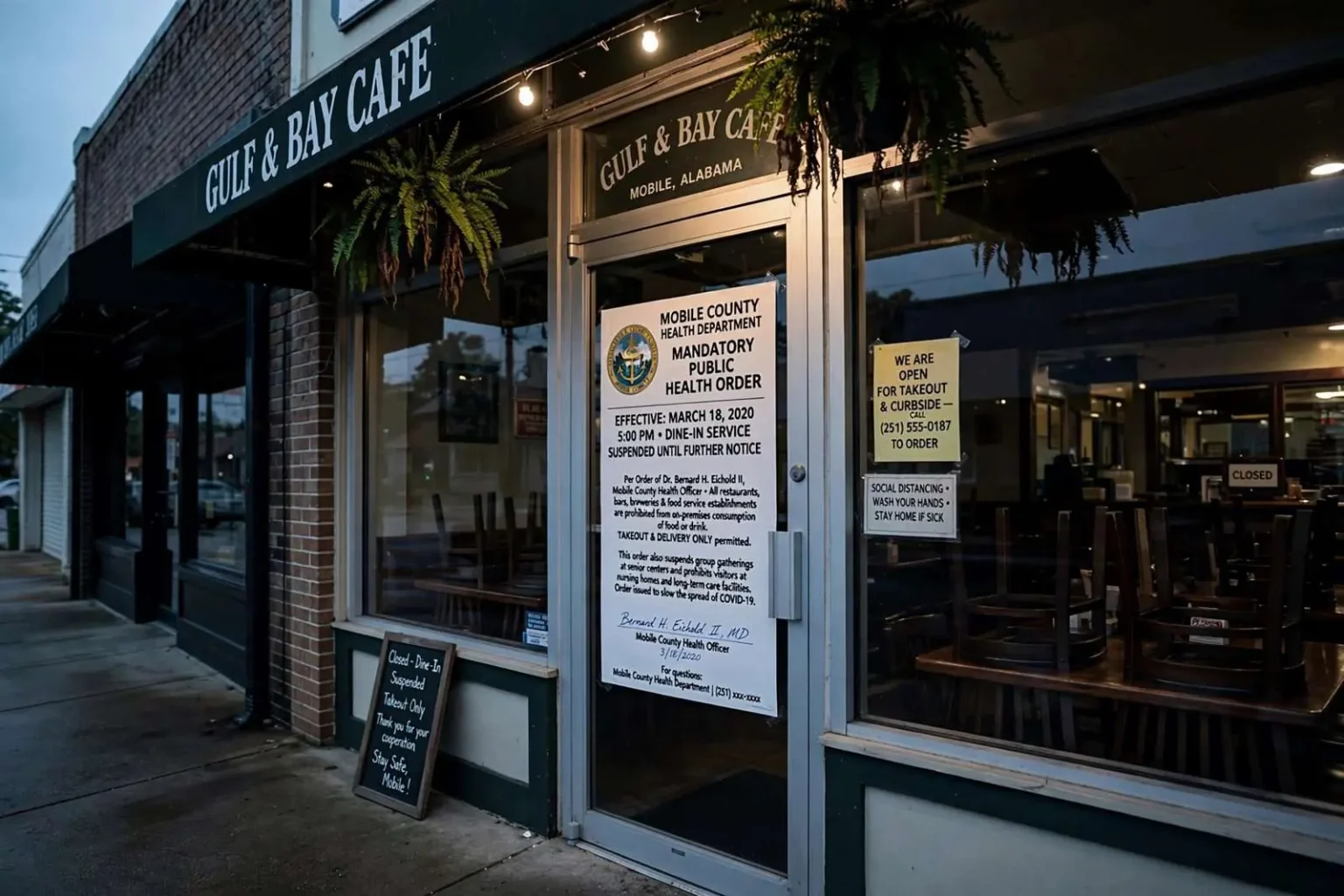
Mobile County Health Officer Dr. Bernard H. Eichold II signed a mandatory public health order on March 18, 2020, temporarily suspending certain public gatherings across the county in an effort to slow the spread of the novel coronavirus, COVID-19. The order took effect that evening at 5 p.m., putting Mobile County among the Alabama communities moving to shut down everyday social activity before the virus had a chance to take hold.
The move came as Jefferson County, home to Birmingham, reported nearly two dozen positive COVID-19 test results, a cluster that alarmed public health officials elsewhere in the state. At the time the order was issued, Mobile County had not recorded a single confirmed case of the virus. That gap — cases to the north, none at home — was precisely the point. Local officials wanted to act while the county was still in the window where prevention, rather than response, was possible.
“In order to prevent what is happening in Birmingham, we are issuing these orders,” Dr. Eichold said, referencing Jefferson County’s rising case count. “We have no confirmed cases in Mobile County, so we want to make every effort to protect our residents. We want to work against this very aggressive virus from being established in our county.”
What the Order Did
Under the order, restaurants, bars, breweries and Priority Category 3 food service establishments in Mobile County were barred from allowing on-premises consumption of food or drink for one week. The restriction effectively converted dining rooms and bar counters into takeout and delivery operations overnight, forcing hundreds of establishments across the county — from neighborhood cafes to waterfront restaurants to brewery taprooms — to reinvent their business model on a day’s notice.
Officials said the restriction would be reevaluated before the week was out, with the possibility of extending, modifying or lifting it depending on how the outbreak developed. That built-in review period reflected the uncertainty of the moment. In March 2020, little was known about how the virus behaved in Gulf Coast communities, and health officers across the country were issuing short orders they could adjust as evidence accumulated.
The order also placed new restrictions on nursing homes and long-term care facilities, requiring them to prohibit visits from outside visitors and non-essential health care personnel. An exception was carved out for compassionate care situations, such as when a resident is nearing the end of life. The restriction recognized a hard reality of the pandemic: older adults in congregate living settings faced the gravest danger from the virus, and a single infected visitor could introduce it to an entire facility.
Senior citizen centers were ordered closed to group gatherings as well. Centers and their community partners were urged to keep serving meals to clients through curbside pickup or delivery rather than in shared dining spaces, so that older residents — among the most vulnerable to severe complications from COVID-19 — would not go without food assistance. For many Mobile County seniors, congregate meal sites were both a source of nutrition and a daily point of social contact, and the order sought to preserve the first while sacrificing the second.
Schools, Daycares and Everyday Prevention
The order additionally reinforced guidance already handed down by the Alabama Department of Education requiring daycares and schools with 12 or more people to remain closed. The directive hit families hard. Parents across Mobile County suddenly faced the practical challenge of caring for children at home while schools closed their buildings, and school systems scrambled to stand up remote learning and meal distribution programs with little notice.
It also advised residents to wash their hands frequently and clean countertops and other frequently touched surfaces — instructions that sound routine now but were, at that early stage of the pandemic, among the primary defenses public health officials could offer. In the weeks before widespread testing, masks mandates, and vaccines, the response to the virus consisted largely of distance, disinfection and handwashing, and local health departments leaned heavily on clear, repeated messaging to make those habits stick.
Dr. Eichold acknowledged the order would disrupt daily life for Mobile County residents and businesses but said the county needed to act before the virus gained a foothold locally, rather than wait for cases to appear. “I apologize for any inconvenience this causes,” he said. “This is a similar order to what was issued for Jefferson, Blount, St. Clair, Shelby, Tuscaloosa and Walker counties. Even though we have not had a case here, we need to do this to stay ahead of the virus.”
Part of a Statewide Wave
Mobile County’s order mirrored steps already taken in several other Alabama counties earlier in March 2020, as state and local health officials began imposing restrictions on gatherings, dining and elder care facilities in the earliest weeks of what would become a prolonged public health emergency. The counties that had acted first — Jefferson most prominently, with its cluster of early cases — effectively set the template, and officers in Mobile and elsewhere adapted it to local conditions.
The legal foundation for such orders is rooted in Alabama’s public health framework. A county health officer’s order carries the force of law within the jurisdiction and is typically issued under authority granted by the state health department to respond to an imminent public health threat. That authority allows a health officer to act quickly — without waiting for a city council or county commission to draft an ordinance — when circumstances demand immediate action to protect the community.
The department also had to keep its ordinary work running. Inspections, immunizations, sewage and food safety programs, and maternal health services did not pause because of the emergency, and staff who normally handled those duties were pulled into pandemic response as needed. It was an early preview of the strain local health departments nationwide would feel as the outbreak stretched on, and a reminder that the county’s public health infrastructure — built for routine prevention — had to scale almost overnight.
For Mobile County, the health officer’s signature set in motion a period of continuous adaptation. Businesses closed or pivoted, houses of worship moved services online or outdoors, and public agencies rewrote their operations week by week. Each renewal or modification of the order was watched closely by residents and business owners alike, who understood that the restrictions were not symbolic: they governed whether a table could be served, whether a visitor could see a grandparent, and whether a classroom could open.
A Gulf Coast Community Adjusts
The weeks that followed the March 18 order tested every corner of the county’s economy. Restaurant workers filed for unemployment in numbers few had seen before, and owners of establishments along Dauphin Street, Old Shell Road and in the county’s bedroom communities worked to convert dining rooms into pickup stations. Grocery stores adjusted hours and added sanitation stations. Bars and breweries, which by definition existed for on-premises consumption, faced the sharpest squeeze, with some leaning on to-go sales where rules allowed and others simply closing their doors for the duration.
Public reaction in those first days was a mixture of anxiety, cooperation and improvisation. Some residents stocked up on staples and settled in; others questioned whether sweeping restrictions were warranted in a county with no confirmed cases. Dr. Eichold and his staff kept repeating the same answer: the absence of cases was not evidence of safety, because testing was limited and the virus was already moving through other Alabama communities. Acting early, they argued, was not panic — it was the whole point.
Health care providers, too, reorganized rapidly. Clinics separated patients with respiratory symptoms, hospitals prepared surge plans, and the Mobile County Health Department expanded its communication with schools, employers and long-term care facilities. The department, one of the oldest county health departments in the state, suddenly found itself at the center of daily life in a way few residents had ever considered, issuing guidance, answering questions and counting every test result that came back from state laboratories.
The county’s early action was consistent with what public health officials across the country were urging in March 2020: that communities which restricted gatherings before widespread transmission — rather than after — stood a better chance of flattening the curve of infections and keeping hospitals from being overwhelmed. Whether the strategy succeeded would take weeks to measure, but the logic of acting while the case count stood at zero was the same logic that had guided public health for generations: the cheapest time to stop an epidemic is before it starts.
For residents, the order of March 18, 2020, marked the moment the pandemic stopped being a distant story about another city and became a set of rules governing their own routines. The empty dining rooms, closed senior centers and locked nursing home doors that followed were the visible face of a county trying to hold an aggressive virus at its borders — and, at least in those first days, doing so from a rare position of strength, with no confirmed cases yet inside the county line.