Mobile County Judicial Race Turns Ugly as Alabama Republican Runoff Nears
Mobile County's circuit judge race and statewide contests like the lieutenant governor runoff have grown increasingly personal ahead of Tuesday's Alabama Republican primary runoff vote.
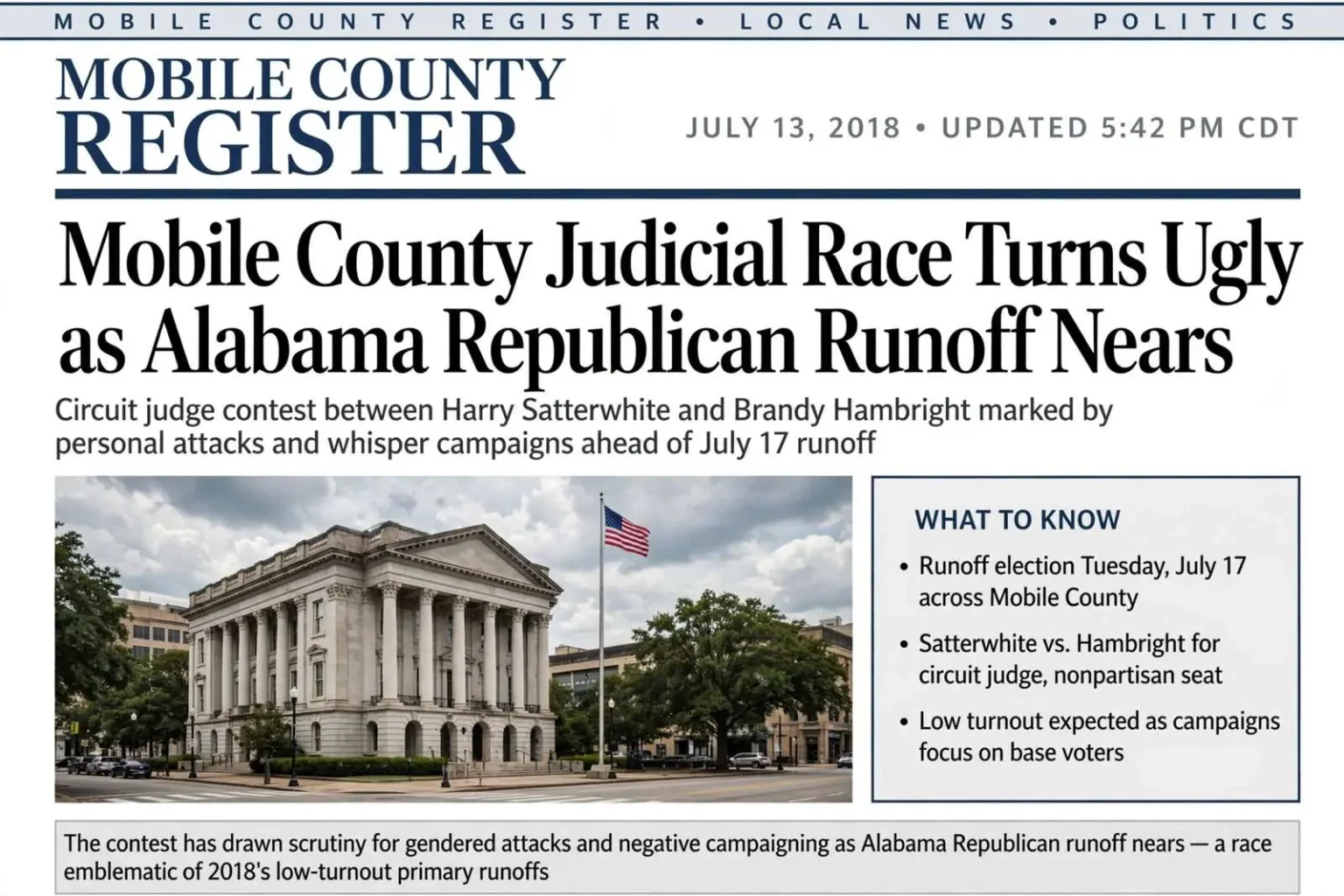
Mobile County voters head back to the polls Tuesday, July 17, to settle a handful of Republican primary runoff contests, and several of the races on the ballot have been marked by an unusually sharp round of personal attacks, whisper campaigns and negative advertising in the final weeks of the campaign.
Runoff elections in Alabama occupy a strange place in the state’s political calendar. Held six weeks after the initial primary, they typically draw only a fraction of the voters who showed up in May, which puts a premium on each campaign’s ability to identify and turn out its most committed supporters. Low-turnout runoffs also change the character of campaigning: with fewer voters persuadable and the party’s base making up most of the electorate, contests often turn inward, fought over loyalty and identity rather than general-election themes. Mobile County’s 2018 runoff ballot is proving the point.
No Mobile County race has drawn more scrutiny for its tone than the contest for circuit judge between Harry Satterwhite and Brandy Hambright.
Supporters of Satterwhite have circulated social media posts referring to Hambright as the “wife, mother candidate” and warning voters not to let her “twang or sugar sweet demeanor” fool them, language critics say plays on gender stereotypes rarely applied to male candidates for the bench. The posts have spread through the local political networks where runoff campaigns largely live — county party groups, neighborhood Facebook pages and the email lists of frequent primary voters.
The Satterwhite campaign has said it was not behind the posts, though it has not publicly asked supporters circulating them to stop. That distinction has become the controversy itself: under modern campaign norms, a campaign is increasingly held responsible for what its supporters do on its behalf, whether or not the candidate directed it, and the decision not to disavow supporters is read by critics as a kind of permission.
Hambright has largely avoided responding in kind, instead continuing to campaign on her legal record ahead of Tuesday’s vote. The strategy carries risks of its own — a candidate who ignores attacks can watch them harden into conventional wisdom — but it also preserves the judicial temperament that voters say they want on the bench, and it keeps the campaign’s public face focused on qualifications rather than grievance.
judicial races, party labels and the runoff
The circuit judge race is nonpartisan in the sense that judicial candidates in Alabama run without party labels attached to the bench itself, but it has still become one of the most closely watched down-ballot contests in the county this cycle, with both camps working to turn out supporters in a runoff that typically draws a fraction of the turnout seen in the initial primary.
Alabama judicial elections occupy a hybrid space. The state elects its judges in partisan elections — a practice increasingly rare nationally — but once on the bench, a judge’s office is institutionally nonpartisan, and candidates for circuit court run as individual lawyers competing for a professional role rather than as standard-bearers for a platform. That makes the campaign landscape unusual: the electorate is selected through party primaries, but the office being contested rewards legal reputation more than ideology.
In a race like Satterwhite-Hambright, where both candidates are respected lawyers in the Mobile bar, the policy differences that drive other races are largely absent — which is precisely why the campaign has devolved into personal framing. With no dispute over taxes or policy to organize around, the contest has become a fight over character, temperament and identity, fought at the retail level where runoffs are decided.
Turnout organization will likely decide it. A Mobile County runoff can be won with a small fraction of the county’s registered voters, and campaigns spend the final days matching their supporter lists against the history of who actually votes in July runoffs. The campaigns that treat a judicial race like a full political operation — calls, rides to the polls, church and civic networks — routinely outperform better-known names that assume runoff voters will find their way to the courthouse on their own.
Statewide: the lieutenant governor’s race
Statewide, the runoff for lieutenant governor between state Rep. Will Ainsworth and Alabama Public Service Commission President Twinkle Cavanaugh has centered less on policy than on which candidate has been the more loyal supporter of President Donald Trump.
Cavanaugh has highlighted her door-to-door campaigning for Trump during the 2016 election, while Ainsworth has run ads emphasizing his own “Pro Trump” credentials and pointing to past comments in which Cavanaugh referred to Trump as a “con artist” before he won the Republican nomination for president.
The lieutenant governor’s race has drawn added attention because of what the office controls. In Alabama, the lieutenant governor presides over the state Senate and shapes the flow of legislation through committee appointments — a role with real power over what becomes law, and one that has grown in influence as governors and legislatures have traded dominance over the years. The 2018 contest to succeed term-limited Kay Ivey, who moved up to governor, drew a deep field of ambitious Republicans for exactly that reason.
What the statewide race shares with Mobile County’s local contests is the logic of a base electorate. In a Republican runoff in Alabama, the voters who show up are the party’s most reliable participants, and both statewide campaigns concluded that the shortest path to them ran through the president. Policy differences between Ainsworth and Cavanaugh — both conservative Republicans with long records in state government — were largely set aside in favor of a single loyalty question, a strategy that reflects how Alabama’s primary electorate has sorted itself in the Trump era.
The “con artist” recording is the kind of opposition research that can define a runoff. Cavanaugh’s defense of the 2016 comments — made before Trump consolidated the nomination — has been that they predate his presidency, but in a low-turnout electorate where Trump’s standing with the base is the dominant currency, the ads matter more than the explanation. Ainsworth’s campaign has treated the clip as the closing argument; Cavanaugh’s has countered with her own organization and her history of statewide elections, having won multiple races for the Public Service Commission.
What runoff day looks like
Polls in Mobile County and across the state open at 7 a.m. and close at 7 p.m. Tuesday, and the runoff ballot carries fewer contests than the primary did — a fact that suppresses turnout further and narrows the electorate to the campaigns’ core supporters. County probate offices have spent the week preparing for a lighter but more concentrated vote, and both parties’ local organizations have been running their final rounds of calls and poll-watching assignments.
For the candidates, the last weekend is about identification and delivery, not persuasion. Judicial and down-ballot campaigns in particular live or die on their lists — the voters contacted, pledged and scheduled — because a runoff decided by a small electorate can turn on a few hundred votes in a county the size of Mobile.
Whatever Tuesday’s results, the tenor of the cycle is likely to be remembered alongside them. The circuit judge race’s gendered attacks, the statewide contest’s loyalty litmus test and the whisper campaigns running beneath them have set the tone for a runoff in which the fight for the party’s soul was fought, as usual, in the quiet weeks when almost nobody was paying attention — except the small, decisive electorate that decides everything in an Alabama July.
The attacks on Hambright fit a pattern that political observers in Alabama have documented in races involving women candidates: scrutiny of family role, accent and demeanor that rarely appears in campaigns against men. Research on judicial elections nationally has found that women candidates are more likely to face questions about their fitness for the bench framed around personality and family obligations, and the “wife, mother candidate” framing in Mobile is being cited locally as a textbook example of it.
The controversy also tests the county’s Republican establishment. Party leaders have generally avoided wading into the Satterwhite-Hambright contest, but the circulation of the posts through local political networks has forced conversations about whether the county party’s channels are being used to amplify them. In runoff season, when the party apparatus is itself a campaign resource, that question has practical weight.
For Hambright, the calculus is familiar to any targeted candidate: respond and elevate, or stay on message and hope the electorate’s better instincts hold. Her campaign has chosen the courts of professional reputation — bar associations, legal community endorsements and her record as a prosecutor and practicing attorney — as its rebuttal, betting that Mobile County’s runoff voters, who tend to be older and more civically engaged than primary voters at large, will weigh credentials over caricature.
Whatever the outcome, campaign consultants across the county are watching the race as a test case for how far surrogate attacks can go in a local judicial contest without generating a backlash — and the answer will shape the next cycle’s down-ballot fights in Mobile County, win or lose.